
TL;DR
- Pure white quartz is a flat, particle-free white at L* 95.4 in our 2026 colorimetry; Super White quartz is a high-brightness white ground carrying mirror-finish crystalline flecks of 0.3–1.2 mm at 3–8% coverage.
- Because a diffuse-lightness measurement cannot see specular reflection, Super White reads L* 93.6 in the colorimeter yet looks brighter in any room with direct or raking light — the flecks return light a flat surface cannot.
- Super White hides countertop seams better, because texture gives the eye a pattern to read across a joint; a flat pure white shows even a color-matched seam under raking light.
- Choose pure white for minimal, daylight-rich schemes and medical-grade cleanliness; choose Super White for dark-cabinet drama, hospitality settings and low-light kitchens where sparkle does the brightening.
- Order either by numbers, not names: L* target ±0.8, gloss 45–60 GU at 60° per ASTM D523, fleck coverage against an approved reference sample, and ΔE ≤1.0 per ASTM D2244.
Two weeks ago I stood behind a client at our Shuitou showroom while he pointed at the white series wall and asked the question every white-stone buyer eventually asks: which of these is “the bright one”? Under the halogens they were the same white. The honest answer is that Super White quartz and pure white quartz differ in one deliberate design element — mirror-finish crystalline fleck — and everything else visual follows from it: measured brightness (L* 93.6 vs 95.4 in our 2026 factory colorimetry), sparkle legibility from four metres, undertone behavior under 3000 K evening light, and how forgiving the surface is at a countertop seam. Because that fleck changes how the surface interacts with every light source in the room, the two whites that match in a showroom can look like different materials by the time they reach a kitchen — so the difference is real, and it is measurable, not a matter of taste. This guide separates them variable by variable, with the numbers we control in production, and finishes with the spec line that makes sure the white you order is the white you saw.
What Is the Difference in One Sentence?
Definitions first, because the industry’s naming is loose and expensive misunderstandings start here. Pure white quartz is engineered stone with no visible particle or fleck — a uniform high-lightness white ground, the closest thing a resin-bound surface gets to a sheet of paper; Super White quartz is the same resin system with mirror-finish crystalline flecks distributed through the white ground, so the surface carries its own light sources. Our Super White quartz lines and pure white lines are sold side by side for exactly this reason — they are siblings, not rivals, and the choice is a lighting-and-mood decision rather than a quality ranking.
A naming caution worth ninety seconds of your time: “super white” means a flecked white quartz in most Asian factory catalogs, but in some US showrooms “Super White” refers to a grey-toned natural dolomite. Neither usage is wrong; both are entrenched. Whenever a supplier says “Super White” without a photo, assume nothing — ask for the fleck: if there is none and the stone reads grey, you are being shown dolomite, not white quartz at all.
How Bright Is Each White, Really?
Here is the number that surprises buyers. In our 2026 colorimetry, the flat pure white lines average L* 95.4±0.5 under standard diffuse illumination, and the Super White lines average 93.6±0.6 — the flecked white is measurably the dimmer surface, by almost two L* points, because every fleck casts a micro-shadow in diffuse light and those thousands of tiny shadows add up. If the story ended at the colorimeter, pure white would win on brightness, full stop.
It does not end there. Because L* is a diffuse measurement — the colorimeter’s geometry averages away specular reflections — the fleck’s single greatest talent is invisible to the instrument: under direct or raking light, mirror flecks fire specular highlights back at the viewer, so the “dimmer” Super White reads as the brighter, livelier surface in any kitchen where sunlight grazes the counter or a pendant lamp hits it at an angle. The instrument sees the shadow; your eye, standing at the island at 7 p.m., sees the sparkle. Both observations are true simultaneously, which is why buyers who compare whites only under showroom halogens so often choose wrong.
The Fleck Test: Can You See Sparkle From Four Metres?
Walk any slab wall and run this test — it takes thirty seconds and sorts the two categories faster than any datasheet. Stand four metres back. If the surface still sparkles, you are looking at Super White; if it reads as a calm field, it is pure white. Fleck size decides how far away the sparkle survives: our Super White lines run flecks of 0.3–1.2 mm at 3–8% coverage, and the 0.8 mm-and-larger grades stay legible from four metres, while finer 0.3 mm “sugar” flecks read as a subtle shimmer only from arm’s length.
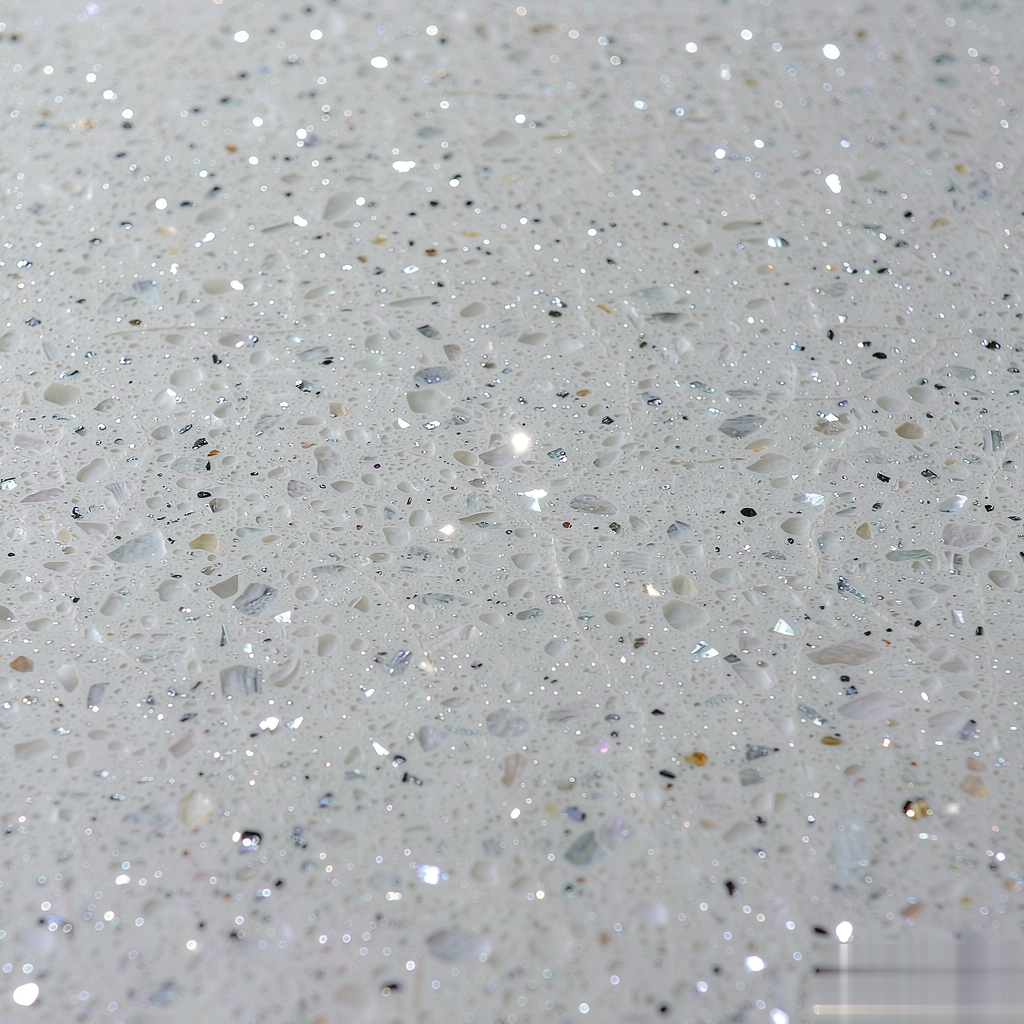
At macro distance the two whites part company for good — mirror flecks against a flat, particle-free ground.
The wet test is the second half of the identification. Pour a little water on the surface and tilt it toward the light: because water amplifies specular reflection the way a lake does at sunset, Super White’s flecks ignite under the wet test while pure white simply darkens half a shade — one of the oldest identification tricks in the stone trade, older than engineered stone itself. Our inspectors still use a variant of it on the production line; a finer-fleck product like the crystal mirror quartz slab grades sits between the two whites on this spectrum, with grain structure visible before sparkle is.
What Do Undertone and Texture Do Under Kitchen Lighting?
Both whites run neutral in our colorimetry — pure white at b* +0.5±0.3, Super White at b* −0.4±0.3 — which means neither carries a yellow or blue cast of its own. What changes is how the room’s light behaves. Because warm 3000 K evening light adds its own yellow to every surface equally, the flat pure white shows that cast honestly while Super White’s specular flecks keep returning cool white pinpoints, so the flecked surface holds a livelier, slightly cooler impression under the same lamp. If your kitchen is lit warm in the evening, the two whites will look more different at 8 p.m. than they did at noon.
Texture is the other undertone story. Pure white’s featurelessness is a superpower in minimalist and clinical settings — medical suites, galleries, Scandi kitchens — precisely because there is nothing to interrupt. The same featurelessness is its weakness up close: dust, water spots and micro-scratches have no visual noise to hide in. Super White’s fleck gives daily life somewhere to disappear. For hard-use family kitchens, the flecked surface forgives roughly twice as much daily patina before a wipe-down becomes necessary, in the same way a speckled floor hides crumbs a white one announces.
Where Does Each White Belong?
Placement, compressed into two lists I hand to designers on a card:
- Pure white belongs in minimal and Scandi schemes, medical and laboratory settings, gallery-white bathrooms, and any room with generous diffuse daylight where the goal is a seamless, serene, uninterrupted white — including backsplash-to-counter runs where you want the stone to read as one sheet, like this polished quartz kitchen countertop in a flat white finish.
- Super White belongs in dark-cabinet kitchens where the counter is the light source, bar tops and hospitality settings that need evening sparkle, low-light apartments, and any scheme where the counter should participate in the lighting design rather than merely receive it.
One seam-honesty note that buyers rarely see quoted anywhere: because a flat pure white gives the eye no pattern to read across a joint, seams on it are the most visible seams in the entire quartz catalog, while Super White’s fleck field lets a color-matched joint disappear into texture — if your kitchen plan forces a seam in the middle of a visible run, that alone is a legitimate reason to pick the flecked white. Both whites are engineered for the same simple care routine that the Natural Stone Institute teaches — neutral cleaner, soft cloth, no abrasives — and both will hold their white under it.
Cool lighting tells the same story from the other end. Under a 5600 K LED strip — the standard in retail, medical and modern office fit-outs — the flat pure white holds its neutral, paper-like calm and simply reads as a clean working surface, while the Super White flecks scatter the cool light into a faint starfield that photographs beautifully but can distract in a laboratory-grade setting. Because undertone behavior is a property of the lighting rather than the stone, no amount of sample-swapping fixes a kitchen whose lamps fight the white you chose — fix the lamps first, then pick the stone. Designers who specify integrated LED task lighting at 4000 K get the most even-handed rendering of both whites, which is why that color temperature dominates showroom design in Europe.
How Do You Order Either White Without Ambiguity?
Names drift between catalogs; numbers do not. ASTM C1528, the consensus guide written for the people who select and specify stone, exists for exactly this moment — and here is the specification line I would send any buyer, distilled from our own production control:
| Variable | Pure white target | Super White target | Method |
|---|---|---|---|
| Diffuse lightness | L* 95.4 ± 0.8 | L* 93.6 ± 0.8 | Spectrophotometer, D65 illuminant |
| Undertone | b* +0.5 ± 0.3 | b* −0.4 ± 0.3 | Spectrophotometer, D65 illuminant |
| Specular gloss | 45–60 GU at 60° | 45–60 GU at 60° | Glossmeter per ASTM D523 |
| Fleck coverage | None (0%) | 3–8% vs approved reference | Physical reference sample, 300×300 mm minimum |
| Batch color tolerance | ΔE ≤ 1.0 vs reference | ΔE ≤ 1.0 vs reference | Calculated per ASTM D2244 |
Two clauses make this table bite. Because a ΔE of 1.0 sits at the edge of what an untrained eye can perceive, holding every batch to ΔE ≤ 1.0 against your approved physical reference — calculated per the color-difference practice ASTM D2244, which recommends exactly this ΔE00 range for industrial color control — is the single line that prevents “my second container is a different white” calls. And the reference must be physical, not photographic: screens drift, print shifts, and the sample that travels in your luggage is the only one a factory can measure against honestly.
The practical workflow is short. Approve a 300×300 mm production sample and mark its back with the date — that physical piece becomes the contract reference, and a responsible factory keeps a twin of it in the sample room with your project number on it. Before every shipment, require colorimeter readings of the actual batch against that twin, plus 20 photos of the loaded slabs taken under the same daylight-booth conditions your approval used. A supplier who records gloss in GU, lightness in L*, and batch ΔE as routine release paperwork is telling you the white you approved and the white in the container are governed by the same instrument — a claim no adjective in a catalog can make.
Frequently Asked Questions
Pick the White Your Room Lights
The choice between these two whites is not a quality contest; it is a lighting decision wearing a stone’s clothing. Flat pure white, L* 95.4 and no fleck, for serene minimal rooms with diffuse light and seamless runs. Super White, L* 93.6 and 3–8% mirror fleck, for dark cabinets, evening sparkle and seams that need to disappear. Whatever you choose, anchor the order to the five numbers in the specification table and an approved physical reference — a white chosen under the wrong light and ordered without numbers is the only version of this decision that can actually go wrong. Tell us your kitchen’s lighting, cabinet palette and seam layout, and we will send matched samples from current production lots of both whites — request pure white and Super White quartz samples here.
Alex Wang
International Business Director, Quanzhou APEX Co., Ltd. (Apex Quartz Stone)
Alex Wang has spent nearly three decades in the stone trade in Shuitou, Nan’an — the heart of China’s stone industry — and leads international business for Apex Quartz Stone, founded in 1997. He writes from the production floor: 40,000 m² of manufacturing, 100,000+ slabs a year, and a spectrophotometer that has opinions about which white is brighter.
Post time: Nov-13-2026