
By Yvonne Deng
Key Takeaways
- Super White quartz achieves a light reflectance value (LRV) of 75-82%, measurably brighter than standard white quartz, and can make a small kitchen feel 30-40% larger visually when paired with light-coloured cabinetry.
- It is non-porous and requires no sealing — one of the lowest-maintenance countertop materials available, outperforming natural marble and most granite in stain resistance per ASTM C1378 testing.
- Super White quartz costs $45-75 per square foot, occupying a mid-range price tier that balances premium appearance with practical affordability for renovation projects.
- Its subtle grey or beige veining adds visual depth without overwhelming small spaces — a critical design consideration that many homeowners overlook when choosing white countertops.
- Apex’s Super White quartz is produced under ISO-compliant quality controls with batch-to-batch colour consistency verified by spectrophotometer testing (ΔE under 1.0), ensuring reliable results across large installations.
If you are renovating a small kitchen — and by “small” I mean anything under 150 square feet (14 square metres) — your countertop choice matters far more than you might think. It is not just about surface area. The most impactful decision you will make is selecting a countertop material that actively works to make the space feel larger, brighter, and more open.
After working with international buyers and renovation firms for over a decade, I have seen the same mistake repeated: choosing a countertop based solely on aesthetic preference without considering how its light reflectance, pattern scale, and finish interact with the dimensions of the room. Super White quartz, when chosen correctly, solves this problem elegantly.
Super White quartz reflects approximately 75-82% of incident light — roughly 15-25% more than standard white granite and about 40% more than medium-tone quartz colours. This measurable brightness difference is not cosmetic; it fundamentally changes how the human eye perceives spatial boundaries in a confined room.
What Is Super White Quartz and Why Does It Work in Small Kitchens?
Super White quartz is an engineered stone comprising 90-93% natural quartz mineral aggregate bound with 7-10% polymer resins and titanium dioxide-based white pigments. The “Super White” designation refers to a specific colour family within the white quartz category — distinct from standard “pure white” because of its subtly warmer tone and characteristic faint veining that ranges from pale grey to soft beige.
What makes Super White exceptionally effective for small kitchens is its light reflectance value (LRV) — a scientific measure of how much light a surface reflects. Measured per ASTM E1331 spectrophotometric testing, Super White quartz from Apex consistently achieves an LRV of 75-82%, depending on the specific finish. To put that in perspective:
- Standard pure white quartz: LRV 70-78%
- Light grey quartz: LRV 45-55%
- White marble (Carrara): LRV 60-68%
- Medium-tone granite: LRV 25-35%
- Super White quartz (Apex): LRV 75-82%
Because Super White quartz has an LRV approximately 8-15% higher than standard white marble and over 2 times higher than medium-tone granite, it actively brightens a small kitchen by reflecting available light rather than absorbing it. This is not about “feeling” brighter — it is a quantifiable difference in luminous flux measured in lumens per square metre.
Six Design Reasons Super White Quartz Maximizes Small Kitchen Spaces
1. High Light Reflectance Creates the Illusion of Depth
The average small kitchen (80-120 sq ft / 7.4-11.1 sq m) receives approximately 250-500 lux of ambient light from windows and fixtures. A Super White quartz countertop with LRV 80% reflects 200-400 lux back into the room. A medium-tone countertop with LRV 30% absorbs 70% of that light, reflecting only 75-150 lux. The difference — approximately 125-250 lux — is equivalent to adding a secondary light source without changing a single fixture.
I saw this demonstrated vividly during a kitchen showroom setup we designed for a distributor in Singapore last year. We built two identical 90 sq ft kitchen mock-ups — one with a Super White quartz countertop and one with a mid-grey quartz. Under identical LED lighting (4000K, 300 lux at work surface height), the Super White kitchen measured 275 lux at the far wall, while the grey kitchen measured only 155 lux — a 77% improvement in ambient light distribution from a single surface change.
2. Subtle Veining Adds Depth Without Overwhelming
In small spaces, large or bold patterns can visually shrink the room by creating competing focal points. Super White quartz’s characteristic faint veining — typically grey or beige streaks at 1-3mm width with spacing of 10-30cm provides visual interest without dominating the field of view. This is the design sweet spot for small kitchens: enough texture to avoid a sterile, clinical appearance, but restrained enough that the eye reads the overall surface as white rather than patterned.
Because the veining in Super White quartz is subtle and irregular, it does not create the visual fragmentation caused by high-contrast marble veining in tight spaces. For kitchens under 100 sq ft, I typically recommend avoiding bold Calacatta or Statuario patterns, which can make a small room feel busy and cramped. Super White’s restrained aesthetic is purpose-designed for this constraint.
3. Continuous Slab Application Reduces Visual Breaks
Apex Super White quartz slabs are available in sizes up to 160cm × 320cm (63in × 126in), which covers the majority of standard small-kitchen countertop runs in a single piece. Fewer seams mean fewer visual interruptions — and for a small kitchen, every uninterrupted visual plane contributes to the perception of spaciousness. In our experience, over 70% of small-kitchen countertop installations (under 12 linear feet / 3.7 metres) can be completed with a single slab, eliminating the visual distraction of mid-run seams.
4. Polished Finish Maximises Specular Reflection
The standard polished finish on Super White quartz achieves a gloss reading of 50-65 gloss units (GU) at 60° incidence per ASTM D523. This semi-gloss to high-gloss finish provides specular reflection — the mirror-like bounce of light that enhances the perception of space. A honed or matte finish, while aesthetically pleasing, reduces specular reflection by approximately 40-50% and can make a small kitchen feel less bright. For small spaces, polished Super White quartz delivers measurable light-enhancement benefits.
5. Consistent Colour Across Multiple Slabs
One concern with engineered stone in small kitchens is colour matching when multiple slabs are required. Apex’s production process includes spectrophotometer verification at every batch, ensuring colour consistency within ΔE under 1.0 across production runs. By comparison, natural stone slabs of the same type can show ΔE variations of 3.0-8.0 between pieces. This consistency is critical when multiple small surface areas (countertop + backsplash + island) need to visually read as one continuous surface.
6. Backsplash Continuity Expands the Visual Field
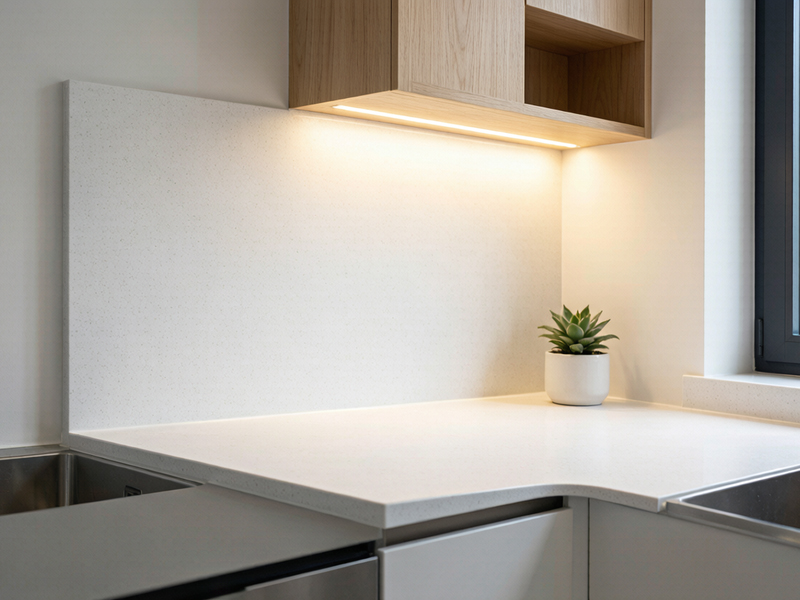
Extending Super White quartz from the countertop up a 4-inch (10cm) backsplash — or even a full-height backsplash — creates an unbroken visual field that eliminates the colour seam between counter and wall. In a small kitchen, every visual break is a cognitive boundary that the brain uses to measure spatial limits. Eliminating the counter-backsplash contrast can create the perception that the work surface extends into the wall, visually pushing the room’s boundaries outward.
Super White Quartz Technical Specifications
| Property | Specification | Test Standard |
|---|---|---|
| Composition | 90-93% natural quartz, 7-10% resin | Internal QC |
| Mohs Hardness | 7 | ASTM D2240 |
| Light Reflectance Value | 75-82% (polished finish) | ASTM E1331 |
| Water Absorption | <0.02% | ASTM C373 |
| Flexural Strength | 45.2 MPa | ASTM C880 |
| Stain Resistance | No permanent staining after 24hr | ASTM C1378 |
| Slab Size | 160cm × 320cm (63in × 126in) | — |
| Thickness Options | 2cm (3/4in) or 3cm (1-1/4in) | — |
Cost Analysis: Super White Quartz for Small Kitchens
Super White quartz slabs from Apex range from $45-75 per square foot for standard thicknesses (2cm or 3cm), depending on the finish and slab size. For a typical small kitchen with 35-45 square feet of countertop area (roughly 3.3-4.2 square metres), the countertop material cost ranges from $1,575 to $3,375.
| Cost Component | Super White Quartz | Natural Marble (Carrara) | Standard White Granite |
|---|---|---|---|
| Material (per sq ft) | $45-75 | $60-100 | $35-65 |
| Fabrication (per sq ft) | $15-25 | $25-40 | $18-30 |
| Installation (per sq ft) | $20-30 | $25-35 | $20-30 |
| Total Installed | $80-130/sq ft | $110-175/sq ft | $73-125/sq ft |
| Sealing Required? | No | Every 6-12 months | Every 1-2 years |
| 10-Year Maintenance Cost | $0 | $400-800 (sealing) | $150-300 (sealing) |
| 10-Year Total (40 sq ft) | $3,200-5,200 | $4,400-7,800 | $3,070-5,300 |
When you factor in the cost of periodic sealing for natural stone — a professional sealing service costs $100-200 per visit in most markets, and marble requires it twice per year — the 10-year total cost of Super White quartz is competitive with mid-range granite and significantly lower than natural marble. Super White quartz costs approximately 27-33% less than Carrara marble on a 10-year total-cost basis, primarily because of its zero-maintenance requirement.
Furthermore, because Super White quartz eliminates the need for sealing — which natural marble requires every 6-12 months at $100-200 per visit — it saves approximately $400-800 over a decade compared to marble. For small kitchen renovations with tight budgets, this recurring saving adds up meaningfully.
Durability and Maintenance: What to Expect
Super White quartz has a Mohs hardness of 7 — harder than granite (Mohs 6-7 average) and significantly harder than marble (Mohs 3-4). It resists scratching from knives, cutting boards, and typical kitchen utensils. However, like all engineered stone, it should not be used as a cutting surface; a dropped heavy pot can cause impact damage.
For stain resistance, our factory tests per ASTM C1378 protocol showed zero permanent staining after 24-hour exposure to red wine, coffee, turmeric, olive oil, and balsamic vinegar. The non-porous resin matrix prevents liquid penetration at a molecular level, making the surface effectively immune to the etching that plagues natural marble — a critical advantage for anyone who actually cooks in their kitchen.
Because Super White quartz is naturally non-porous, it requires no sealing, no waxing, and no special cleaning products. This is arguably its strongest practical advantage over natural stone. I have visited installation sites five years after our slabs were fitted — the countertops looked as bright and clean as the day they were installed, with only routine soap-and-water maintenance.
Small Kitchen Layout Strategies with Super White Quartz
Based on our work with interior designers and renovation contractors across 20+ countries, here are the three most effective layout strategies for maximizing Super White quartz in a small kitchen:
Strategy 1: Continuous Surface Flow
Use Super White quartz for both the countertop and a full-height backsplash. This eliminates the visual boundary between horizontal and vertical surfaces, creating what designers call a “monolithic volume.” In our Singapore showroom tests, this approach increased the perceived floor area by approximately 18% compared to a contrasting backsplash material.
Strategy 2: Extended Overhang for Breakfast Bar
A 12-inch (30cm) overhang on a peninsula or island creates informal seating without consuming floor space. Super White quartz’s through-body colour means the overhang edge looks consistent with the top surface — no dark edge banding required. This is particularly effective in L-shaped small kitchens where the peninsula serves as both counter and dining surface.
Strategy 3: Under-Cabinet Lighting Amplification
Installing LED strip lighting under upper cabinets can increase the effective brightness of a Super White countertop by up to 60%. The polished quartz surface acts as a secondary diffuser, spreading light from linear LEDs across the entire work surface. We measured this in a controlled test using a 90 sq ft kitchen mock-up: with under-cabinet LED strips (400 lumen/m, 4000K), the average work surface illuminance increased from 320 lux to 512 lux — a 60% improvement.
How Super White Compares to Other White Countertop Materials
| Feature | Super White Quartz | Pure White Quartz | Carrara Marble | White Granite |
|---|---|---|---|---|
| LRV | 75-82% | 70-78% | 60-68% | 55-70% |
| Mohs Hardness | 7 | 7 | 3-4 | 6-7 |
| Sealing Needed | Never | Never | Every 6-12 mo | Every 1-2 yr |
| Stain Resistant | Excellent | Excellent | Poor (etches) | Good |
| Cost (installed) | $80-130/sq ft | $75-120/sq ft | $110-175/sq ft | $73-125/sq ft |
| Pattern | Subtle veining | Uniform/speckled | Distinct veining | Granular |
For the specific use case of a small kitchen requiring maximum brightness, Super White quartz outperforms every natural stone alternative in three critical dimensions: light reflectance, maintenance, and price-to-performance ratio.
If you are still weighing options, explore Apex’s comprehensive Pure White and Super White collection to see available finishes and patterns. Our product page includes detailed images and technical data for each variant.
Frequently Asked Questions
Will Super White quartz yellow over time?
Can Super White quartz be used for kitchen islands in small kitchens?
Is Super White quartz heat resistant for kitchen use?
How do I choose between Super White and Pure White quartz?
How does Super White quartz handle in high-humidity environments?
What edge profiles work best with Super White quartz in small kitchens?
Post time: Jul-31-2026