
By Alex Wang, International Business Director, Apex Quartz Stone | October 27, 2026 | 12-minute read
TL;DR
- The stone itself typically accounts for less than 15% of an installed retail quartz price; a mid-grade jumbo slab that leaves a Chinese factory at roughly $150–$250 FOB commonly retails installed at $50–$125 per square foot.
- In duty-free markets, landed cost runs about 1.4–1.8× FOB once ocean freight ($40–$95 per jumbo slab on major lanes), insurance, duty and inland charges are added.
- In the United States, antidumping deposits of 326.15% for the China-wide entity (plus 45.32% countervailing) dominate the calculation, which is why US buyers should treat China-origin quartz as a duty problem, not a factory-price opportunity.
- Retail labor of $10–$35 per square foot (15–50% of installed cost) can exceed the entire FOB value of the stone, and no sourcing channel can remove it.
- Factory-direct buying makes sense when volume is measured in containers and you have fabrication capability; for a single kitchen, the honest end-to-end saving is 20–35% in duty-free markets, not the 70% the material gap suggests.
I have spent nearly three decades in the engineered quartz trade — first in natural stone processing in Shuitou, and since 1997 building engineered quartz stone production that now ships more than 100,000 slabs a year from a 40,000 m² plant to over 20 countries. The question I hear most from buyers comparing our quotation with a retail sticker is simple: why is the same stone five to fifteen times more expensive in a showroom? The direct answer: because a retail quartz price is mostly not a stone price — it is a logistics, duty, fabrication and service price with a slab inside it. The slab that leaves our factory at roughly $150–$250 FOB for a mid-grade jumbo format becomes $50–$125 per square foot installed at retail, and less than 15% of what you pay at retail is the stone itself. This guide decomposes that gap layer by layer, with the 2026 numbers I use in real quotations, so you can judge honestly whether factory-direct buying pays in your market.
What Are You Actually Paying for in a Retail Quartz Price?
Every installed retail price, in any market, decomposes into the same six layers. Four layers — import, fabrication, installation, and distribution margin — add 70–85% of the final price after the slab leaves the factory. Here is the anatomy, using mid-grade quartz as the reference case:
| Layer | Typical share of installed price | What it actually buys | Who keeps it |
|---|---|---|---|
| Stone (FOB factory) | 8–15% | Raw polished slab, crated | Manufacturer |
| Ocean freight + insurance | 3–8% | Container move from origin port to destination port | Carrier, insurer |
| Duty, customs, port charges | 0–40%+ | Import taxes and handling; varies wildly by origin and market | Government, port |
| Fabrication | 15–30% | CNC cutting, cutouts, edge profiles, sink fitting | Fabricator |
| Installation labor | 10–20% | Delivery, lifting, leveling, seaming | Installer |
| Distribution & retail margin | 20–35% | Warehousing, showrooms, sales staff, warranty reserve | Distributor/retailer |
Read the table once more and one conclusion stands out: the retail channel is not a markup on the stone; it is a bundle of local services priced around the stone. That is why the factory-to-retail multiple looks outrageous on a per-slab basis but reasonable once you list what a fabricator actually does between your order and the finished kitchen. According to Fixr’s 2026 cost data, installed quartz runs $50–$200+ per square foot depending on grade, and labor alone — measuring, cutting, cutouts, leveling and installation — runs $10–$35 per square foot, or 15–50% of the installed cost.
Where Does the Factory Price Come From?
The factory price of a quartz slab is driven by five inputs: quartz sand and aggregate (typically 90%+ of the slab by weight), the resin system that binds it, pigments that create the vein or grain, the specific pressing and curing line it runs on, and the polishing/inspection labor at the end. Because the first two inputs dominate, two slabs that look similar in a photo can differ 40% in factory price purely from resin system and vein complexity.
For a concrete reference, I pulled our own quotation records. Across 42 FOB quotations we issued between January and October 2026 for mid-grade polished white quartz in 3200×1600 mm jumbo format at 20 mm, prices clustered between $28 and $46 per square metre. The spread inside that band is systematic, not random: bold-vein and Calacatta-style patterns sit at the top because they demand more pigment control and higher rejection rates, while uniform whites sit at the bottom. Premium resin systems — UV-stabilised or low-silica formulations — add a further 10–25% because the raw material itself costs more.
What Happens Between the Factory Gate and the Retail Sticker?
Trace one container and the picture sharpens. A 40-foot high-cube carries roughly 90 jumbo slabs at 20 mm within its ~26-tonne payload, so every container-level cost divides by 90. On the China-to-North-America West Coast lane, the Freightos Baltic Exchange FBX01 index stood at roughly $8,300 per 40-foot container at the time of writing (November 2026) — about $92 per jumbo slab, or $18 per square metre, on that lane. Shorter lanes and off-peak bookings run lower. Across the markets we serve, ocean freight plus marine insurance typically adds $40–$95 per jumbo slab — roughly $8–$19 per square metre.
Here is the worked waterfall for a mid-grade slab into a duty-free market (much of the Middle East, Southeast Asia and Africa), using the middle of each range:
| Cost step | Per jumbo slab (3200×1600×20 mm) | Per m² | Running total (per m²) |
|---|---|---|---|
| FOB Chinese port | $180 | $35 | $35 |
| Ocean freight + insurance | $45–$95 | $9–$19 | $44–$54 |
| Import duty @ 5–10% (market-dependent) | $11–$28 | $2–$5 | $46–$59 |
| Port handling, customs, inland to warehouse | $8–$15 | $2–$3 | $49–$63 |
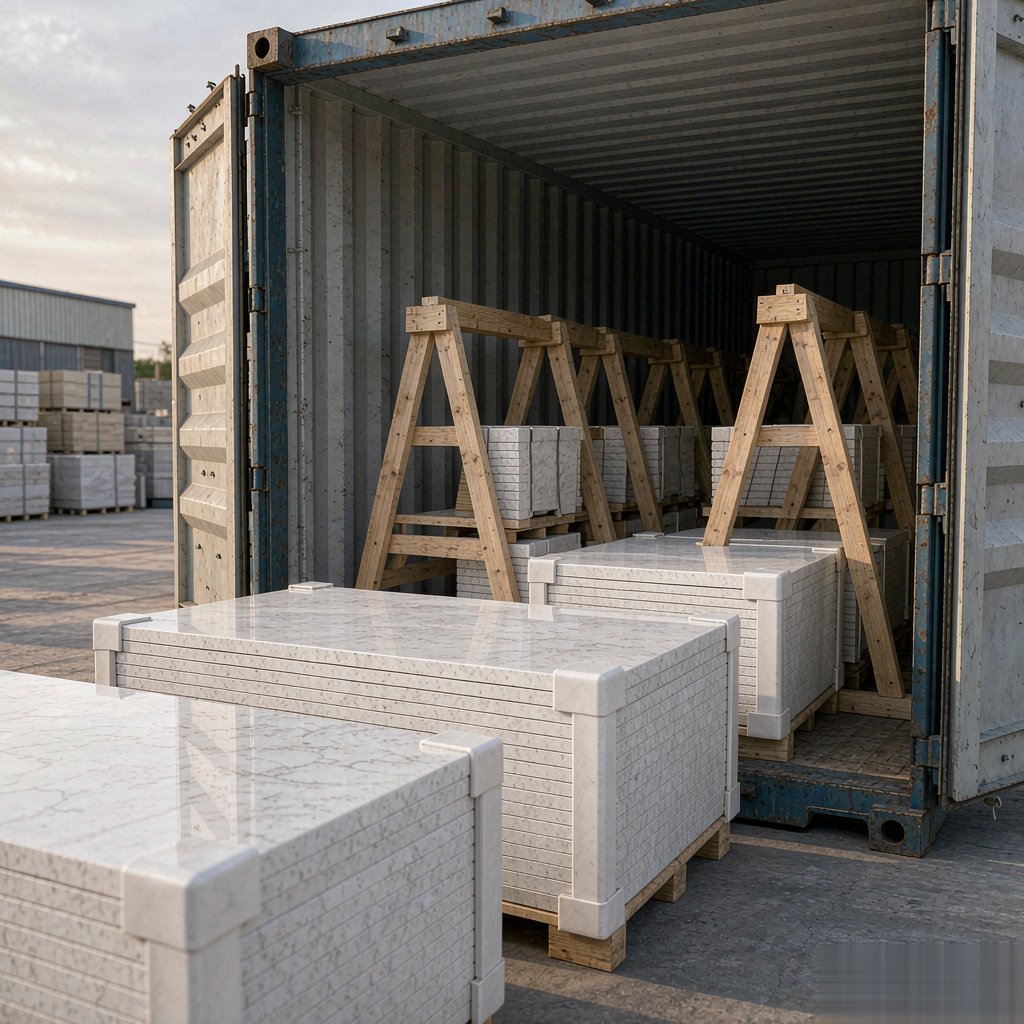
The result: in duty-free markets, landed cost runs about 1.4–1.8× FOB — a $35-per-square-metre slab becomes $49–$63 per square metre at the local warehouse. Because freight is charged per container rather than per slab, the single most effective landed-cost lever a buyer controls is container fill: an order that fills a 40-foot high-cube at 90 slabs pays half the per-slab freight of an order that ships 45 slabs in the same box.
What happens next is where the multiple explodes. The local distributor or fabricator takes the $49–$63/m² stone, adds warehousing and showroom overhead, then quotes fabrication and installation — the $10–$35 per square foot of labor that Fixr’s data places in every US quote. Retail labor alone can exceed the entire FOB value of the stone underneath it. That is not a scandal; it is a crane, a CNC saw, a templating visit, two installers and a warranty.
Why the Same Slab Costs Several Times More in the United States
US readers need the honest version of this section, because the US is the exception among our markets. In May 2019, following investigations that found dumped and subsidised imports, the US Department of Commerce issued antidumping and countervailing duty orders on quartz surface products from China. Under the July 2019 order, the China-wide antidumping cash-deposit rate is 326.15%, with company-specific respondent rates near 255–295% and countervailing deposits of 45.32% for most exporters (up to 190.99% for others). The orders were reaffirmed in the January 2025 sunset continuation, meaning they remain in force for the foreseeable cycle.
What does that do to the math? Because antidumping deposits of 300%+ are assessed on customs value, a $180 FOB slab can carry over $580 in deposits before a single local cost is added — turning a $2.5 landed multiple into a 4.7× one. This is why the US retail quartz market re-sourced after 2019 toward other origins and domestic production, and why I tell American buyers plainly: factory-direct China-origin quartz rarely pencils for you today. The duty layer, not the factory price, decides the outcome. Buyers in markets without such orders — our customers across the Middle East, Southeast Asia, Oceania and Latin America — face the gentler 1.4–1.8× landed multiple shown above, which is why the factory-direct question means completely different things in Houston and in Dubai.
What Fabrication and Installation Add — and Why No Channel Can Skip Them
A slab is not a countertop. Between the warehouse and your kitchen sit templating, CNC cutting, sink and cooktop cutouts, edge profiling, and a physical installation that involves moving 100–250 kg pieces of stone into a finished interior. Fixr’s 2026 figures price this at $10–$35 per square foot of labor within a $50–$200+ installed range, with add-ons that stack fast: decorative edge profiles at $30–$60 per linear foot, old-countertop removal up to $500, and per-slab delivery at $100–$200. A retail-installed mid-grade top costs roughly 10–15× the FOB stone value, primarily because fabrication labor, local logistics and distribution margin are added after import — not because anyone is marking up the stone itself.
There is an uncomfortable corollary worth saying out loud: the factory-direct channel only compresses the 8–15% of the price that is stone, plus part of the distribution margin — it cannot touch the 40–60% that is local labor and service. Anyone promising “factory prices” on a finished, installed kitchen is quoting you the same fabrication economics with a thinner label on it.
When Does Buying Factory Direct Actually Make Sense?
After pricing containers for buyers in 20+ countries, I can compress the decision into volume and capability. Buying factory direct makes sense when your annual volume is measured in containers, not slabs. The profile that benefits: distributors and importers with warehouse capacity, developers running multi-unit projects, and fabricators with their own CNC lines who are already buying slab-in, finished-out.
- Choose factory direct when: you buy 20+ slabs per order and at least a few containers per year; you can receive and store bundles; you or your fabricator handle templating, cutting and installation; your market imposes no prohibitive duty on the origin; and you want lot-level control — reserving consecutive slabs from one batch keeps within-lot colour difference at ΔE 1.0 or less across a whole project.
- Choose retail when: the project is one kitchen; you need showroom samples, a templating service, and one warranty covering stone, fabrication and installation; the order is under a container and freight per slab would eat the material saving; or your market’s duty structure erases the factory advantage, as US antidumping deposits do for China-origin stone.
- The hybrid most projects actually use: buy retail installation locally but specify the stone — ask your fabricator which factory or lot a slab comes from, request the lot’s test certificates, and pay attention to whether consecutive slabs are being reserved for visible runs.
How to Compare a Factory Quote With a Retail Quote Honestly
Most “factory vs retail” comparisons I see are invalid before they start, because the two numbers describe different things. A per-square-metre FOB quote and a per-square-foot installed quote are only comparable after you convert units, add landed costs, and separate material from labor. Use this five-step protocol:
- Normalise units. Convert everything to one basis: $/m² ÷ 10.76 = $/sq ft for material. A $35/m² FOB quote is $3.25/sq ft of stone — compare that only to the material line of a retail quote, never to the installed total.
- Fix the price basis. FOB (factory delivers onto the vessel), CIF (freight and insurance to your port added), DDP (delivered, duty paid, to your warehouse). Two quotes on different bases are not the same number.
- Build the landed cost. Landed ≈ FOB + freight + insurance + duty + port/customs + inland. In duty-free markets expect 1.4–1.8× FOB; in duty-heavy markets, model the duty line first and ask the exporter for the HS codes and origin documentation needed to confirm it.
- Strip labor to compare stones. Subtract the fabricator’s labor quote ($10–$35/sq ft in the US per Fixr) from the installed price to see the effective material-plus-margin line you are competing against.
- Audit the quote itself. Check thickness (20 mm vs 30 mm changes price ~30–45%), slab format (jumbo 3200×1600 mm vs standard), polished faces, bundle and crating charges, and whether quality documentation — per-lot test reports — is included or extra.
One caution from the quoting desk: because freight and handling are charged per container and per bundle, small orders systematically carry the highest per-slab cost — the buyer of 10 slabs subsidises the same container move the buyer of 90 slabs divides cleanly. If your volume sits between the two, ask the factory about mixed-container programs or consolidation with other buyers of the same destination port.
The Honest Ceiling of Factory-Direct Savings
Suppose everything goes right: you buy container-scale, your market is duty-free, and your fabricator works on material you supply. What is the real saving versus walking into a showroom? On the material slice, factory direct commonly saves 40–60% versus distributor pricing; on the whole installed project, the honest end-to-end saving is 20–35%, because fabrication and installation — the untouchable 40–60% of retail price — do not change with the sourcing channel.
And the honest costs of those savings: you carry inventory risk, you own the quality inspection at receipt (ask for per-lot certificates and photograph bundles at unloading), you absorb currency and freight movement — the FBX01 index moved enough in 2026 alone to shift per-slab freight by tens of dollars — and you give up the single throat to choke when a seam fails. For a $3,500 average US kitchen remodel per Fixr, most homeowners should keep that trade. For a 200-unit development or a fabricator buying eight containers a year, the math points the other way every time.
Frequently Asked Questions
Price the Chain, Not the Stone
The quartz stone price you see at retail is an honest bundle once you decompose it: a stone worth 8–15% of the ticket, a logistics and duty layer that doubles it in friendly markets and quadruples it in the US, and a local service economy of fabrication and installation that no sourcing trick can remove. Factory-direct buying is not a hack that beats that structure — it is a decision to own part of the chain yourself, and it pays exactly to the extent that your volume, capability and duty environment let you. If you buy at container scale and want lot-certified slabs — from a polished quartz kitchen countertop in mid-grade white to a Calacatta white quartz countertop in custom sizes — send us the project dimensions and destination port, and we will build the waterfall above around your numbers: request a factory-direct quotation.
Play Three: Let One Slab Own the Room
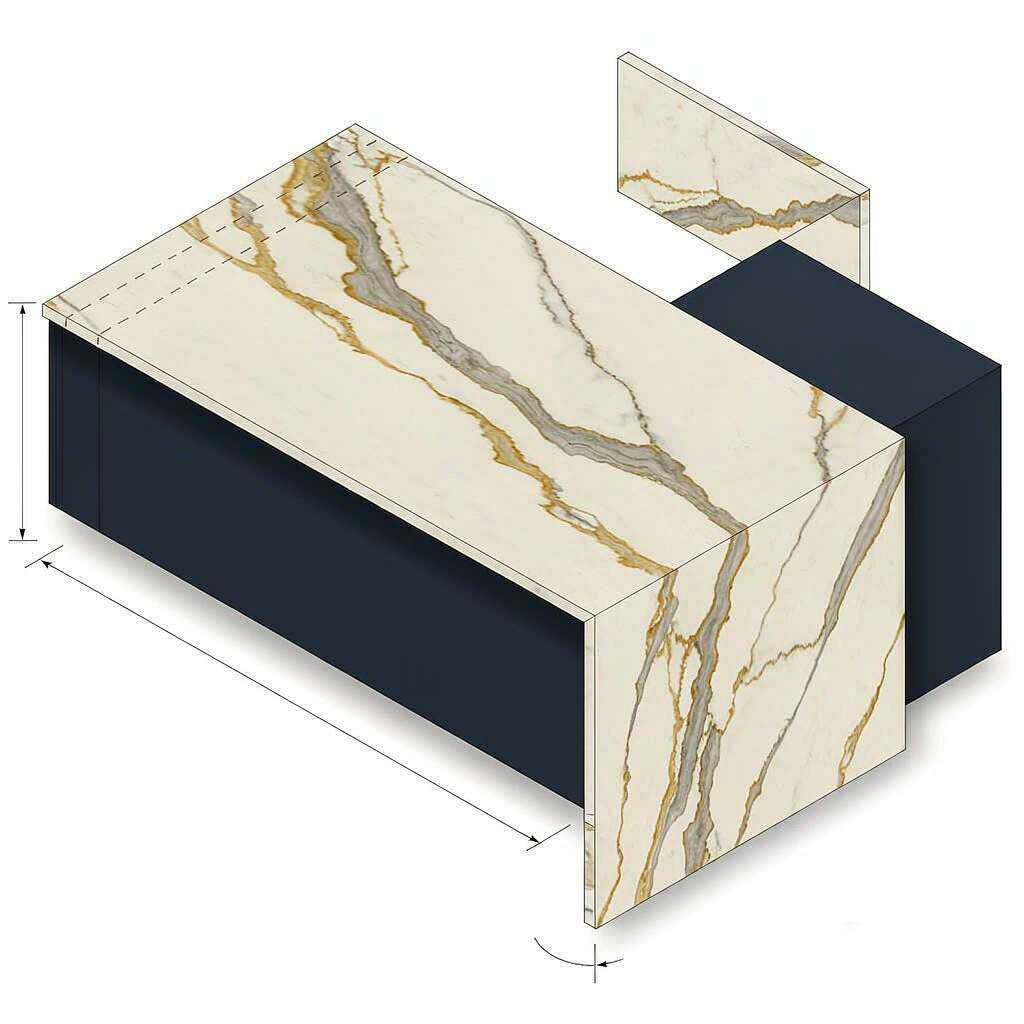
The strongest island is a single-slab island, and the arithmetic is kinder than most people expect. A 3200×1600 mm jumbo slab gives 5.12 m² of stone — enough to cover a 3.0×1.2 m island top with overhangs (3.6 m²) and still yield one 0.55 m² waterfall panel, so the majority of real islands fit inside a single slab. Across roughly 40 island projects we supplied through 2025–2026, 34 left our plant as one-slab tops; the other six went over two slabs because a waterfall ran down both ends or the designer demanded a specific grain direction that forced a second piece.
Where two slabs must meet — longer islands, L-shaped tops — the seam belongs on the diagonal of the vein, where a break in pattern hides best, and both slabs should come from the same lot. The seam craft itself is a fabricator conversation; from the design side, the rule is simply that fewer seams beats prettier slabs, because a visible joint on a bold Calacatta interrupts the vein exactly where the eye follows it.
Play Four: Pair Cabinets by Undertone, Not by Beige
Calacatta’s white is never neutral white — it runs either warm (cream-to-gold ground, gold veins) or cool (blue-white ground, grey veins), and cabinet colour has to follow that undertone. Gold-veined Calacatta pairs with warm greige, honey oak and brass hardware; grey-veined Calacatta pairs with cool whites, stainless and soft blue-grey paints — and mismatching the undertone makes both the stone and the cabinets look slightly dirty. This is the same contrast logic Better Homes & Gardens applies to painted islands: shades drawn from one colour family in differing values keep a large island from feeling heavy.
| Calacatta type | Vein band | Cabinet pairing that works | Pairing to avoid |
|---|---|---|---|
| Gold-ground, bold gold veins | 20–80 mm | Warm greige, walnut, unlacquered brass | Blue-white cabinets (grey cast on the gold) |
| Cool white, grey hairline veins | under 2 mm | Cool whites, stainless, matte black taps | Cream/ivory cabinets (yellow cast on the white) |
| Gold-and-grey blend | 5–15 mm | Soft sage, oak, brushed nickel | High-gloss saturated cabinet colours |
| Dramatic dark veins | 20–80 mm | Deep navy or charcoal-painted island base | Busy patterned floors competing at vein scale |
Floors count as cabinets here: a grey-oiled oak floor will pull the grey out of a blended Calacatta, while a warm cherry floor fights it. Because undertone is a lighting effect as much as a pigment, approve the slab and the cabinet door side by side under the kitchen’s own LED light, not under a showroom’s 4000 K tubes.
Play Five: Choose the Edge Like a Picture Frame
The edge is the quarter-second impression before the eye reaches the veining, so it should either disappear or echo — never advertise. A 3–6 mm eased or pencil edge is the modern default on Calacatta: it reads as a clean line, hides nothing, and costs nothing extra. Ornate profiles do the opposite: ogee and Dupont edges carry a sculptural shadow line that competes with a 50 mm vein, and they cost real money — about $30–60 per linear foot for ogee or Dupont, with decorative edges adding up to roughly $1,050 on a standard kitchen per Fixr’s 2026 pricing.
The one elaborate edge that suits Calacatta is the mitered build-up: a 20 mm slab assembled to a 40–60 mm profile with the vein continued down the face. It is the trick behind every “thick stone slab” photographed in interiors magazines, and it works precisely because the edge is generated from the slab’s own pattern rather than applied to it. Because a mitered edge wraps the vein, reserve the matching strip from the same slab during templating — the look is impossible to fake with a second slab.
Play Six: Light the Island Like a Gallery Piece
Veins are topography, and topography only exists where there is light. Two or three pendants at 3000 K with CRI 90+ render Calacatta’s white as warm and its gold as gold; the same island under 6500 K daylight tubes looks clinical, and the veining flat. Spacing is arithmetic: for two pendants over an L-metre island, divide the run into three and hang at the one-third and two-third points; for three, divide into quarters. Hang them 75–90 cm above the top so the light grazes rather than floods — a shallow angle exaggerates the vein, which is exactly what a statement Calacatta wants and exactly what a hairline slab should avoid.
The finishing touch is the waterfall panel: a 2700 K strip tucked under the counter overhang washes the stone’s vertical face at night and turns the fold into a lantern. It costs a few dollars of LED channel and it is the single most-photographed detail in the island installs I see at our export partners’ showrooms.
Small Kitchens: Does a Calacatta Island Still Make Sense?
Yes — with the volume turned down, not off. A compact 1.2–1.5 m island in a Calacatta hairline or soft grey still delivers the “one beautiful stone” effect, because the island only needs to be the prettiest object in a small kitchen, not the biggest. Better Homes & Gardens’ small-space island guide makes the same point from the furniture side — slim islands with open bases keep small rooms feeling light, and a 20 mm eased-edge stone on a legged base borrows that lightness.
The rules that change below 1.8 m: skip the waterfall (enclosing two sides of a small island shrinks the room), keep the edge eased rather than mitered, and hold pendant count to one or two small shades. The rules that never change: consecutive slabs from one lot, vein along the sightline, and a non-porous quartz slab wipe-clean surface — small islands work harder per square metre than large ones, usually doubling as prep bench, dining table and dumping ground.
What to Send Your Fabricator Before Anyone Cuts
Every failed island spec I have seen traces back to a missing line in the original brief. Six items prevent almost all of them:
- Finished dimensions with overhangs — the stone’s size, not the cabinet’s: a 2.4 m cabinet island with a 30 cm seating overhang is a 2.9 m stone order.
- Vein direction and the entry view — one sentence and a phone photo of the room from the doorway beat a hundred words of “dynamic movement”.
- Waterfall sides and bookmatch yes/no — this decides the slab count and the reservation before anything else.
- Edge profile and target thickness — eased 3–6 mm, mitered 40 mm, or otherwise, with the matching strip reserved on the miter.
- Cutout positions relative to veining — a sink cutout through the slab’s densest vein patch is the most common and most avoidable regret.
- Reserved lot and slab serials — the same production lot, consecutive slabs, written into the order; for custom sizes, our Calacatta white quartz countertops program cuts and photo-approves each slab before shipment so the file and the stone agree.
Frequently Asked Questions
Design First, Then Shop the Slab
The best Calacatta islands are not bought — they are specified. Decide vein scale, direction, waterfall, edge and light before you open a slab inventory, because a well-briefed order turns a good colorway into a designed kitchen, while an unbriefed order just puts expensive stone in the middle of the floor. The six plays above fit on one page; that page is worth more than any catalog.
When you are ready to reserve, send us your island brief with the Calacatta quartz slab spec — dimensions, vein band, waterfall sides and edge — and we will confirm slab availability from current lots, send vein-direction photos of the exact slabs, and hold consecutive pairs for bookmatched projects before your fabricator commits.
Post time: Nov-03-2026