
Wholesale quartz pricing is built around the container, and once you understand that, the discount structure stops being a mystery. On an FOB China basis, 2026 market pricing runs roughly $20–30 per m² for entry mono-colors, $30–50 for mid-range colors, and $50–80+ for premium veined Calacatta-style slabs. Volume discounts then layer on top: sample quantities of 1–5 slabs are quoted near list, roughly 100–300 m² starts to earn a first tier, and the first full container — about 310–350 m² of 3 cm or 460–540 m² of 2 cm slabs — typically improves the sample rate by 5–8%, with multi-container and repeat programs reaching 8–12% or better. The other half of the equation is freight: at October 2026 spot index levels, one 40-foot container to the US West Coast costs about $8,149 and to the East Coast about $9,606, which adds roughly $16–29 per m² depending on thickness and coast. In other words, the discount you negotiate and the container you fill are the two levers that decide your landed cost per square metre — everything else is detail.
This article lays out the math the way our export team at Apex Quartz Stone runs it for buyers in more than 20 countries: discount tiers, container loading figures, freight per square metre, the seven levers that move your price, and a line-by-line method for reading a bulk quote before you wire a deposit.
TL;DR
- FOB reference tiers for 2026: entry colors $20–30/m², mid-range $30–50/m², premium veined $50–80+/m² — the discount comes on top of these, not instead of them.
- The first full 40-foot high-cube (about 310–350 m² of 3 cm or 460–540 m² of 2 cm) is where pricing steps down most sharply, typically 5–8% below the sample rate.
- For 3 cm slabs, container payload of about 26,500 kg is the binding constraint; for 2 cm, A-frame capacity is — so thickness changes how much a container can physically carry.
- At October 2026 spot levels, ocean freight adds roughly $16–19/m² on 2 cm and $25–29/m² on 3 cm to the US, so freight can rival the entire discount you negotiated.
- Always price your order per square metre landed, not per slab FOB — the two rankings can disagree, and only one of them is your real cost.
Why Suppliers Discount by Volume — and Where the First Container Sits
Volume discounts in quartz are not generosity; they are process economics. A production line earns its efficiency when it runs the same or compatible colors back-to-back: one mixed batch of a given color fills many molds, quality control calibrates once, and the changeover cost of flushing pigments and re-setting the line gets spread across hundreds of square metres instead of a few. Because changeovers, not pressing, are the expensive interruption in slab production, an order that lets a factory schedule clean batch runs is genuinely cheaper to produce — and part of that saving is what you see as a discount. Planning stability is the second driver: a supplier who can lock a slot in next month’s production schedule prices differently from one reacting to ad-hoc requests.
That is why discount tiers almost always align with how your order fits the factory’s and the vessel’s schedule. A realistic structure looks like this (indicative figures — every supplier prices differently, and color tier and payment terms move the result):
| Order size | Position | Indicative pricing vs sample rate |
|---|---|---|
| 1–5 slabs | Sample order | List price; often priced to cover handling rather than volume |
| < 100 m² | LCL / partial pallet | 0–3% below list; freight per m² is at its worst here |
| 100–300 m² | Approaching a container | 3–5% below list |
| 310–600 m² (≈ 1× 40-foot high-cube) | First full container | 5–8% below list; the single biggest step |
| 600–1,200 m² (2+ containers or program volume) | Repeat program | 8–12% or better, negotiated on schedule flexibility |
Two practical notes from the negotiating table. First, the biggest single step is the move from “almost a container” to “a full container” — if your order is at 250–280 m², topping it up to a full 40-foot high-cube usually wins on total landed cost even though you buy more material, because the freight per m² and the discount both improve. Second, discount tiers are quoted on total volume, not single-SKU volume: a mixed container of entry, mid and premium colors counts as one order. Experienced buyers exploit this deliberately — entry mono-colors carry the volume, while a smaller share of Calacatta quartz slab SKUs carries the margin.
Container Math: How Many Slabs Actually Fit
Before you can compare any quotes, you need to know what one container physically holds. Quartz slabs travel vertically on steel A-frames, bundles banded and padded, and the two constraints — internal volume and legal payload — pull in different directions by thickness. A 20-foot general purpose container offers about 5.90 × 2.35 × 2.39 m of internal space and roughly 28,000 kg of payload; a 40-foot high-cube offers about 12.03 × 2.35 × 2.70 m and roughly 26,500 kg.
Do the arithmetic on the standard jumbo format, 3,200 × 1,600 mm (5.12 m² per slab): a 3 cm slab at roughly 72 kg/m² weighs about 370 kg, so 68 slabs — about 348 m² — lands near 25.2 tonnes, just inside a high-cube’s payload. At 2 cm (roughly 48 kg/m², about 246 kg per slab), weight stops being the constraint around 105 slabs, but the A-frames and headroom run out first. Hence the planning table most loaders work from:
| Format | 20-foot GP (typical load) | 40-foot high-cube (typical load) |
|---|---|---|
| 2 cm, 3,200 × 1,600 mm | 45–55 slabs ≈ 230–280 m² | 90–105 slabs ≈ 460–540 m² |
| 3 cm, 3,200 × 1,600 mm | 30–36 slabs ≈ 155–185 m² | 60–68 slabs ≈ 310–350 m² |
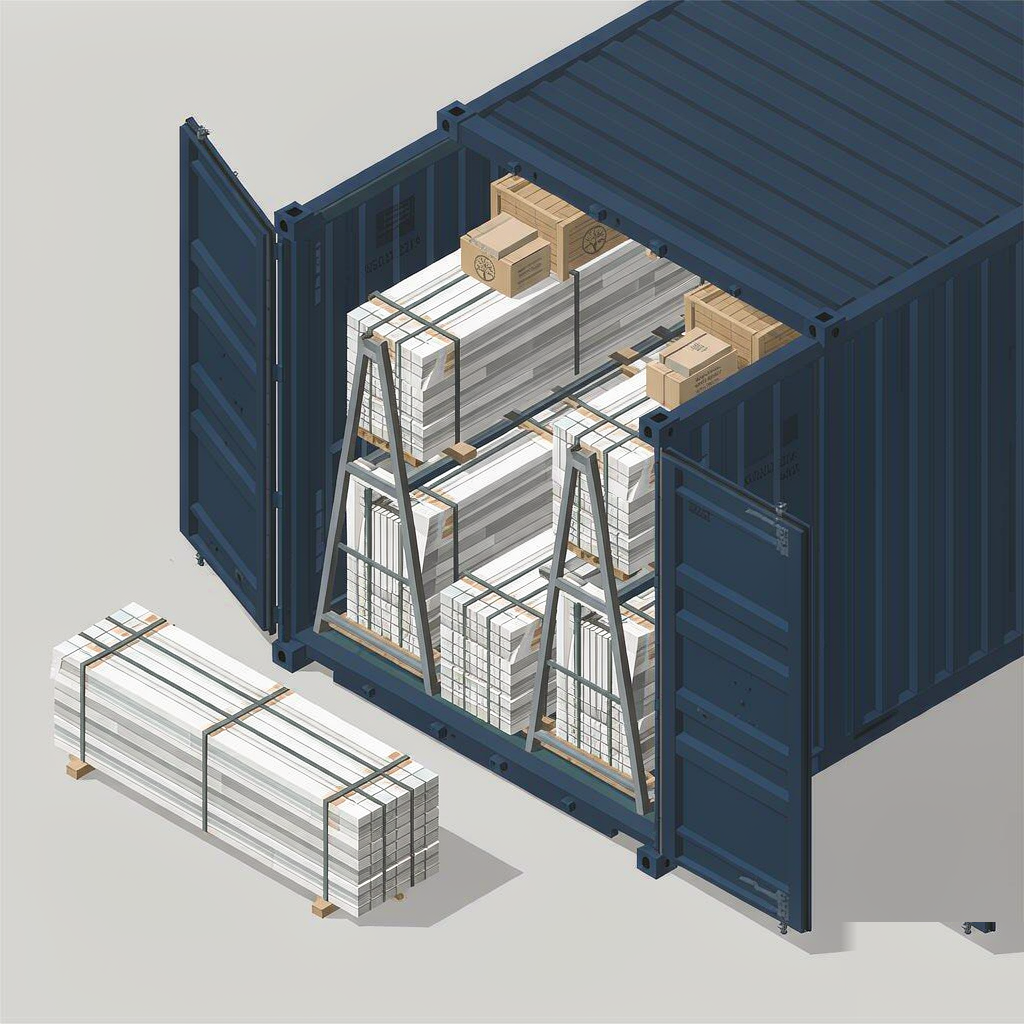
The insight worth internalizing is that thickness silently changes your container economics by nearly 50%: the same 40-foot high-cube carries roughly 500 m² of 2 cm but only about 330 m² of 3 cm, so identical per-m² FOB prices produce very different landed costs per m² once freight is divided in. This is also why quote comparisons must be normalized: a “$38/m²” 3 cm offer and a “$38/m²” 2 cm offer are not the same offer once you price the freight behind each.
What Ocean Freight Adds per Square Metre — and Why It Moves
Freight is the part of your landed cost you control least, so it deserves its own arithmetic. The reference numbers for this week: the Freightos Baltic Index — compiled with the Baltic Exchange from tens of millions of price points — puts a 40-foot container from China/East Asia to the US West Coast at about $8,149 and to the US East Coast at about $9,606 at spot (FBX01 West Coast index; FBX03 East Coast index). Spread those over a full high-cube and the freight component lands at roughly:
| Container load | US West Coast (≈ $8,149) | US East Coast (≈ $9,606) |
|---|---|---|
| 2 cm, ≈ 500 m² per 40-foot HC | ≈ $16/m² | ≈ $19/m² |
| 3 cm, ≈ 330 m² per 40-foot HC | ≈ $25/m² | ≈ $29/m² |
Read that table twice, because it contains the two facts that most first-time importers learn the expensive way. First, on 3 cm slabs, freight can cost you as much as the entire bulk discount you negotiated — twice over; a 10% discount on $50/m² saves $5, while the West-to-East Coast difference alone is $4/m² and the 2 cm-to-3 cm freight penalty is $9/m². Second, spot freight moves sharply by season and by year — these are index levels, not contract rates, and a quote you hold for six weeks may no longer be bookable. Practical defenses: ask for quote validity in writing, consider booking freight separately from the goods so you control timing, and remember that a 40-foot high-cube beats a 20-foot on per-m² freight almost every time, because you pay per container but consume per square metre.
What about LCL — shipping less than a container load? It exists, and it is the right choice for samples and market tests. But LCL is priced per cubic metre or per weight-measure unit, and dense 3 cm slabs are exactly the cargo that LCL punishes; per-m² freight typically runs 20–30% above full-container rates, with added consolidation handling at both ends that raises breakage exposure. Industry bodies such as the Natural Stone Institute publish handling and care guidance precisely because stone is one of the few commodities where bad handling destroys value silently. Rule of thumb: LCL is for testing demand; full containers are for making margin.
Seven Levers That Move Your Per-Square-Metre Price
Discount tiers and freight are the macro economics. Inside any quote, these seven levers decide where within the range your order actually lands:
- Thickness. 2 cm is cheaper per m² at FOB and ships roughly 50% more area per container. Choose 3 cm where the market demands it (US kitchen worktops) — but price the difference consciously, not by default.
- Slab size. Jumbo 3,200 × 1,600 mm formats maximize yield per slab and per container for large runs; smaller 3,060 × 1,400 mm formats can reduce waste on small vanity programs. Match format to your fabrication plan, e.g. custom-size programs like Calacatta white quartz countertops in custom sizes.
- Color tier. Entry mono-colors and mid-range patterns are the volume play; premium veined slabs carry margin. Blend deliberately.
- Pigment and resin load. Bold colors, metallics and complex veining add real production cost — typically $5–15 per m² — because batches are harder to match and changeovers are longer.
- Surface finish. Polished is the standard and usually carries no surcharge; honed, leathered or specialty finishes add cost and lead time because they run as separate batches.
- Mixed containers. Mixing colors and thicknesses (within one frame type) lets you reach the container tier without betting everything on one SKU — and keeps cash out of slow-moving inventory.
- Incoterms and payment terms. FOB named port (for us, typically Xiamen) keeps freight in your control; CIF bundles it at the supplier’s margin. Payment structure — deposit vs balance vs LC — also moves the quoted price, because it moves the supplier’s risk.
Notice what is not on that list: certifications and specialty products sit partly outside it. A non-silica quartz or low-silica product line, for instance, is priced on its own formulation economics, and documented quality programs carry their own premium of typically $3–8 per m² — money that is usually well spent where market access demands documentation. The seven levers above are the ones you can actually pull in a negotiation.
How to Read a Bulk Quote Line by Line
A professional bulk quote should be boringly itemized. Before you compare two quotes, normalize them against this checklist:
- Base price per m² by SKU — color code, thickness and finish stated explicitly, not “premium white, 3 cm” alone.
- FOB port named — “FOB Xiamen” tells you where your cost ends and freight begins; quotes without a named port are not comparable to anything.
- Origin charges itemized — THC, documentation, and crating. A-frames, wooden bundles and edge protection should be stated as included or priced.
- Discount basis visible — what volume earned which tier, so a re-quote at different quantity is predictable.
- Loading plan — slabs per container by SKU, frame count, and declared weight. This is where you catch an over-promised container before the vessel does.
- Quality documents — batch test data and a stated replacement policy for breakage or off-spec slabs.
- Quote validity — in writing, with the freight assumption behind it.
Red flags are the mirror image: a quote valid “today only”, no named port, no loading plan, a discount offered before you have stated volumes, or prices quoted per slab without dimensions. Any one of these makes the number meaningless, because a per-slab price on an unspecified size is not a price — it is a placeholder.
Frequently Asked Questions
Price the Container, Not the Slab
Every experienced stone importer converges on the same discipline: stop comparing per-slab FOB prices and start modeling each candidate order as a full landed container — material at tier price, freight at current index levels, charges itemized, divided by the square metres the container actually carries. That one division, m² landed, is the only number that ranks suppliers honestly, because it is the only number that contains the discount, the thickness and the freight at once.
At Apex Quartz Stone, we have run this math with buyers across more than 20 countries since 1997, from our 40,000 m² plant in Shuitou that ships over 100,000 slabs a year. Send us your project square metres — even a rough figure — and our team will come back with a tiered quote, a loading plan and a freight assumption you can check line by line. That is what a wholesale price should look like: a worksheet, not a riddle.
Alex Wang
Alex Wang leads international business development at Quanzhou APEX Co., Ltd. (Apex Quartz Stone), an engineered quartz manufacturer founded in 1997 in Shuitou Town, Nan’an, Quanzhou, Fujian, China. The company operates a 40,000 m² production facility with an annual output of more than 100,000 quartz slabs, exporting to over 20 countries.
Post time: Oct-16-2026