
By Yvonne Deng
International Sales Director, Apex Quartz Stone | 12+ Years in Engineered Stone Manufacturing
linkedin.com/in/yvonne-deng-5b35b543/
Quartz slab manufacturing is a sophisticated industrial process that transforms raw quartz crystals into the durable, beautiful countertop surfaces found in millions of homes worldwide. Understanding how quartz slabs are made helps buyers assess quality, compare suppliers, and make informed purchasing decisions. This guide walks through each stage of production from quarry to finished slab.
The Raw Materials: What Goes Into a Quartz Slab
Engineered quartz slabs consist of approximately 90-93% natural quartz aggregates combined with polymer resins, pigments, and additives. The remaining 7-10% includes binding agents, colorants, and performance enhancers. The precise formulation determines the slab’s final appearance, durability, and performance characteristics.
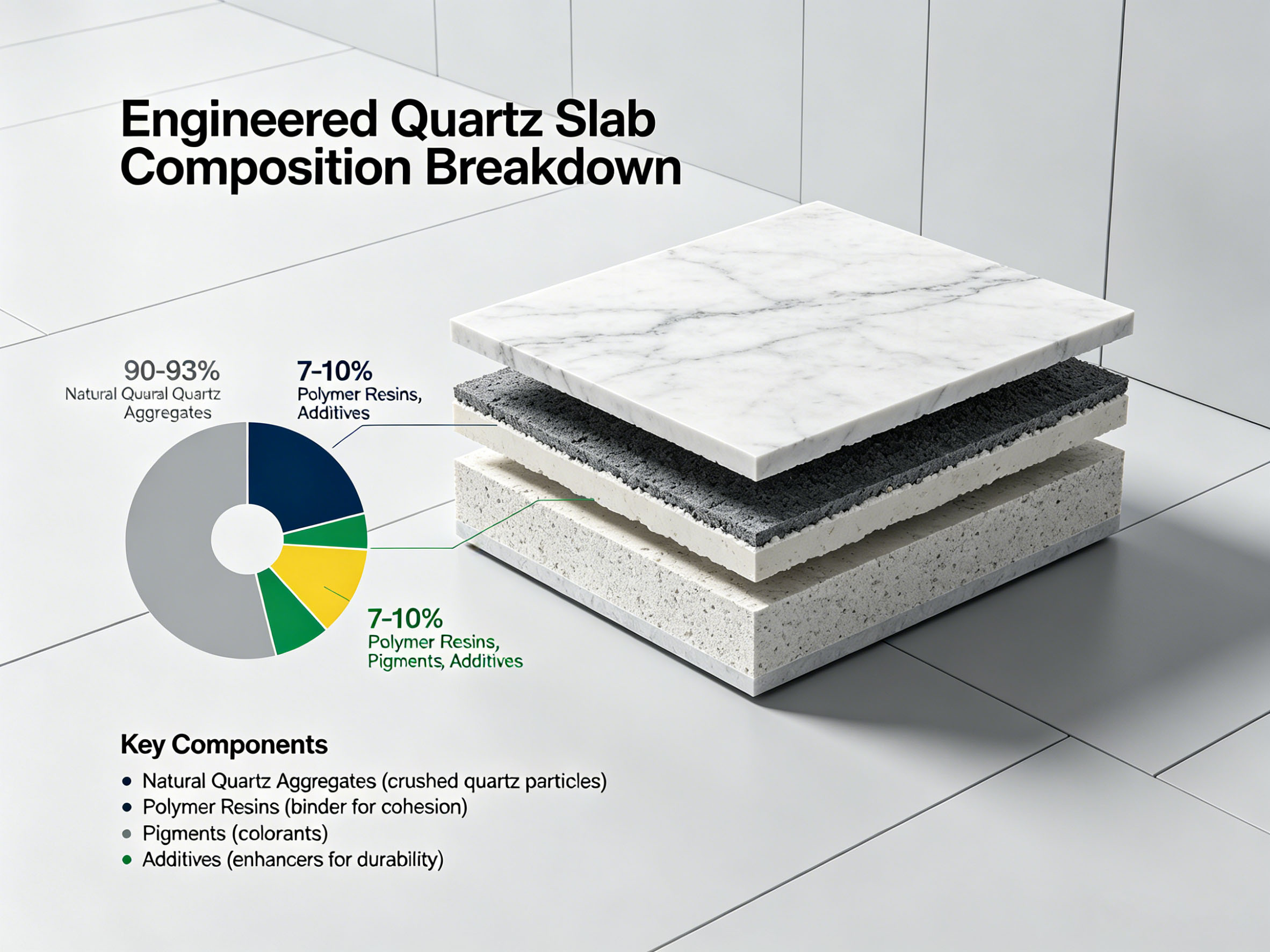
Quartz Aggregates. The primary raw material is crushed quartzite or quartz sand sourced from mines worldwide. Quality varies significantly by source. High-purity quartz with low iron content produces whiter base colors and stronger structural properties. Apex Quartz Stone sources quartz from multiple regions to maintain consistent quality across production batches.
Polymer Resins. Unsaturated polyester resins act as the binding agent. The resin quality directly affects slab strength, stain resistance, and color stability. Premium manufacturers use imported resins from suppliers with proven track records. Resin content typically ranges from 7-10% of total composition.
Pigments and Colorants. Inorganic mineral pigments create the color spectrum available in quartz slabs. Iron oxides produce warm tones, titanium dioxide creates whites, and carbon-based pigments produce blacks and greys. Pigment quality affects UV stability and long-term color retention.
Additives. Performance-enhancing additives include coupling agents for resin-to-quartz adhesion, UV stabilizers for color retention, anti-microbial agents for hygiene, and processing aids for manufacturing efficiency. The additive package distinguishes premium slabs from budget products.
The Manufacturing Process: Step by Step
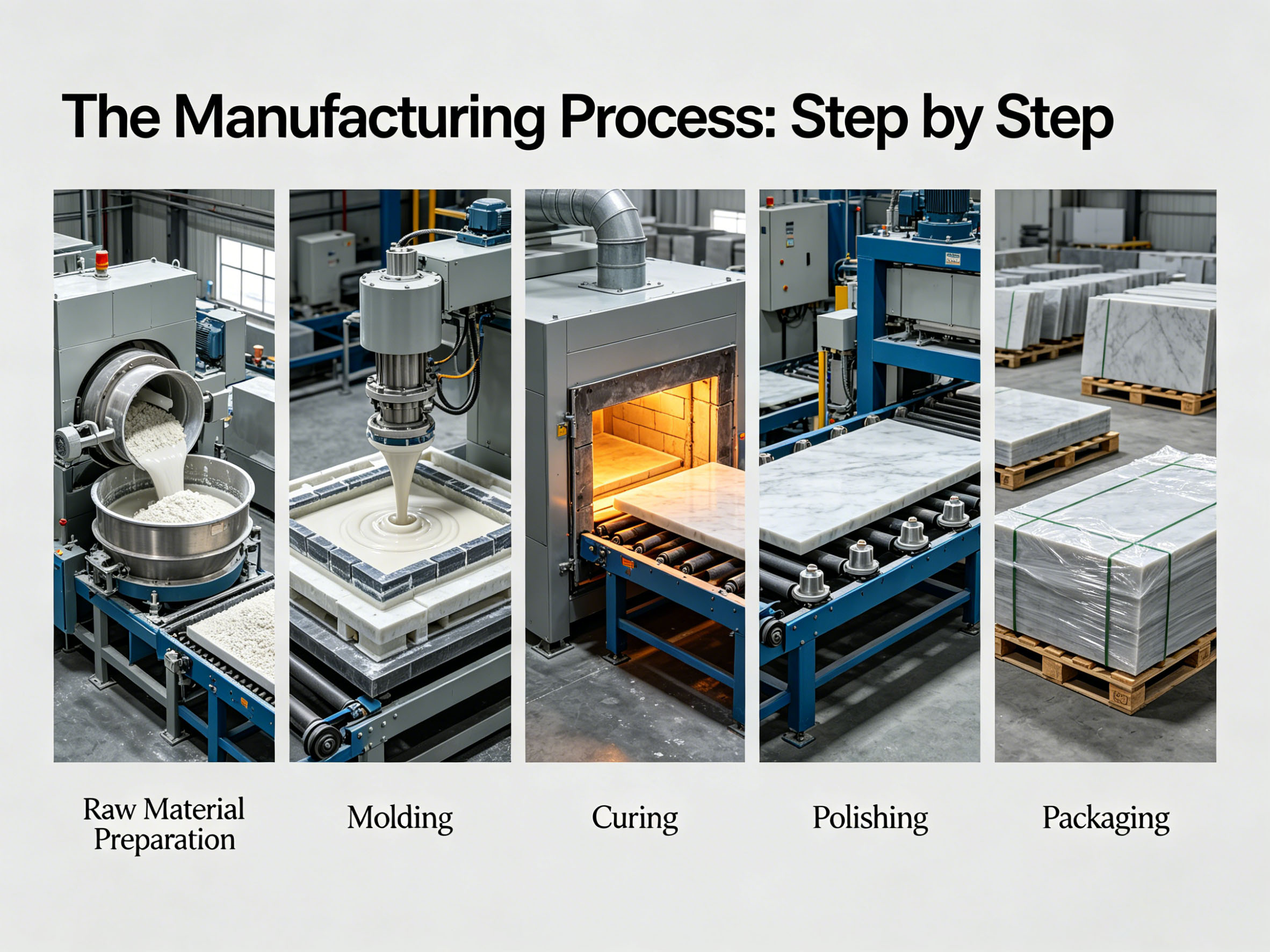
Step 1: Raw Material Preparation. Quartz aggregates arrive at the factory in various particle sizes, from fine sand to coarse granules. These are sorted, cleaned, and stored in silos. Computer-controlled dosing systems precisely measure each ingredient according to the formulation recipe for the specific slab design being produced.
Step 2: Mixing and Blending. The measured ingredients enter industrial mixers where they are blended with resin and pigments. Mixing time and speed are precisely controlled. Under-mixing produces inconsistent patterns; over-mixing generates excess heat that may prematurely cure the resin. Experienced operators monitor mixing conditions in real time.
Step 3: Vacuum Compression. The blended mixture is spread evenly onto a steel frame tray and enters a vacuum compression chamber. High-powered vacuum pumps remove air pockets from the mixture. Pressures of 100-150 tons are applied to compact the material into a dense, void-free slab. This step is critical for achieving the non-porous surface that defines quality quartz.
Step 4: Heat Curing. Compressed slabs move to curing ovens where controlled heat (80-100 degrees Celsius) accelerates the resin curing process. Curing time ranges from 30-60 minutes depending on slab thickness and formulation. Temperature control is essential. Over-curing causes brittleness; under-curing results in soft spots and reduced durability.
Step 5: Cooling and Stabilization. After curing, slabs enter cooling stations where temperature decreases gradually. Rapid cooling causes internal stress and micro-cracking. Stabilization time allows the resin to reach full structural strength before further processing.
Step 6: Calibration and Thickness Control. Cooled slabs pass through precision calibration machines that grind both surfaces to achieve uniform thickness. Tolerance is typically within 0.3mm across the entire slab. This precision ensures consistent installation and seamless joint matching.
Step 7: Polishing. The slab surface undergoes progressive polishing using diamond abrasive heads. Polishing sequences typically include 6-12 stages, starting with coarse 50-grit abrasives and finishing with 1500-grit or finer for high-gloss results. The number of polishing heads and abrasive quality directly affect final surface quality.
Step 8: Quality Inspection. Every slab undergoes visual inspection for color consistency, pattern accuracy, and surface defects. Advanced factories use automated imaging systems that scan each slab and compare it against design specifications. Slabs that fail inspection are either reprocessed or rejected.
Step 9: Surface Protection and Packaging. Inspected slabs receive protective coatings or films to prevent scratching during transportation. Slabs are crated vertically in steel frames with padded separators, then wrapped for container shipping. Proper packaging prevents damage during the long journey from factory to international buyers.
Quality Indicators at Each Production Stage
Knowing what to look for at each manufacturing stage helps buyers evaluate factory capability. When visiting a quartz slab factory or reviewing their production credentials, consider these indicators.
Raw Material Storage. Covered storage for quartz aggregates indicates quality-conscious operations. Open-air storage allows moisture contamination that affects color consistency. Separate silos for different particle sizes demonstrate batch control capability.
Mixing Equipment. Computer-controlled batching systems provide consistent formulations. Manual batching relies on operator skill and introduces variation. Multiple mixing lines allow simultaneous production of different colors without cross-contamination.
Compression Technology. Vacuum pressure capability of 100+ tons is standard for quality production. Multi-directional compression produces more uniform density than single-direction methods. The vacuum holding time affects air removal completeness.
Curing Control. Multi-zone temperature-controlled ovens provide even curing. Single-zone ovens may produce inconsistent results. Automated temperature logging demonstrates process control capability.
Polishing Line. The number of polishing heads correlates with surface quality. Budget factories may use only 4-6 polishing stages, while premium producers use 10-12. Diamond abrasive quality also varies significantly between manufacturers.
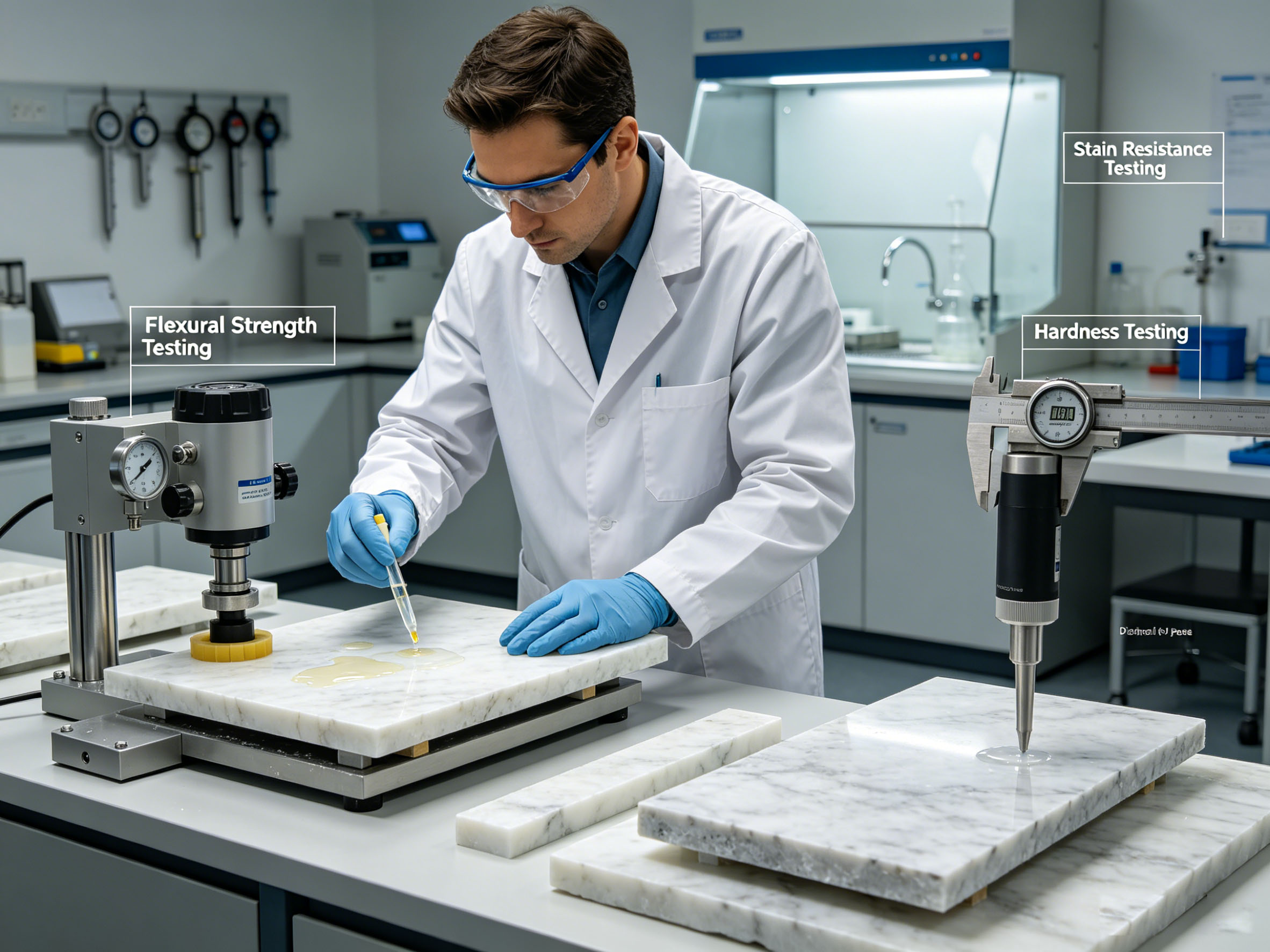
Quality Control Systems. ISO 9001 certification indicates basic quality management. Factory testing equipment for hardness, stain resistance, and flexural strength demonstrates technical capability. Third-party testing provides independent verification.
Factory Scale and Production Capacity
Quartz slab manufacturing is capital-intensive. A single production line costs $2-5 million to establish. Large factories operate multiple lines to serve export markets efficiently. Annual production capacity varies widely. Small factories produce 50,000-100,000 slabs per year. Medium-sized operations produce 200,000-500,000. Large-scale producers like Apex Quartz Stone, with a 40,000-square-meter facility, exceed 100,000 sheets annually.
Factory location affects logistics and pricing. Factories near quartz mines benefit from raw material cost advantages. Factories near major ports reduce inland transportation costs for export customers. Manufacturing clusters in Fujian province, China benefit from established supply chains and skilled labor pools built over decades of stone processing experience.
Quality Control Testing Methods
Reputable quartz manufacturers conduct regular testing to verify product performance. Key tests include flexural strength testing per ASTM C880, measuring slab resistance to bending stress. Stain resistance testing per ASTM C1378 evaluates surface reaction to common staining agents. Hardness testing using Mohs scale confirms mineral durability. Water absorption testing verifies the non-porous surface quality.
Thermal shock resistance testing subjects slabs to rapid temperature changes to verify structural integrity. Color consistency testing uses spectrophotometers to measure color variation between batches. Dimensional accuracy testing confirms thickness and flatness specifications are met. Quality manufacturers maintain detailed records of all test results and make them available to buyers upon request.
Environmental and Sustainability Considerations
Modern quartz manufacturing increasingly incorporates sustainable practices. Water recycling systems capture and treat process water for reuse, reducing consumption by up to 80%. Dust collection systems capture silica particles from cutting and polishing operations, protecting worker health and reducing environmental emissions. Energy-efficient curing ovens reduce fuel consumption. Recycled quartz content in new slabs reduces raw material demand.
Leading manufacturers pursue environmental certifications that demonstrate their commitment to sustainable production. These include ISO 14001 environmental management certification, NSF/ANSI 51 certification for food contact safety, and Greenguard certification for low chemical emissions. Buyers should ask about environmental certifications when evaluating potential suppliers.
Conclusion
Quartz slab manufacturing combines mineral science, precision engineering, and quality control to produce the durable surfaces used worldwide. Understanding the production process helps buyers evaluate supplier capability, assess product quality, and make informed purchasing decisions. For buyers seeking detailed information about manufacturing processes and quality standards, established manufacturers with transparent production practices provide documentation and factory tour opportunities.
Post time: Jun-30-2026