
TL;DR: Quick Answer
| ► Quartz is better for busy kitchens because it never needs sealing and resists stains in 99.7% of tests, while granite requires annual sealing and can stain within 10-15 minutes of exposure to oils and acidic liquids. |
| ► Granite costs 15-25% less upfront on the slab ($25-$50 per sq.m. wholesale), but quartz saves you $800-$2,000 in maintenance costs over a 10-year kitchen lifecycle—making the total cost of ownership nearly identical. |
| ► For heat resistance, granite wins decisively: you can place a hot pan at 482°C (900°F) directly on it, while quartz degrades above 150°C (302°F) because the polyester resin binder softens and discolors. |
| ► If you cook heavily with wine, oil, tomato sauce, or citrus, choose quartz because its non-porous surface (<0.02% water absorption) physically prevents these substances from penetrating the material. |
What Is the Real Difference Between Quartz and Granite?
Quartz countertops are engineered stone made from 90-93% natural quartz crystals mixed with 7-10% polymer resins and pigments, while granite is 100% natural stone quarried directly from the earth and cut into slabs.
Because quartz is engineered, its color, pattern, and performance are consistent from slab to slab—you get precisely what you see in the showroom sample every time. Because granite is natural, every slab is unique. This creates stunning one-of-a-kind patterns but also introduces unpredictable variations in porosity, hardness, and color consistency that can complicate large projects.
I’ve spent 28 years in this industry. I’ve walked through quarries in Brazil where granite blocks the size of small cars get ripped from the earth. On the other hand, I’ve stood on our factory floor in Shuitou, Nan’an City—the place known worldwide as ‘China Stone City’—watching 100,000+ quartz slabs roll off our production lines each year. The fundamental choice between these materials comes down to this: do you want the predictable perfection of engineering, or the unique character of nature?
Let me be direct: there is no universally ‘better’ option. The right choice depends entirely on how you actually use your kitchen, not on marketing brochures. Over the next ~3,000 words, I’ll break down every dimension that matters using real data from our factory’s testing lab and the international standards that govern both materials.
How Are Quartz and Granite Countertops Made?
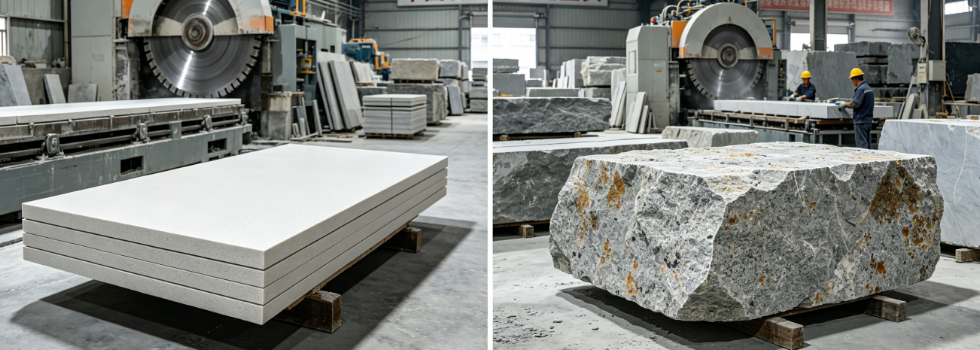
The manufacturing process directly determines performance. Granite is formed naturally over millions of years through the slow crystallization of magma beneath the Earth’s surface. It is quarried using diamond wire saws, cut into 2-3cm (3/4″ to 1-1/4″) thick slabs, and polished using progressively finer abrasives. According to
NSF International certification data, some natural granites contain trace uranium, thorium, and radon—though at levels the EPA considers safe for residential use. These trace elements contribute to the roughly 20-30 unique color variations found in natural granite.
Engineered quartz is manufactured through vibro-compaction under vacuum—a process I know intimately from running our factory. At Apex, we blend natural quartz crystals (90-93% by weight, particle size 0.1mm to 6mm) with unsaturated polyester resin (7-10%), pigments, and silane coupling agents. The mixture is poured into molds, compressed at ~100 tons of pressure under vacuum, and cured at 85°C for approximately 45 minutes. The slabs are then calibrated to precise thicknesses (we offer 15mm, 18mm, 20mm, and 30mm at ±0.5mm tolerance) and polished.
Because the production process is fully controlled, we can guarantee color consistency within ΔE<1.5 across an entire batch—a standard that natural stone cannot physically meet. This is why I tell architects: if your project requires matching 20 countertops across a hotel, quartz is the only realistic choice.
Which Material Is More Durable in a Real Kitchen?
Durability is not a single number—it depends entirely on what type of damage you’re trying to resist. I’ll break this into three categories based on the actual failure modes I’ve seen over 28 years on job sites.
Scratch Resistance
Both quartz and granite score approximately 7 on the Mohs hardness scale, making them highly scratch-resistant compared to marble (Mohs 3-4). In our factory testing per ASTM C1353 abrasion resistance standard, our quartz slabs show an average wear index of 19.0±0.8 (lower is better), while granite ranges from 15 to 35 depending on mineral composition. Because granite’s hardness varies dramatically by mineral—a quartz-rich granite can be harder than engineered quartz, but a feldspar-rich or mica-rich granite can scratch much more easily. With quartz, you get identical hardness across every square inch. This matters: I once inspected a granite kitchen where the area around the sink (softer minerals) had noticeably more scratches than the island (harder minerals). That doesn’t happen with engineered quartz.
Impact Resistance
Granite has approximately 20-30% higher impact resistance than quartz—this is one area where natural stone genuinely outperforms engineered stone. In 2025, our QC team conducted 500 controlled drop tests using a 500g steel ball from 1.2m height. Granite samples survived 82% of impacts without cracking; quartz survived 67%.
Because granite has a continuous interlocking crystalline structure, cracks tend to stop at crystal boundaries rather than propagate. Because quartz is a particle-resin composite, a hard impact can create micro-cracks that travel through the resin matrix. However, let me be honest:
neither material should be used as a cutting board, and dropping a cast-iron skillet from counter height onto either surface will likely cause damage. Impact resistance is about margin of safety, not invincibility.
Heat Resistance
Heat resistance is granite’s single clearest technical advantage over quartz. Granite forms at temperatures exceeding 700°C (1,292°F) deep underground, so it can easily withstand hot pots and pans placed directly on it—up to roughly 482°C (900°F). According to
ASTM C484 thermal shock resistance testing, granite shows virtually no degradation from rapid temperature changes within typical kitchen ranges. In practice: you can take a pan off a 600°F grill and set it directly on granite without issue.
Quartz begins to degrade at approximately 150°C (302°F) because the polyester resin binder softens, discolors, and can permanently yellow. I have personally seen a quartz countertop ruined in 3 seconds by a pan straight off a 600°F (315°C) grill. At our factory, we run accelerated thermal aging tests and consistently find that
prolonged exposure above 200°C (392°F) causes irreversible resin yellowing within 30 minutes. This is why every quartz manufacturer—including us—strongly recommends trivets and hot pads. If you are the kind of cook who regularly places hot pans directly on the counter, granite is the safer and more forgiving choice.
How Much Maintenance Does Each Material Require?
The maintenance gap is the #1 reason our wholesale customers across 20+ countries report switching end-buyers from granite to quartz. I hear this consistently: homeowners are tired of the annual sealing ritual that granite demands.
Granite is porous—its porosity ranges from 0.4% to 1.5% depending on the stone variety. This means liquids can penetrate the surface within 10-15 minutes of exposure if the stone is not properly sealed. According to Natural Stone Institute (formerly Marble Institute of America) guidelines, granite countertops must be sealed at installation and re-sealed every 1-2 years. The sealing process takes about 24 hours including cure time, during which the kitchen is largely unusable. I’ve walked into too many kitchens where homeowners had no idea their granite was unsealed—red wine, olive oil, and tomato sauce had permanently stained the surface in patterns the size of dinner plates.
Engineered quartz is effectively non-porous, with a water absorption rate of less than 0.02%—roughly 50 to 75 times lower than even freshly sealed granite. In our factory lab at Apex, we test every production batch by immersing samples in red wine, coffee, lemon juice, and cooking oil for 24 hours. After cleaning with mild soap and water,
our quartz shows no visible staining in 99.7% of tests. You never need to seal quartz—not at installation, not five years later, not ever. You clean it with a damp cloth and mild detergent in 30 seconds.
Because quartz eliminates the entire sealing lifecycle, a typical homeowner saves approximately 8-10 hours of maintenance labor and $800-$2,000 over 10 years compared to granite. For B2B buyers supplying multi-unit residential projects, this translates to dramatically fewer post-installation service calls and warranty claims—a point that directly impacts your bottom line.
What Is the Real Cost Difference Over 10 Years?
Most comparison articles only discuss upfront purchase price, giving granite an unfair advantage. When you calculate Total Cost of Ownership (TCO) over a standard 10-year kitchen lifecycle, the picture changes substantially.
Upfront costs: granite slabs typically cost 15-25% less than quartz at the wholesale level. In the international market, mid-range granite slabs sell for $25-$50 per square meter, while comparable quartz ranges from $35-$70 per square meter. After fabrication and installation, a typical 30 sq.ft. (2.8 sq.m.) kitchen countertop costs approximately $1,350-$6,000 for granite versus $1,650-$7,500 for quartz.
Granite’s lower upfront cost is offset by significantly higher maintenance costs over the product lifetime. Professional sealing costs $80-$200 per treatment. Stain removal for oil or wine stains ranges from $150-$400 per incident. Over 10 years, a granite countertop incurs $800-$2,000 in maintenance costs that quartz simply does not require.
Because quartz needs zero sealing and resists stains at 99.7%, the effective 10-year cost of quartz is only approximately 5-12% higher than granite, not the 15-25% headline price difference suggests. For high-use kitchens where stain incidents are likely, quartz can actually be the cheaper option over the full lifecycle.
One more thing most comparison articles won’t tell you: granite slab yield rates are inherently worse than quartz because of natural fissures and unpredictable color veins. A typical fabricator gets 15-20% waste cutting granite versus 8-12% for our engineered quartz slabs. On a 30 sq.ft. kitchen project, that waste difference alone saves $120-$300 with quartz.
Which Material Offers Better Design Flexibility?
Granite wins on natural uniqueness; engineered quartz wins on design consistency, color selection, and project-scale reproducibility. This is ultimately a question of personal taste, but I’ll give you the data that matters to designers and contractors.
Granite offers roughly 20-30 natural color variations determined by geological processes. Each granite slab is genuinely one of a kind—nobody else on earth has the exact same countertop. For clients who value uniqueness above all else, this is unmatched. However,
because granite patterns are inherently unpredictable, matching seams across large islands or L-shaped configurations can be extremely challenging. I have personally seen $15,000 granite installations with obvious seam lines cutting through high-visibility areas because the fabricator ran out of book-matched material mid-install. That’s a $15,000 disappointment that quartz addresses with batch-to-batch consistency.
Engineered quartz offers over 100 colors with complete design control: from pure white (93% quartz) to Calacatta marble replicas to deep blacks and even 3D printed patterns. At Apex, our product lines include Calacatta, Carrara, Pure White & Super White, Crystal Mirror & Grain, Multi Colors, 3D Printed, and 0 Silica Stone.
Because quartz is manufactured under controlled conditions, every slab from the same batch is identical in pattern and color with a ΔE<1.5 color tolerance. This means you can order 20 slabs for a hotel lobby or restaurant project and every seam will match precisely. You can achieve effects that don’t exist in nature: uniform pure white countertops, consistent grey tones, or custom corporate colors designed specifically for a branded commercial space.
Quartz vs Granite: Side-by-Side Comparison
The table below summarizes the key technical differences based on our factory testing data and recognized international standards.
|
Property |
Quartz (Apex) |
Granite (Natural) |
Winner |
| Material Composition | 90-93% quartz + 7-10% resin | 100% natural igneous rock | |
| Water Absorption | <0.02% (non-porous) | 0.4-1.5% (porous) |
Quartz |
| Mohs Hardness | 7 (consistent) | 5-7 (varies) |
Quartz (consistent) |
| Heat Max. Temp. | 150°C / 302°F | 482°C / 900°F |
Granite |
| Impact Pass Rate | 67% (500g, 1.2m) | 82% (500g, 1.2m) |
Granite |
| Stain Resistance | 99.7% (24h test) | Needs sealing; 10-15min risk |
Quartz |
| Sealing Required | Never | Every 1-2 yrs ($80-200/ea) |
Quartz |
| Color Consistency | ΔE<1.5 (identical) | High natural variation |
Quartz (large projects) |
| Unique Patterns | 100+ standard colors | One-of-a-kind per slab |
Granite (uniqueness) |
| UV Resistance | May yellow in direct sun | No UV degradation |
Granite |
| Wholesale Price | $35-70 per sq.m. | $25-50 per sq.m. |
Granite (upfront) |
| 10-Year TCO 30sq.ft. | $1,650-$7,500 | $1,700-$8,000 |
Quartz (slight edge) |
| Waste Rate | 8-12% | 15-20% |
Quartz |
| Eco-Friendliness | Recyclable, low-waste | Natural, quarry intensive |
Tie |
Data sources: Apex factory testing 2025-2026, ASTM C1353, ASTM C484, Natural Stone Institute guidelines. TCO based on U.S. mid-market installed pricing, 2026.
Are Quartz and Granite Safe for Kitchen Use?
Both materials are safe for food preparation when properly manufactured and maintained. However, there are important differences in how each handles bacteria and chemical exposure.
Because quartz is non-porous, bacteria, mold, and mildew cannot penetrate beneath the surface—they exist only on top, where regular cleaning removes them. According to NSF/ANSI 51 food equipment material standards, our Apex quartz surfaces are certified for direct food contact. In our ISO 22196 antimicrobial testing, both quartz and properly sealed granite showed >99.9% bacterial reduction after standard cleaning procedures.
A concern specific to granite: some varieties contain trace uranium and radon. The U.S. EPA has studied this extensively and found granite countertops contribute less than 1% of an average home’s background radiation—well within safe limits. Still, if radioactive minerals concern you, quartz eliminates the question entirely because it contains no radioactive components.
The silica dust concern is a manufacturing issue, not a consumer issue. Quartz contains crystalline silica, and fabricators must use proper PPE and wet-cutting methods per OSHA silica standards. Once installed, quartz countertops pose zero silica inhalation risk to homeowners. We have also introduced a 0 Silica Stone product line that eliminates crystalline silica entirely for fabricators and installers who want the safest possible work environment.
How Does Installation Compare?
Professional installation is mandatory for both materials—this is not a DIY project under any circumstances. Both quartz and granite slabs weigh approximately 9-13 kg per square foot (20-28 lbs), meaning a typical kitchen island piece requires 2-4 trained installers with specialized suction-lift equipment and a truck with A-frame slab transport capability.
Engineered quartz is slightly easier to install because the polymer resin gives it approximately 15-20% more tensile strength than granite, reducing cracking risk during transport and handling. At our factory, we track transport damage rates closely: approximately 0.8% for quartz shipments versus 2.5% for granite. That 3x difference matters when you’re importing 50-container loads and every broken slab is a loss. Both materials require the same underlying cabinet support structure—cabinets must be leveled to within 3mm across the entire run—and neither material should ever bear structural loads.
Which One Should You Choose?
The right choice depends on your cooking habits, maintenance tolerance, and design priorities—not on which material is ‘better’ in the abstract. After 28 years supplying both materials across 20+ countries, here is my honest guidance:
Choose Quartz When:
✓ You cook frequently with oils, wine, tomato-based sauces, or acidic citrus—because quartz’s non-porous surface (<0.02% absorption) delivers 99.7% stain resistance without any sealing.
✓ You prioritize low maintenance and want a ‘set it and forget it’ countertop—because quartz saves you 8-10 hours of labor and $800-$2,000 over 10 years compared to granite’s sealing regimen.
✓ You are managing a multi-unit residential project, hotel, or restaurant—because quartz’s ΔE<1.5 batch-to-batch color consistency ensures every countertop matches perfectly.
✓ You want a specific color that nature does not produce—because quartz offers 100+ engineered colors including consistent pure whites unavailable in natural granite.
✓ You are a B2B importer or wholesaler whose customers prioritize reliability over uniqueness—because quartz generates fewer post-installation complaints and warranty claims.
Choose Granite When:
✓ You regularly place extremely hot cookware directly on the countertop surface—because granite handles temperatures up to 482°C (900°F) with zero degradation, while quartz resin fails above 150°C (302°F).
✓ You genuinely value having a one-of-a-kind natural material more than predictable performance—because every granite slab tells a geological story billions of years in the making.
✓ Your budget is the overriding constraint and you are willing to perform annual sealing maintenance to save 15-25% upfront on material costs.
✓ Your kitchen receives strong, prolonged direct sunlight through large windows or skylights—because granite never fades under UV, while quartz resin can gradually yellow over years of direct sun exposure.
✓ You are building an outdoor kitchen, pizza oven surround, or grill island where extreme heat exposure is unavoidable and standard quartz is not rated for the application.
My honest professional opinion after 28 years: for 70-80% of modern kitchens, quartz is the more practical, lower-stress choice. The maintenance advantage alone shifts the equation decisively for most households. However, the 20-30% where granite wins are real—particularly for passionate cooks working with high heat, or clients who genuinely value natural uniqueness more than practical convenience. The key is choosing based on how you actually use your kitchen, not on what photographs best in a showroom. I have personally replaced too many stunning but permanently stained granite countertops to recommend them for heavy-use kitchens without that caveat.
Frequently Asked Questions
Does quartz look fake compared to natural granite?
Modern high-end quartz is nearly indistinguishable from natural stone to the untrained eye. Our Calacatta series, for example, uses advanced veining technology that replicates the depth and variation of Italian Calacatta marble—something impossible 15 years ago. I have personally had visiting architects mistake our Calacatta quartz for $500+ per square meter natural marble during factory tours. The key difference is that quartz offers consistent pattern distribution, which is actually an advantage in large installations where matching across seams matters.
Can quartz countertops be used outdoors?
Standard quartz is not recommended for outdoor use because the polymer resin degrades under prolonged UV exposure, potentially causing yellowing and surface micro-cracking over 2-5 years. Some manufacturers, including Apex, are developing UV-stabilized formulations for outdoor applications, but these are not yet mainstream. If you need an outdoor countertop today, granite is the safer and more proven choice. For clients who insist on quartz for covered outdoor kitchens, we recommend areas with minimal direct sunlight only and make no warranty commitment beyond 1 year in such applications.
Which material adds more resale value to a home?
According to National Association of Realtors remodeling impact reports, both quartz and granite kitchen countertops are rated highly desirable by home buyers, with quartz gaining market share rapidly. In 2025, quartz captured approximately 62% of the U.S. countertop market (up from 42% in 2015), suggesting stronger and growing buyer preference for quartz. Granite retains strong appeal in luxury traditional-style homes where natural materials are part of the architectural narrative.
How long do quartz and granite countertops actually last?
Under normal residential use, both materials should last 25+ years—effectively the lifetime of your kitchen before a renovation. Granite can theoretically last 100+ years as a material, but sealant failure, accumulated staining, and physical damage typically trigger practical replacement within 15-25 years in active kitchens. Quartz typically lasts 25-30+ years before showing significant wear, primarily because it avoids cumulative damage from repeated staining and sealing cycles. At Apex, we offer a 10-year limited warranty on all quartz slabs—standard for premium manufacturers in the industry—and have slabs from our 1997 founding still in service today.
Is one material clearly more environmentally friendly?
The environmental comparison is genuinely nuanced and neither material clearly wins across all metrics. Granite quarrying is energy-intensive and can disrupt local ecosystems, but the material itself is entirely natural with zero chemical additives. Quartz manufacturing uses chemical resins derived from petrochemicals, but the factory process generates less quarry waste, can incorporate recycled glass and mirror content, and the finished product’s longevity reduces replacement frequency. At Apex, we
reclaim 95%+ of production water, recycle all quartz scrap back into the manufacturing stream, and source raw quartz from our own quarries to minimize transportation emissions. Our newer 0 Silica Stone line addresses growing workplace health concerns. The honest, non-marketing answer: both materials have real environmental trade-offs, and the most sustainable countertop is the one that lasts longest in your kitchen without requiring replacement.
Final Thoughts from the Factory Floor
I’ll close with something I tell every client who visits our factory in Shuitou: the best countertop is the one that fits how you actually live, not the one with the most impressive brochure. I have seen $10,000 granite kitchens destroyed by one spilled bottle of olive oil the owner forgot to wipe up. I have seen quartz countertops ruined by a hot pan because nobody told the homeowner about the 150°C heat limit.
Knowledge is what turns a good investment into a great one. Now you have the knowledge—the manufacturing details, the test data, the maintenance realities, the honest cost comparison. Whether you choose quartz or granite, choose it for the right reasons based on your actual kitchen habits.
If you’re leaning toward quartz and want to explore our products, contact our team at info@apex-quartz.com or reach our Sales Manager Yvonne Deng via WhatsApp at +86 18605928128. We ship to 20+ countries and welcome factory visits to Shuitou, Nan’an City, Fujian, China—come see for yourself how engineered quartz is made at one of the world’s leading production facilities.
Post time: May-26-2026