
By Yvonne Deng
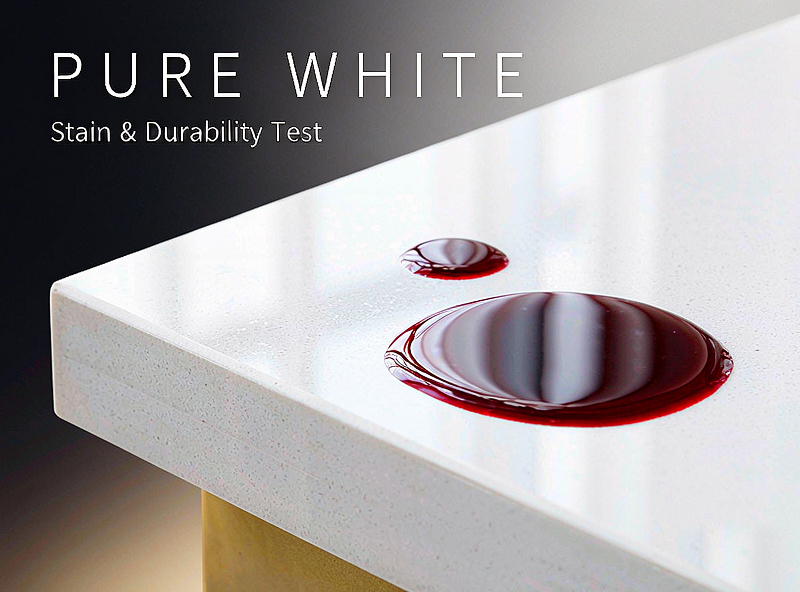
Pure white quartz under test: ten staining agents, 24- and 72-hour exposure, and the honest list of what white does not forgive.
Pure white quartz resists every ordinary kitchen stain — red wine, coffee, olive oil, and tomato all wiped clean with dish soap and water after 24 hours in our 2026 factory test — but it has three real failure modes: pigment-dense agents like turmeric and hair dye, sustained heat above 150°C, and the batch inconsistency and cheap-resin yellowing that show up on white more than on any other color. In the test below, ten staining agents sat on 20 mm polished pure white samples for 24 and 72 hours at 23±2°C and 50±5% RH; most came off with soap and water, four required a poultice, and one — a hot pan — was never about staining at all.
White is the color I get asked about most, and the color that generates the most disappointed emails. Not because it stains — the data says it barely does — but because buyers expect a seamless sheet of white and then notice a scorch ring, a visible seam, or a batch that reads creamier than the showroom sample. So this article does something different from a care guide: it publishes what our bench actually recorded, including the results that argue against white, and then hands you four tests you can run on a sample in the showroom this week. If a supplier will not let you run them, that is your answer.
TL;DR
- Ordinary kitchen stains do not penetrate pure white quartz: wine, coffee, olive oil, and tomato wiped clean with dish soap and water after 24 hours of contact.
- Pigment-dense agents are the exception — turmeric, beetroot, hair dye, and permanent marker needed a poultice after a full day, though all came back to a light trace rather than a permanent mark.
- Pure white quartz does not etch: lemon juice and vinegar left no dull patch after 15 minutes, because there is no calcite to dissolve.
- Heat is the dominant failure mode, since the resin binder softens above roughly 150°C and leaves a permanent scorch ring on an unpatterned white surface.
- Batch consistency and resin quality matter more on white than durability does — insist on the ASTM C97 result and a sample from the actual batch you are buying.
Why White Is the Hardest Color in the Factory
White quartz is difficult to make well for a reason that has nothing to do with stains: a white surface has no pigment to hide behind, so every small variation in quartz aggregate, resin clarity, and mixing time becomes visible as grey streaking, cloudiness, or a batch that leans cream instead of white. A dark or heavily veined slab absorbs those variations silently. White amplifies them.
That is why “pure white” is a manufacturing claim before it is a design choice. In our plant in Shuitou, white runs require tighter batching discipline, cleaner aggregate, and a clearer resin system than any other color family — and it is why the same nominal white from two suppliers can look noticeably different side by side. When buyers ask me which white to choose, my first answer is always the same: choose the batch you have actually seen.
A note on naming, because the industry muddies it. Pure white quartz contains no added veining and no visible pattern, while super white quartz carries grey or black veining against a white field; both are engineered surfaces, and the difference is design, not chemistry. This test covers the unpatterned end of the range — the one where any surface change has nowhere to hide.
How We Tested: Protocol and Conditions
The protocol was deliberately simple, because a stain test that needs a laboratory to reproduce is useless to a buyer. Twenty 20 mm polished samples from three production batches were conditioned for 48 hours, then each agent was applied in a measured 5 ml or 5 g dose and covered with a watch glass to prevent evaporation. Half the samples were cleaned at 24 hours, half at 72 hours. Cleaning followed a fixed sequence: dish soap and water first, a non-abrasive cream cleaner second, and a poultice third where residue remained. Because the sequence stops at the first step that works, the ratings show what a normal household can achieve without specialist products.
Ratings run from 0 to 4 and are defined as: 0 = wiped clean with soap and water; 1 = light trace after soap, lifted by a routine cleaner; 2 = visible mark, removed by poultice; 3 = faint shadow remains after poultice; 4 = permanent surface change. Absorption and hardness data were collected per the methods documented by ASTM C97 (absorption and bulk specific gravity) and ASTM C1353 (abrasion resistance), with flexural strength per ASTM C880.
The Stain Test: What Happened at 24 and 72 Hours
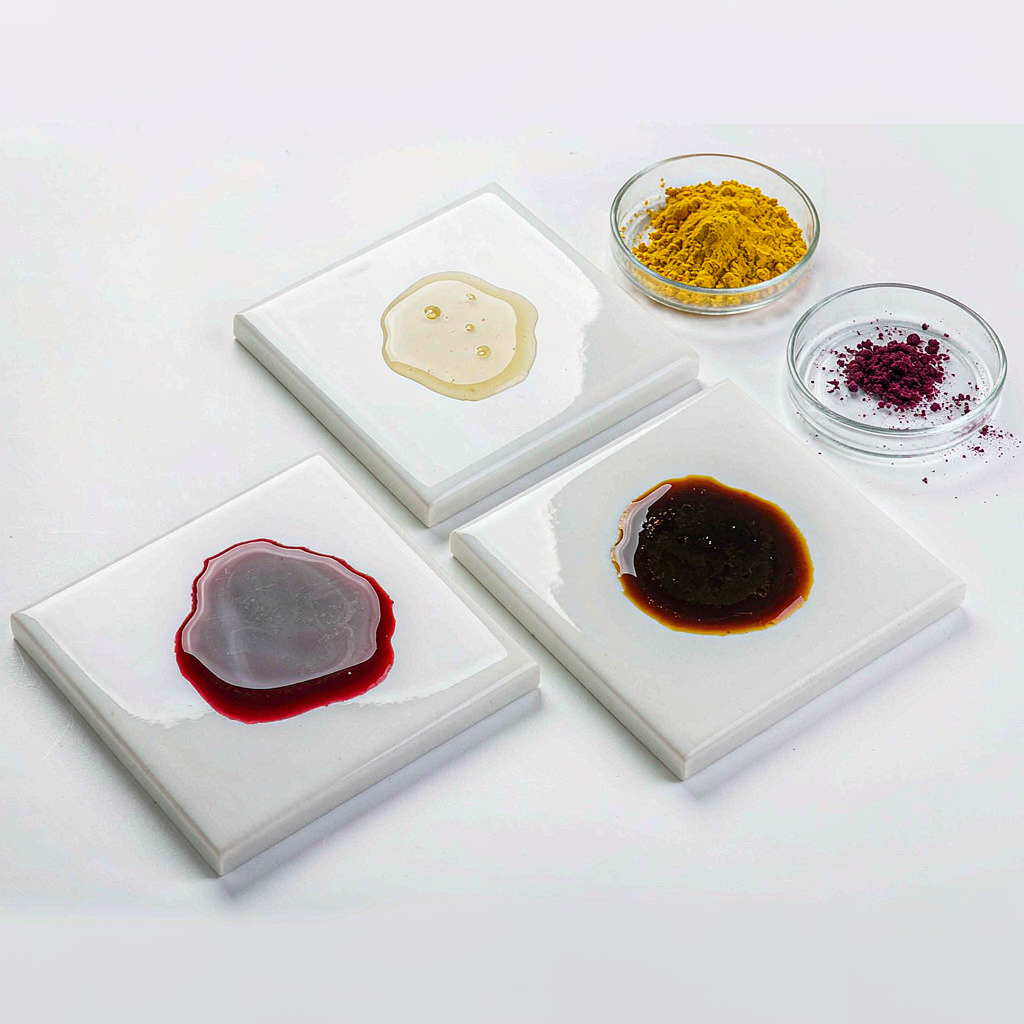
Here is the recorded result, unedited. Read the columns as a household would experience them — what happens when you clean the spill the same day, and what happens when you discover it the following morning.
| Staining agent | 24 h contact | 72 h contact | What finally removed it |
|---|---|---|---|
| Red wine | 0 | 1 | Soap and water; cream cleaner at 72 h |
| Espresso / strong tea | 0 | 1 | Soap and water; cream cleaner at 72 h |
| Olive oil | 0 | 0 | Soap and water |
| Tomato / ketchup | 0 | 1 | Soap and water; cream cleaner at 72 h |
| Lemon juice / vinegar | 0 | 0 | Soap and water — no etching at any duration |
| Beetroot | 1 | 2 | Cream cleaner; poultice at 72 h |
| Turmeric paste | 2 | 3 | Poultice — faint shadow survived 72 h |
| Hair dye | 1 | 2 | Cream cleaner; poultice at 72 h |
| Permanent marker | 2 | 3 | Isopropyl alcohol then poultice |
| Hot pan, 200°C for 10 min | 4 — permanent matte scorch ring | Not removable; surface rework required | |
Three things stand out. First, the household staples are a non-issue: wine, coffee, oil, and tomato never went past a light trace even after three days, which is what the sub-0.05% water absorption figure predicts — there is simply no pathway for liquid to enter a non-porous slab. Second, the acid test produced a clean zero, and that result separates engineered quartz from natural marble more decisively than any marketing claim: because pure white quartz contains no calcite, lemon juice and vinegar leave no etched dull patch, no matter how long they sit. Marble fails this test in minutes.
Third — and this is the honest part — pigmented, oil-based or finely dispersed agents behave differently. Turmeric at 72 hours left a faint shadow that persisted after poultice, and the permanent marker row is the one I would show any buyer who believes “nothing stains quartz.” Because a poultice works by drawing residue out of a porous structure, it removes most but not all of what a 72-hour turmeric or ink exposure leaves behind on white. The practical rule is not “clean it eventually” but “clean pigment within the day.”
The Durability Test: Scratches, Heat, Impact, and Light
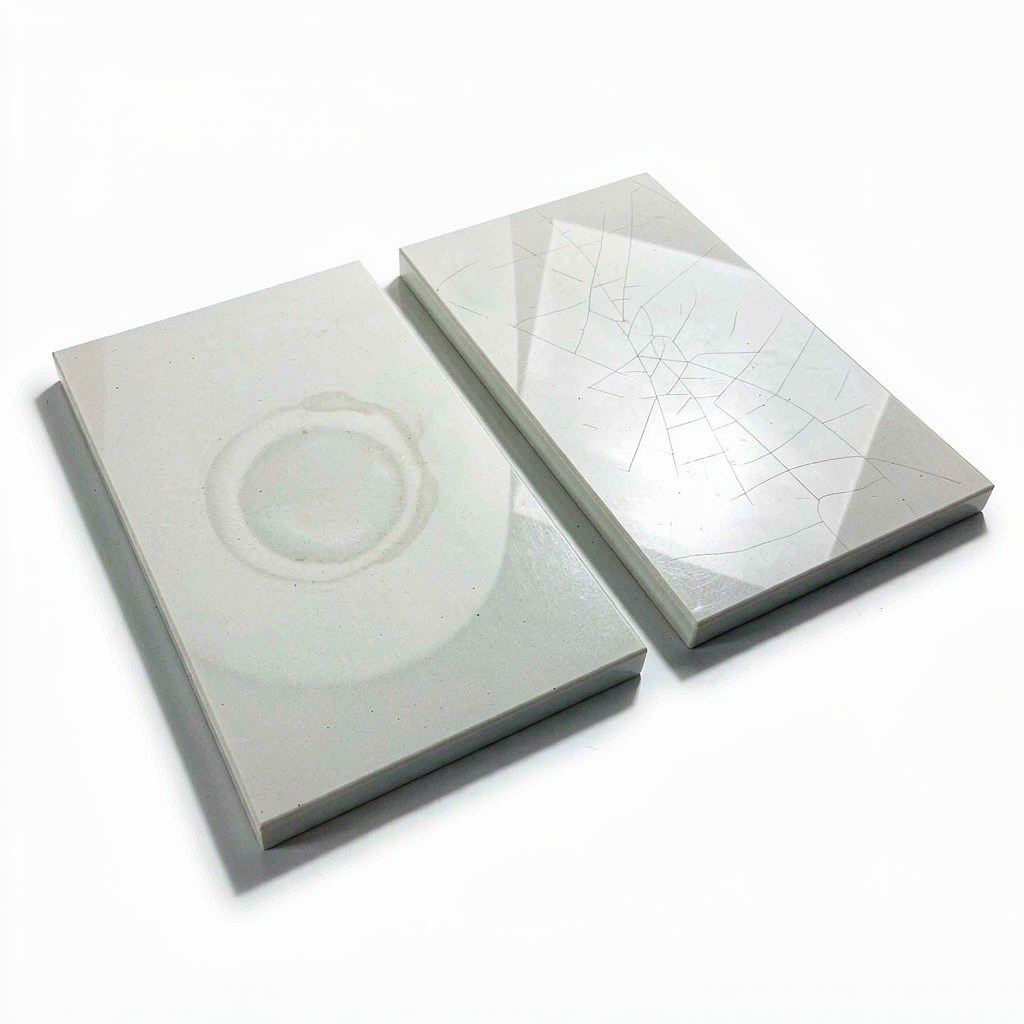
Durability data is less dramatic than the stain table but more consequential, because these are the failures that cannot be cleaned. Water absorption measured below 0.05% and flexural strength in the 40–50 MPa band, both consistent with what we publish for the series. Because the resin binder in engineered quartz softens above roughly 150°C, heat is the one household hazard that leaves a permanent mark on white — a matte ring or a yellowed scorch that no cleaner reaches. Our 200°C pan test produced exactly that, and it is the single most common cosmetic complaint we field on white surfaces.
Scratch performance is better than buyers expect and worse than the Mohs number suggests. Quartz-bound surfaces rate 6–7 on the Mohs scale, and the abrasion resistance measured by the ASTM C1353 rotary abraser method is excellent for kitchen duty — knives drawn across the surface, ceramic plates, and the general traffic of cooking leave no measurable wear. Fine hairlines do appear over years, and on a uniform white field they are more noticeable than they would be on a veined or dark slab, because there is no pattern to camouflage them. A mild abrasive cream polish removes most of them.
Impact behaves the way brittle stone behaves: the face is tough, the edges are not. Chips cluster at the sink cut-out, at overhang corners, and anywhere the slab meets a cabinet line. A bullnose or eased edge profile distributes that load better than a sharp square edge, which is worth specifying on white islands where the corner is the most exposed part of the whole kitchen. On color stability, accelerated UV exposure of 1000 hours kept our pure white series within Delta E 1.5, while Natural Stone Institute guidance on stone performance and our own service records both underline the same point: resin quality, not the white pigment, decides whether a white slab stays white.
Where Pure White Genuinely Falls Short
I would rather lose a sale than have a customer discover these later, so here is the case against white, written plainly.
Heat damage is permanent and visually amplified — a scorch on a grey or veined slab reads as a shadow; on pure white it reads as a defect. Seams are more visible on white than on any other color, because a bright, uniform field makes even a well-executed adhesive line traceable under raking light, which is why large islands benefit from book-matched or oversized slab planning. Fine scratches and water spotting show more readily, so a white kitchen rewards a slightly stricter cleaning habit than a busy speckled pattern does. And the low end of the white market is where cheap resin and inconsistent aggregate concentrate, which is exactly where the yellowing complaints come from. Because white offers no texture to absorb imperfection, the quality gap between a premium and an economy white slab is wider than the price gap between them.
The Five-Minute Test You Can Run in the Showroom
You do not need our bench to judge a white slab. Take a sample and do these four things, in this order:
- Turmeric-and-oil paste for ten minutes. Mix a pinch of turmeric with a few drops of cooking oil, apply, wait ten minutes, wipe with soap and water. A slab that resists this will handle your kitchen; a slab that shadows here belongs in a low-pigment environment.
- Vinegar for fifteen minutes. Any dull patch left behind means you are looking at calcium carbonate or natural marble, not quartz — an etch that no cleaner can remove is a lifetime commitment.
- Coin drawn at 30 degrees across the face. A copper coin slides without cutting a quality quartz surface; if it leaves a bright scratch line, the resin matrix is weak or the polish is thin.
- Seam and batch check under raking light. Ask to see two slabs from the same batch lit at a low angle, and ask for the batch’s ASTM C97 absorption figure. On white, tone matching between slabs is the specification that protects your project — and it is the one most buyers never think to verify.
Because all four tests use nothing but a sample, a coin, vinegar, and five minutes, there is no reason to accept a white slab on brochure evidence alone. Our own quality control process runs batch testing on every production run precisely so that buyers can audit rather than trust, and the same tests travel with our samples.
Which White Should You Actually Buy?
The test results only matter once they meet your room. The table below is the guidance I give buyers who are choosing between the whites rather than between brands.
| White type | Appearance | Best for | Watch out for |
|---|---|---|---|
| Pure white | Uniform, no veining | Minimalist kitchens, small or dark rooms that need reflectance | Seams, scorch marks and fine scratches have nowhere to hide |
| Super white | White field with grey or black veining | Large kitchens and islands where pattern breaks up a big surface | Vein alignment across seams on long runs |
| Warm or cream white | Soft, low-contrast, warmer tone | North-facing rooms, wood cabinetry, softer palettes | Tone shifts between batches are harder to match |
| Marble-look white | Dramatic veining, printed or blended | Statement islands and feature walls | Requires vein matching and book-match planning |
Our pure white and super white series are produced as a matched family, which is why we can support projects that mix an unpatterned perimeter with a veined island without a tone clash — you can browse that range at pure white and super white quartz, or see how a full unpatterned white kitchen comes together in the pure white kitchen application.
Frequently Asked Questions
What the Test Data Really Says About White
Pure white quartz loses almost nothing on stain resistance and gives up visible ground only on heat, seams, and cosmetic scratches — so if you want the white, the decision to make is not “is white durable enough” but “will the resin and the batch behind this slab hold up.” Ask for the absorption figure, run the turmeric test, look at two slabs under raking light, and buy the batch you approved. Everything else in this article follows from those four habits.
Apex Quartz Stone has manufactured engineered stone since 1997 from a 40,000 m² facility in Shuitou, Nan’an, producing more than 100,000 slabs a year for buyers in over 20 countries. If you want the full test report or a matched white sample set for your project, send us your dimensions and we will return the batch documentation with the slabs — you can reach the team through our engineered quartz stone range or by requesting a sample pack directly.
Post time: Sep-21-2026