
By Yvonne Deng
Engineered stone changed kitchens twice: once when it made quartz countertops affordable and consistent, and again when regulators discovered what cutting that stone was doing to the people who fabricate it. Traditional engineered quartz is roughly 90–95% crystalline silica by weight — the same mineral that, inhaled as respirable dust over years of dry cutting and polishing, scars lung tissue irreversibly. Australia’s response was the sharpest in the world: from July 1, 2024, engineered stone containing more than 1% crystalline silica cannot be supplied, manufactured, or installed anywhere in the country. That single number turned silica content from a health-and-safety footnote into a line item on every specification sheet.
Non Silica Pinted Stone is an engineered surface that removes crystalline silica from the slab entirely — replacing it with calcium-carbonate and alumina-trihydrate mineral fillers bound in polymer resin — while keeping the marble-look aesthetics, the 5–6 Mohs hardness, and the standard-tooling workability that buyers specify engineered stone for, which makes it both the safest surface in the fabrication chain and the most future-proof line on a spec sheet as silica regulations tighten worldwide. This guide covers what the material is, what factory testing actually shows, why the economics favor it earlier than most buyers expect, and — the section most guides skip — how to verify that a “non-silica” claim is real before you commit a project to it.
TL;DR
- Zero crystalline silica — verified by XRF batch analysis — removes the silicosis hazard from fabrication rather than managing it with dust suppression.
- Factory-tested performance holds within engineering distance of traditional quartz: Mohs 5–6, water absorption below 0.05%, heat resistance to 180°C, flexural strength 35–45 MPa.
- Australia banned engineered stone above 1% silica from July 1, 2024, and regulators in the US and EU are moving in the same direction — silica content is now a procurement question, not a chemistry footnote.
- Raw material costs roughly 8–12% more than quartz, but total project cost frequently lands 15–25% lower because fabrication needs no silica-specific suppression equipment or compliance overhead.
- Verification is a five-step checklist: XRF batch data, ASTM-format test reports, third-party sample testing, batch cards, and a live factory walkthrough.
The Problem in One Number: Why Silica Content Became the Spec That Matters
The hazard is old and well documented. Crystalline silica is classified as Group 1 — carcinogenic to humans — in the IARC Monographs, and the American Lung Association describes silicosis as a progressive, disabling pulmonary fibrosis with no cure, preventable only by preventing the exposure itself. A finished quartz countertop in a home is inert and safe; the risk is concentrated at the saw, the router, and the polisher, where dry fabrication converts a slab into respirable dust. In the US, OSHA maintains dedicated crystalline silica standards that have progressively tightened exposure limits and mandated wet-cutting and extraction controls — each control adding cost and complexity to the fabrication stage.
Because every control regime manages the hazard rather than removing it, the material that eliminates silica outright changes the compliance question itself: a 0% silica slab cannot generate silica dust, no matter how it is cut. The regulatory timeline shows why that matters commercially as well as ethically:
| Region | Regulatory status | Effective |
|---|---|---|
| Australia | Ban on supply, manufacture, and installation of engineered stone above 1% crystalline silica | July 1, 2024 |
| United States (federal) | OSHA silica standards tightened; proposed rulemaking on engineered stone under review | Active / pending |
| California | Proposition 65 warning requirements for silica exposure | Active |
| European Union | REACH restriction process covering engineered stone silica content under evaluation | Under evaluation |
What Non Silica Pinted Stone Is: Composition and Manufacturing
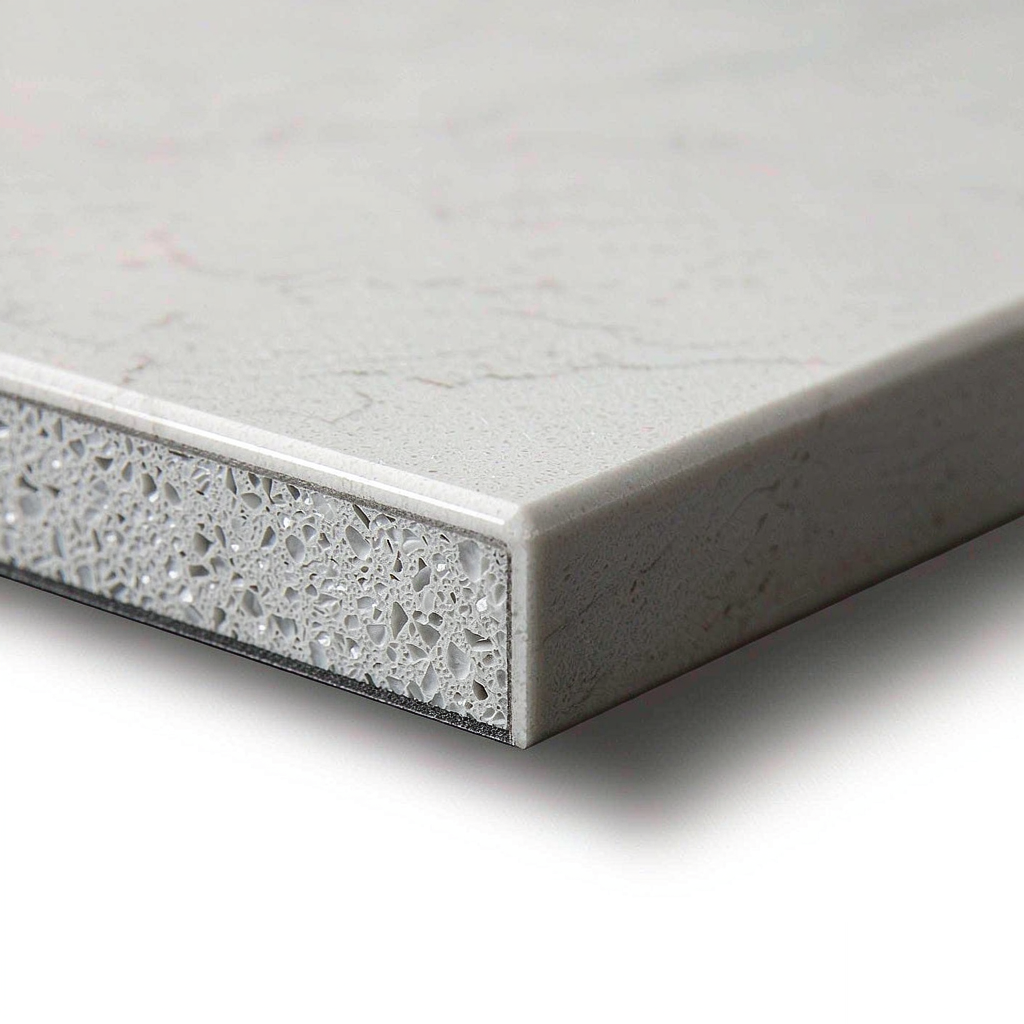
Non Silica Pinted Stone is built the way all engineered surfaces are built — minerals bound by resin — but the mineral package is chosen to exclude crystalline silica from the ground up. The structural core is a blend of non-silica fillers, primarily calcium carbonate and alumina trihydrate (ATH), which supply hardness and body; high-performance polymer resins bind the blend into a non-porous, homogeneous slab; and the surface aesthetic — the marble looks buyers expect — is applied through high-definition 3D digital printing rather than depending on the color of the mineral package itself. A UV-cured protective finish locks the printed pattern in and supplies scratch and stain resistance.
| Layer | Share of composition | Function |
|---|---|---|
| Non-silica mineral fillers (calcium carbonate, ATH) | 65–75% | Structural integrity, hardness, dimensional stability |
| High-performance polymer resins | 25–35% | Binding, non-porosity, flexural strength |
| 3D digital printed pattern | Surface layer | Marble-look veining and color, series-repeatable |
| UV-cured protective finish | Topcoat | Scratch resistance, stain protection, UV stability |
Because the fillers contain no crystalline silica, the hazard is removed at the formulation stage rather than controlled at the fabrication stage — which is the entire difference between a safer workflow and a changed material reality for the shop that cuts the slab. The printed construction also carries a specification benefit carried over from our 3D printed quartz slab technology: patterns repeat within a series, so multi-slab and multi-unit projects keep veining coherent across seams and shipments.
The Test Data: What Factory Verification Actually Shows
Claims about silica-free surfaces are only as good as the test reports behind them, so the table below is the data we produce for our own production batches, with the traditional quartz benchmarks alongside:
| Property | Non Silica Pinted Stone | Traditional quartz | Test basis |
|---|---|---|---|
| Crystalline silica content | 0% | 90–95% | XRF analysis |
| Mohs hardness | 5–6 | 6–7 | ASTM C1353 |
| Water absorption | <0.05% | <0.05% | ASTM C97 |
| Density | 2.2–2.4 g/cm³ | 2.3–2.5 g/cm³ | ASTM C97 |
| Heat resistance | Up to 180°C | Up to 200°C | ASTM C484 |
| Flexural strength | 35–45 MPa | 40–50 MPa | ASTM C880 |
Read honestly, the data says: near parity with small, known trade-offs. The roughly one-point Mohs difference against quartz is real but sits below the threshold of what ordinary use — knife slides, keys, ceramic plates, daily cleaning — can detect. Water absorption below 0.05% means the surface is non-porous in practical terms, with the same stain resistance and hygiene profile that made engineered stone popular. Heat resistance to 180°C covers routine kitchen contact, with trivets remaining good practice exactly as they are on quartz.
The Fabrication Dividend: Why the Shop Cares as Much as the Owner
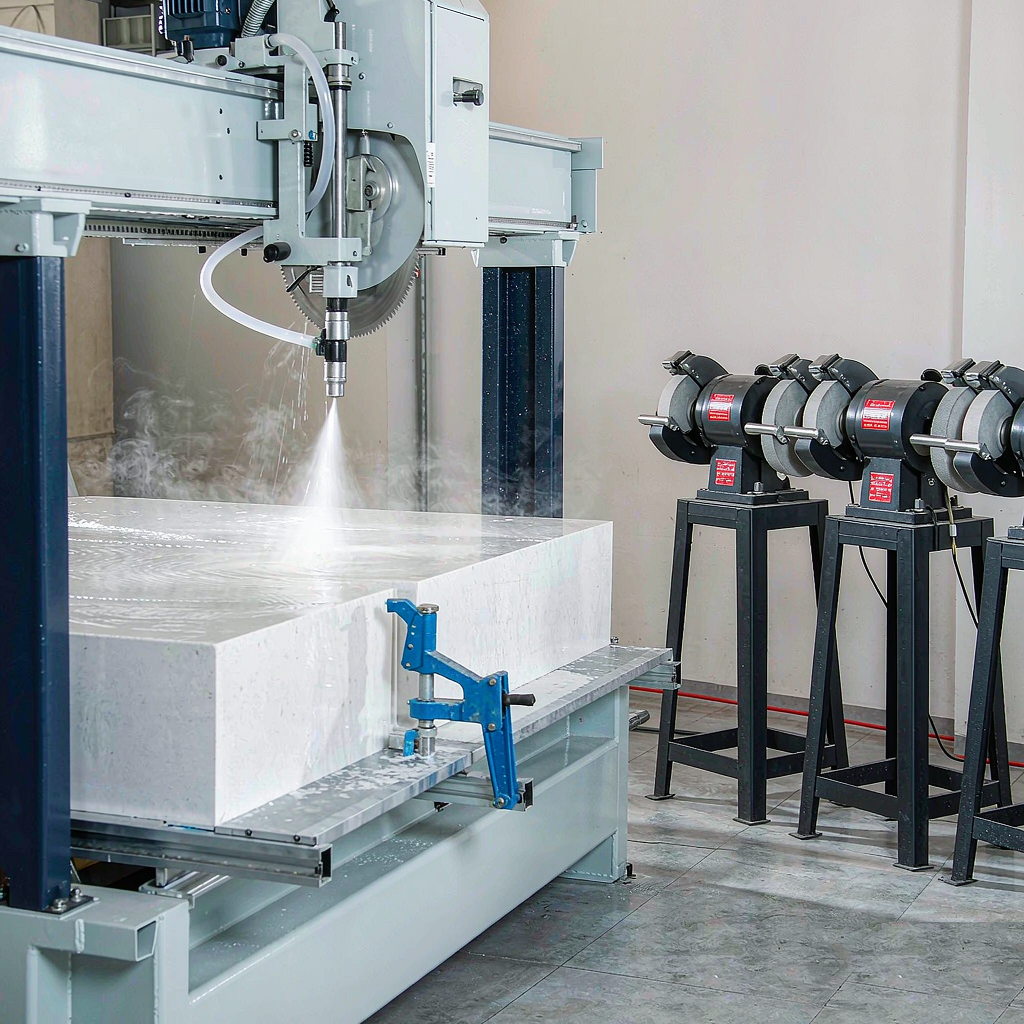
The economics of the material invert at the fabrication stage. Raw slabs cost roughly 8–12% more than traditional quartz, because engineered non-silica mineral systems are more expensive than abundant crystalline silica. But the fabrication chain that cuts those slabs no longer needs the apparatus that silica demands: no silica-specific dust suppression installations, no wet-cutting mandates tied to silica standards, no respirator programs designed around a carcinogen, and lower compliance overhead per project. Across realistic projects, that flips the total: because the shop’s silica-driven costs disappear from the chain, total project cost frequently lands 15–25% below the traditional quartz equivalent, despite the higher slab price.
For fabricators in jurisdictions that have already tightened — or banned — the arithmetic is even more direct. A shop cutting 0% silica slabs is not managing a regulatory risk; it has deleted the risk from its workflow. Insurance, audit preparation, and the growing requirement to document dust control on commercial projects all simplify at once.
Where to Spec It: Applications
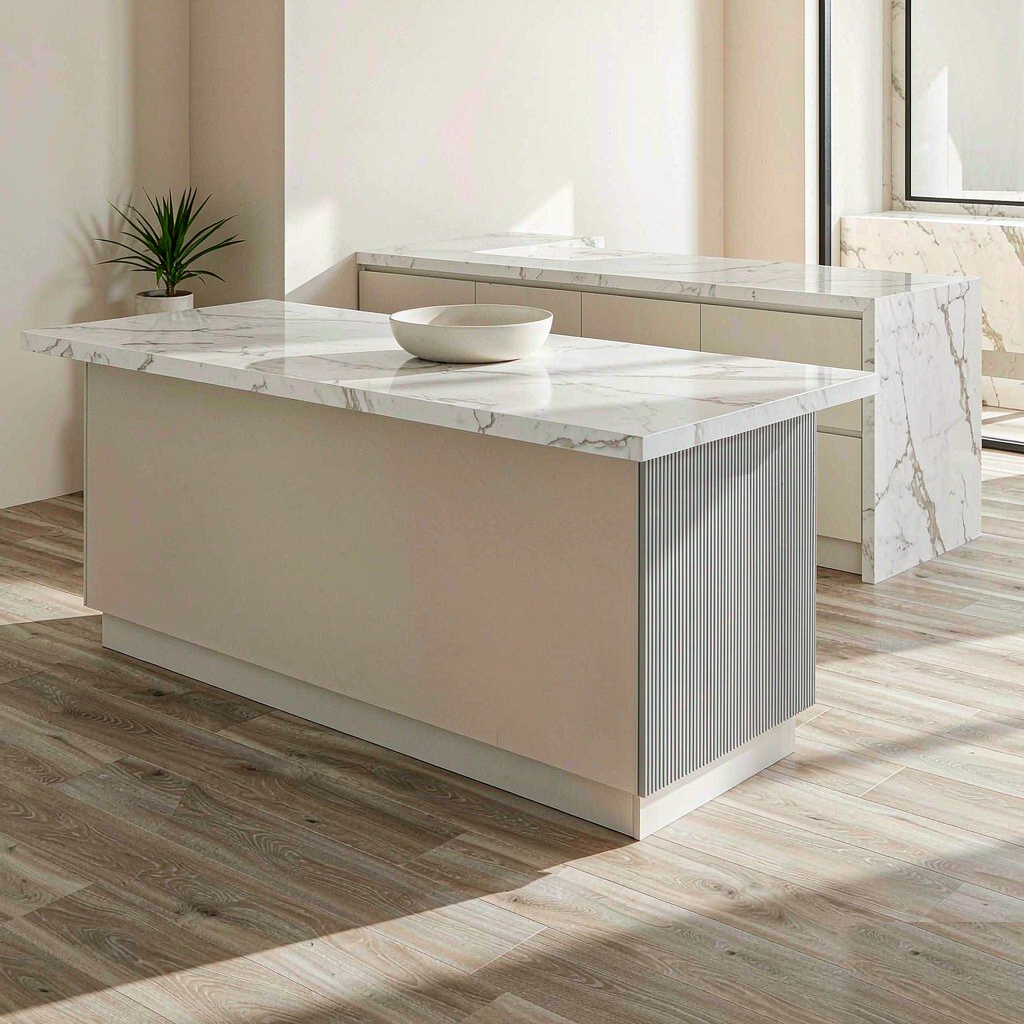
The application map mirrors engineered quartz, with the interior-use caveat noted below. In residential work the material covers kitchen countertops, bathroom vanities, tabletops, and fireplace surrounds — the 180°C heat tolerance handles hot cookware contact with normal trivet practice. In commercial work, the non-porous, low-maintenance profile suits healthcare facilities, education, hospitality, and corporate interiors, and the printed pattern repeat matters wherever multiple units must match. Standard slab format is 3200 × 1600 mm with thickness options of 12, 15, 18, 20, and 30 mm, in polished or honed finishes.
Because the surface is a printed system, designers gain a range that natural material economics cannot offer — marble looks from soft Carrara-style greys to high-contrast statement veining, all in one performance envelope. The material is primarily interior-rated: the UV-cured finish resists fading, but prolonged uncovered exterior exposure is a technical-team conversation, not a default specification.
How to Verify a “Non-Silica” Claim Before You Buy
“Silica-free” is now a marketing phrase, which means verification is now a procurement skill. Whether you are buying from us or from anyone else, run the same five checks:
- Demand batch-level XRF analysis. The claim lives or dies on instrument data, not brochures — ask for the actual XRF report for the production batch you are buying, not a generic certificate.
- Require ASTM-format test reports. Hardness, water absorption, density, and flexural strength should arrive as test results against recognized methods (ASTM C97, C880, C1353), tied to the product series you are specifying.
- Test a physical sample independently. For volume commitments, send a slab sample to a third-party laboratory and verify the silica figure yourself.
- Check the batch card system. A manufacturer who controls composition will have batch traceability; ask how a specific container maps back to production records.
- Walk the line, live. Serious suppliers will run a real-time video walkthrough of production and quality control — the same way our own team hosts factory audits from Shuitou for buyers in the 20+ countries we serve.
Because every one of these checks is documentation a real manufacturer already possesses, a supplier who stalls on any of them has answered your most important question.
Frequently Asked Questions
The Short Version of the Future
Non Silica Pinted Stone is engineered stone with its one structural flaw engineered out: the same look, the same daily performance, and standard-tooling fabrication — minus the mineral that cost an industry its health and, jurisdiction by jurisdiction, its license to operate. The buyers moving to it now are not making a sacrifice; they are making the specification the market is converging on. To see the full range, request XRF batch data and test reports, or discuss a project specification, start at the non-silica quartz collection — our team responds with documentation, not promises.
Post time: Sep-18-2026