
By Alex Wang | International Business Director, Apex Quartz Stone | October 20, 2026 | Reading Time: 13 min
A low silica quartz slab is a slab formulated with roughly 5–20% crystalline silica by weight instead of the 85–95% that conventional engineered quartz carries — and in one major market that is no longer a marketing preference but a legal boundary. Since 1 July 2024, Australia has prohibited the manufacture, supply, processing and installation of engineered stone benchtops, panels and slabs containing at least 1% crystalline silica by weight, and since 1 January 2025 those same products have been prohibited imports under regulation 5M of the Customs (Prohibited Imports) Regulations 1956, as summarised by Safe Work Australia. The United States and the United Kingdom took the other road: they regulate the dust, not the slab. OSHA’s permissible exposure limit for respirable crystalline silica is 50 µg/m³ as an eight-hour time-weighted average, with an action level of 25 µg/m³ (29 CFR 1910.1053).
Those two philosophies explain almost everything that has happened to quartz slab range planning since 2024. Because Australia wrote its rule as a product threshold in weight-for-weight percentage, formulators had to change the aggregate — not just the ventilation — which is why low-silica slabs look, feel and price differently from the classic Calacatta look. This article is the briefing I now give to distributors before they build a 2027 range: the timeline, what the numbers actually measure, who carries the duty in each market, how to verify a claim before you load, and where low-silica still loses.
TL;DR
- Two rules now run in parallel: Australia bans engineered stone benchtops, panels and slabs at or above 1% crystalline silica by weight, while the US and UK limit airborne exposure to 50 µg/m³ over eight hours.
- “Low silica” has no legal definition outside Australia and usually means 5–20% crystalline silica, so a slab described as low silica can still be illegal in Sydney.
- A “silica-free” or non-silica product sits below 1% crystalline silica and is the only band that clears the Australian prohibition without an exemption.
- Indicative premium for low-silica formulations is 10–25% over a comparable conventional SKU, widening to 30% or more below 1% and in small quantities.
- Verification is documentary, not verbal: a batch-specific certificate naming crystalline silica by weight, the test method, the laboratory and the report date is the only claim worth accepting.
What Changed, and When: A Regulatory Timeline
The transition did not arrive as one law; it arrived as a sequence of decisions that each moved a different lever, and different markets now sit at different points on it. Below is the version I keep on one page for distributors, ordered by the date that affects a purchase order.
| Date | What happened | Practical effect on buyers |
|---|---|---|
| December 2023 | Australian work health and safety ministers unanimously agreed to prohibit engineered stone benchtops, panels and slabs from 1 July 2024, with a transition period for contracts signed on or before 31 December 2023. | Range planning for Australia had roughly six months to change. |
| 1 July 2024 | The prohibition commenced across the Commonwealth and all states and territories, covering manufacture, supply, processing and installation of products containing at least 1% crystalline silica by weight. | Any Australian-bound slab above 1% became unsaleable, regardless of shop controls. |
| 2024 (UK) | The Health and Safety Executive strengthened its engineered stone messaging after deaths of young workers in Great Britain, and published updated employee guidance on silica control (INDG463, 2024). | UK demand for low-silica alternatives began to move ahead of any statutory ban. |
| 1 January 2025 | Engineered stone benchtops, panels and slabs became prohibited imports into Australia under regulation 5M of the Customs (Prohibited Imports) Regulations 1956. | The enforcement point moved offshore: the shipment itself is now the risk. |
| February 2026 | NIOSH and OSHA jointly reissued the hazard alert on worker exposure to silica during countertop manufacturing, finishing and installation (DHHS Publication 2026-101). | US fabricators got a fresh, citable control hierarchy to implement. |
| 2026 onward | Buyer documentation norms harden: silica declarations move from “on request” to “standard attachment” in public tenders and healthcare projects. | Suppliers without batch-level test data lose bids on paperwork, not price. |
Two details in that table are routinely misread, and both cost money. The first is the scope: the Australian prohibition is drafted around a product form — benchtops, panels and slabs — so a finished engineered stone object such as a sink or a garden ornament is outside it, while the same material cut as a 3,200 × 1,600 mm slab is inside it. The second is the legacy carve-out: controlled work on already-installed stone — removal, repair, minor modification or disposal — remains lawful, but the work health and safety regulator must be notified before the work starts. That is not a loophole for new supply, and any distributor presenting it as one is a counterparty to walk away from.
What Does “Low Silica” Actually Measure?
It measures crystalline silica specifically, and this is the single most common source of confusion in the whole conversation. Silica as an element of chemistry is silicon dioxide, and a slab can contain a great deal of silicon dioxide that is not crystalline quartz — amorphous silica, feldspar-derived silicates, glass frit. Regulation is written against crystalline silica because it is the crystalline polymorphs — quartz, cristobalite and tridymite — that generate the respirable particles linked to silicosis, which is the distinction OSHA’s definition turns on and the distinction a certificate must state explicitly.
In the market, three bands have settled out. They overlap at the edges and no two suppliers draw the lines in exactly the same place, but the pricing and the compliance consequences behave consistently:
| Band | Crystalline silica (w/w) | Australian status | Indicative FOB premium |
|---|---|---|---|
| Conventional engineered quartz | 85–95% | Prohibited | Baseline |
| Low silica quartz | Roughly 5–20% | Prohibited unless an exemption applies | +10–25% |
| Non-silica / silica-free | Typically under 0.5%, always under 1% | Outside the prohibition | +20–30%, wider on small runs |
Read the third column twice, because it is where projects fail. A slab at 8% crystalline silica is low silica by any honest description, and it is still prohibited in Australia, because the threshold is 1% and not 10%. The percentage that matters is the one on the certificate, not the one on the brochure.
Why the 1% Line Redraws the Product Map
Because the Australian rule is a compositional threshold rather than a dust-control target, the only way to comply is to remove quartz from the formulation — and quartz is precisely the ingredient that gives engineered stone its best-known optical properties. Quartz aggregate is hard (7 on the Mohs scale), dense, and translucent at the edges; that translucency is what makes a deep grey vein read as depth rather than as a printed stripe. Replace most of it with feldspar, alumina trihydrate or glass frit and the slab still presses, polishes and wears well, but the light behaves differently.
Three consequences follow, and every one of them shows up in a 2026 price list:
- The palette narrows at the top end. Dense opaque whites, fine-grain speckles and marble-inspired patterns translate convincingly. The deep, luminous, book-matched Calacatta effects are harder, and the best of them remain in the high-silica band.
- Batches drift more. Non-quartz aggregates vary more between lots than a tightly graded quartz sand does, so color control needs more frequent correction and the reject rate rises. That cost is real and it lands in the price.
- Fabrication behaviour changes. Softer aggregate chips differently at an edge and polishes faster, which alters feed rates and edge-profile tooling.
The result is not one market but two overlapping ones. Distributors in Australia now buy a compliant range for domestic work and a conventional range for export or for non-benchtop products, and the two are priced, stocked and templated separately. Because a single production line cannot switch aggregate families cheaply, minimum order quantities for a sub-1% color are typically higher than for a conventional one — often a full container rather than a part load, which is the hidden cost that surprises first-time buyers more than the unit price.
Who Carries the Duty: Fabricator, Importer, or Specifier?
The duty lands in a different place in each market, and the differences decide which documents you need to hold. In Australia the duty attaches to the person conducting a business or undertaking that manufactures, supplies, processes or installs the prohibited product, which in practice captures the importer and the fabricator, and increasingly the specifier who names a product in a tender. In the United States the duty attaches to the employer whose workers breathe the dust, under a standard built around exposure assessment, engineering controls, a written exposure control plan and medical surveillance. In the United Kingdom the mechanism is COSHH assessment, with the same logic: control the exposure.
| Market | Regulatory mechanism | Who is exposed | Evidence to hold |
|---|---|---|---|
| Australia | Product prohibition, at or above 1% crystalline silica by weight, plus prohibited import | Importer, supplier, fabricator, installer; specifier at risk contractually | Batch certificate below 1%, supplier written declaration, customs documentation |
| United States | Exposure limit of 50 µg/m³ eight-hour TWA, action level 25 µg/m³; engineering controls since 23 June 2021 | Fabrication employer; downstream customers via indemnity and insurance | Exposure monitoring records, written exposure control plan, training and medical surveillance records |
| United Kingdom | COSHH assessment and control of exposure, with HSE guidance INDG463 (2024) | Employer; principal contractor on site work | COSHH assessment, LEV inspection records, health surveillance where required |
That table contains the most useful strategic insight in this article. The United States does not ban high-silica quartz; it requires you to prove you controlled the dust — so a US fabricator with excellent controls is fully compliant on a 93% slab, while an Australian fabricator with perfect controls is committing an offence on the same slab. Same material, opposite outcome, and the reason is philosophical: one regime regulates the product, the other regulates the process. If you export to both, you need two SKU logics, not one compromise.
There is a further shift worth noticing: even where the law regulates dust rather than product, procurement has begun regulating product anyway. Hospital groups, school districts and several large developers now write sub-1% crystalline silica into specifications, because substitution is the first-ranked control in the NIOSH and OSHA hazard hierarchy, and a declaration is easier to audit than a ventilation system.
How Do You Verify a Low-Silica Claim Before You Buy?
You verify it with paperwork that names a number, a method, a laboratory and a date — and you verify it per batch, not per product family. Five checks cover almost every failure mode I have seen:
- Ask for crystalline silica by weight, not “silica”. If the reply says “silica content”, reply again and ask for the crystalline fraction. This one question separates technical suppliers from traders.
- Require the test method. X-ray diffraction against a recognised method such as NIOSH 7500 is the credible route for crystalline content; infrared against NIOSH 7602 is also accepted. “Internal laboratory” without a method is not evidence.
- Insist the certificate is batch-specific and dated. A type test from 2023 tells you what a development batch contained, not what is on the water today. Batch traceability is also what lets you defend a shipment if a regulator samples it.
- Match the number to the destination threshold. Under 10% clears a tender preference; under 1% clears Australia. Choosing a slab by the wrong threshold is the most expensive paperwork error in this category.
- Test one slab from your own container. Independent verification of a single slab typically costs a few hundred dollars and settles the argument permanently. On a first Australian shipment it is not optional in my view.
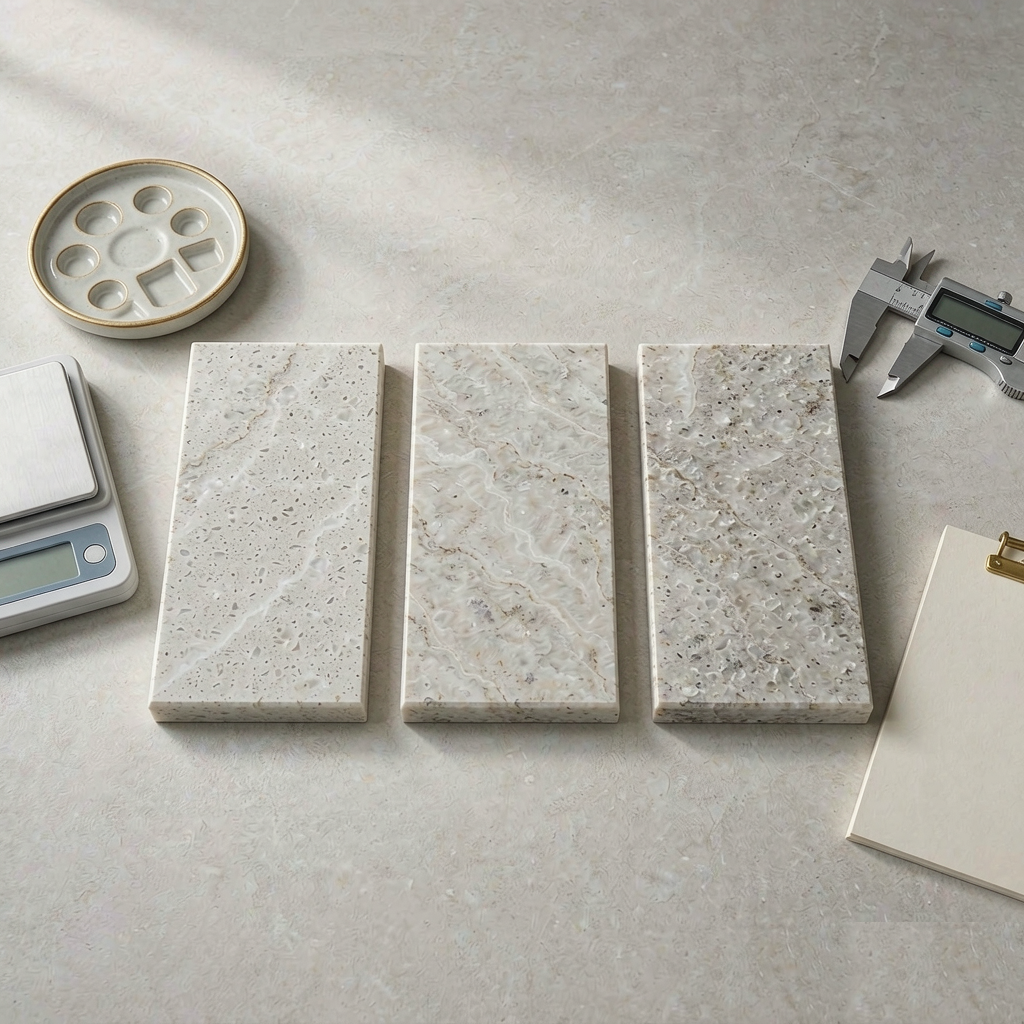
The direction of travel in enquiry patterns is unambiguous. In our own export desk, the share of first-time enquiries that asked for a written crystalline silica figure with the quotation moved from roughly 5% of enquiries in 2024 to roughly 30% in January–September 2026, and the share that asked specifically about the Australian threshold went from near zero to about one in eight. This is a desk-level observation rather than a controlled survey, but the shape of it matches what distributors report independently: the question has moved from the technical team to the purchasing team.
Where Low-Silica Slabs Still Lose
They lose on three fronts, and a supplier who will not say so is not worth the meeting. The first is price: a 10–25% premium at the low-silica band and 30% or more below 1%, before the higher minimum order quantity is counted. The second is design range: the very deepest translucent Calacatta effects remain easier in the high-silica band, so a design-led project may legitimately choose a conventional slab and control the dust rather than change the material. The third is schedule: sub-1% colors are made less often, so a replacement slab in three weeks is a normal request in the high-silica band and an optimistic one below 1%.
There is also a category error to avoid. Low silica reduces the hazard at source; it does not make dust harmless, and it does not remove the fabricator’s duty to control it. HSE’s 2024 employee guidance is blunt that respirable crystalline silica is too fine to see in normal lighting, which is exactly why control measures cannot be judged by eye. And a slab at 8% still generates respirable dust when it is cut, so wet methods, on-tool extraction, local exhaust ventilation and respiratory protection remain the compliance mechanism in every market that regulates exposure.
What low silica does buy is optionality: it keeps an Australian channel open, wins tender points in institutional work, and hedges against the next move elsewhere. That is where the honest uncertainty sits — nobody can tell you whether the European Union, the United Kingdom or individual US states will adopt a product threshold, only that the direction of regulation has been one-way since 2023.
What to Put in Your Next Specification
Specify by destination and by purpose, and write the number into the purchase order rather than into a conversation:
- Shipping to Australia: specify “crystalline silica below 1% by weight, verified by XRD per batch, certificate with shipment”. Anything above 1% is not a negotiation, it is a customs event.
- Shipping to the US or UK: a conventional high-silica slab remains lawful; specify the exposure controls instead — wet cutting, on-tool extraction and a written exposure control plan — and hold the records.
- Institutional or healthcare projects anywhere: write a sub-1% or low-silica preference into the specification, because procurement will ask for it and the substitution control is the easiest one to evidence.
- Design-led projects in non-Australian markets: choose the slab the design needs, then document the controls; do not trade a Calacatta effect for a compliance badge the project does not require.
- Any first order in a new band: buy a paid sample, test it independently, and keep the report. It becomes the reference document for every later batch.
That is the whole discipline, and it is mostly paperwork. At Apex Quartz Stone we have pressed, polished and shipped engineered quartz since 1997 from a 40,000 m² plant in Shuitou that produces more than 100,000 slabs a year, and the change since 2024 has not been in the press — it has been in what buyers ask us to prove. Our non-silica quartz slab range is the option for buyers whose destination or tender calls for a sub-1% product, and our quartz slab quality control records are what travel with it. If you are building a two-band range for 2027, request a low-silica quartz slab quotation with your destination markets and we will tell you which SKUs can legally land there — including the ones that cannot.
Regulatory Questions Buyers Keep Asking
Read the Certificate, Not the Brochure
The stone industry has spent two decades arguing about how a slab looks. Since 2024 a second argument runs alongside it, about what a slab contains — and unlike aesthetics, that one has a binary answer written into law in at least one market. The suppliers who will still be selling into Australia in 2030 are the ones who can hand you a dated, method-specific, batch-level number today, and the buyers who avoid expensive mistakes are the ones who ask for it before the deposit rather than after the container.
If you want to check where a current range sits, send one slab reference per color with your destination markets — we will say plainly when the answer is “this one cannot ship there”, which is a cheaper conversation than a customs hold.
Alex Wang
Alex Wang leads international business development at Quanzhou APEX Co., Ltd. (Apex Quartz Stone), an engineered quartz manufacturer founded in 1997 in Shuitou Town, Nan’an, Quanzhou, Fujian, China. The company operates a 40,000 m² production facility with an annual output of more than 100,000 quartz slabs, exporting to over 20 countries, and has supplied both conventional and non-silica engineered surfaces through the regulatory changes of 2024–2026.
Post time: Oct-20-2026