
By Yvonne Deng
International Sales Director, Apex Quartz Stone | 12+ Years in Engineered Stone Manufacturing
linkedin.com/in/yvonne-deng-5b35b543/
Company Background and Industry Experience
Founded in 1997, Quanzhou Apex Co., Ltd has been part of the stone industry for nearly three decades. The company transitioned from natural stone processing to engineered quartz manufacturing as the market shifted toward more durable and consistent surfacing materials. This background gives Apex a deeper understanding of stone behavior at the geological level than many newer quartz-only manufacturers.
The company maintains its own quartz quarry, which provides raw material independence that few competitors can match. Having direct control over quartz aggregate sourcing means Apex can maintain consistent quality across production batches. Importers who work with manufacturers dependent on third-party quartz suppliers often face color variations when the supplier changes sources. Apex avoids this issue entirely.
Apex operates with a team of experienced engineers and production technicians who have been in the stone industry for 10-25 years. This depth of experience shows in the consistency of the finished product and the factory’s ability to handle complex custom orders. Learn more about the company’s history and capabilities on the About Apex Quartz Stone page.
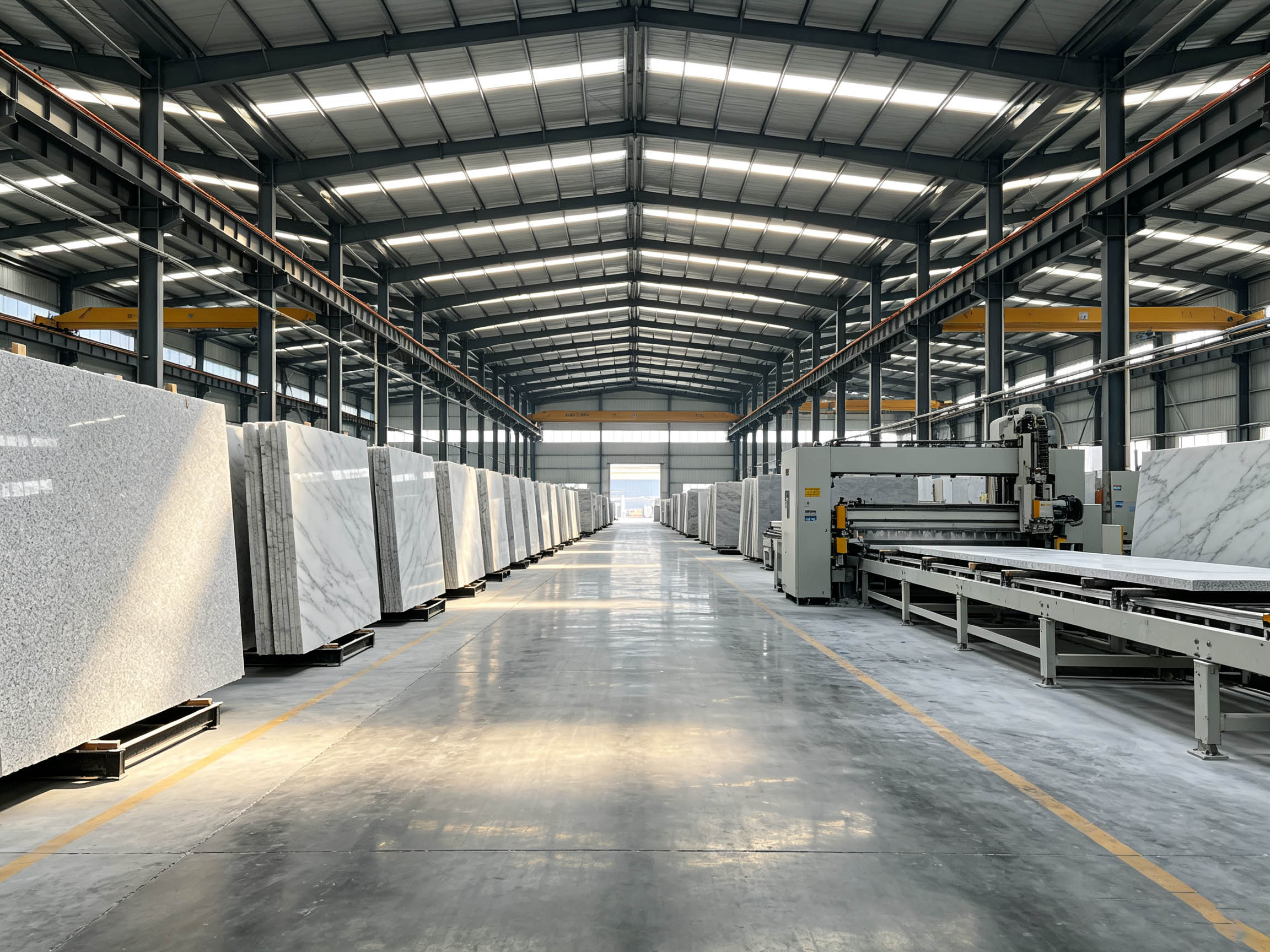
Factory Scale and Production Capacity
The 40,000-square-meter facility is organized into distinct zones for raw material storage, mixing and compression, curing and cooling, polishing and finishing, quality control, and finished goods warehousing. Each zone is designed for efficient material flow. Raw quartz aggregates enter at one end and finished slabs emerge at the opposite end, ready for packaging and export.
Annual production capacity exceeds 100,000 sheets, making Apex one of the larger quartz slab producers serving the international market. The factory operates multiple production lines simultaneously, allowing for efficient production of standard colors alongside custom-developed formulations for exclusive buyer partnerships.
| Specification | Apex Capacity | Industry Benchmark |
|---|---|---|
| Factory Area | 40,000 sqm | Small: 5,000 sqm; Large: 20,000+ sqm |
| Annual Output | 100,000+ sheets | Small: 50,000; Medium: 200,000; Large: 500,000 |
| Production Lines | Multiple lines | Small factories: 1-2 lines |
| Quartz Quarry | Own quarry | Most manufacturers buy from third parties |
| Export Markets | 20+ countries | Experienced exporters cover 10-30 countries |
| Year Established | 1997 | Longevity indicates stability |
Raw Material Area: Where Quality Begins
The raw material storage area is the first stop on any factory tour. Apex maintains covered storage for all incoming quartz aggregates, protecting them from moisture contamination that can affect color consistency. Aggregates arrive in multiple particle sizes, from fine powder to coarse granules, and are stored in separate silos to prevent cross-contamination.
Resin and pigment storage follows strict temperature control protocols. The polymer resins used in quartz manufacturing are sensitive to temperature extremes. Apex stores resins at controlled temperatures between 15-25 degrees Celsius to maintain consistent viscosity and curing properties. Pigments are stored in sealed, light-protected containers to prevent UV degradation.
Each incoming batch of raw materials undergoes quality testing before entering production. Quartz aggregates are tested for particle size distribution and purity. Resin batches are tested for viscosity and curing characteristics. This incoming inspection prevents substandard materials from reaching the production line. Browse the full quartz slab collection produced from these carefully selected raw materials.
Mixing and Compression: The Core Process
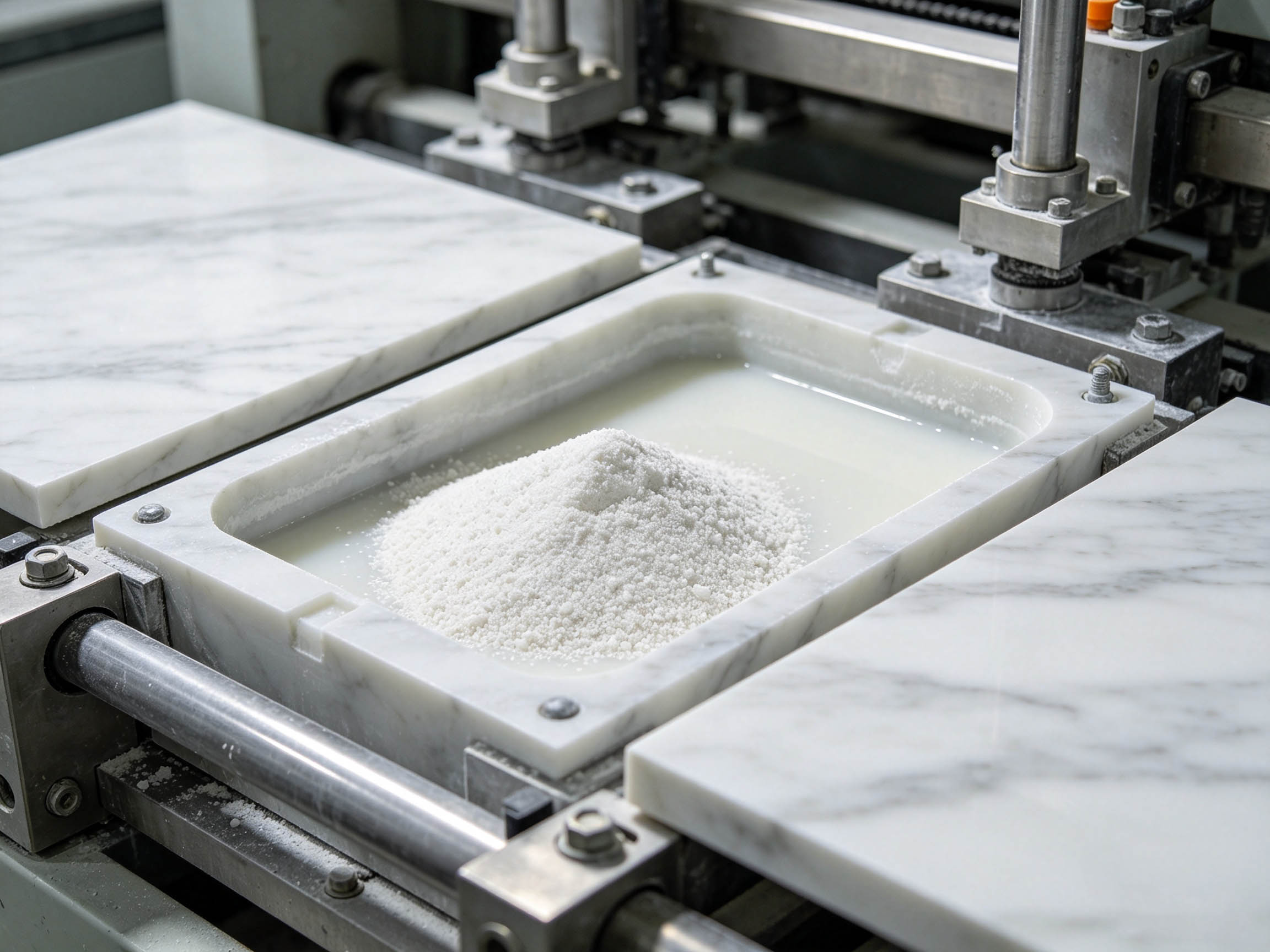
The mixing station is where the transformation from raw materials to engineered stone begins. Apex uses computer-controlled batching systems that precisely measure each ingredient according to the formulation recipe for each slab design. This eliminates the human error that plagues factories relying on manual measurement.
After mixing, the blended material is spread evenly onto steel trays and enters the vacuum compression chamber. The vacuum system removes air pockets from the mixture. Air voids weaken the slab structure and create visible defects in the finished surface. Apex’s compression equipment applies consistent pressure across the entire slab area, producing uniform density from edge to edge.
This step requires experienced operators who understand how different formulations behave under compression. Color formulations with larger quartz particles behave differently than those with fine particles. A skilled operator adjusts compression parameters based on the specific formulation being produced. At Apex, operators with 10-18 years of experience manage this process, bringing practical knowledge that cannot be replaced by automated systems alone.
Heat Curing and Cooling
Curing is where the resin permanently bonds with the quartz aggregates. Apex uses multi-zone temperature-controlled curing ovens that maintain precise temperature profiles throughout the curing cycle. The curing temperature ranges from 85-95 degrees Celsius depending on slab thickness and resin formulation. Each zone in the oven is independently controlled to ensure even curing across the entire slab surface.
After curing, slabs enter a controlled cooling station where temperature decreases gradually over several hours. Rapid cooling creates internal stress that may cause micro-cracking. These micro-cracks are invisible immediately after production but can grow over time, leading to slab failure during fabrication or installation. Apex maintains documented cooling protocols with specific temperature ramp-down rates for each product type.
Polishing and Finishing Line
The polishing line at Apex uses 10-stage progressive polishing with diamond abrasives. Each stage uses progressively finer grit, starting at 50-grit and finishing at 1500-grit for high-gloss surfaces. The number of polishing stages directly affects surface quality. Budget factories may use only 4-6 polishing stages, resulting in surfaces that lack the deep, reflective gloss of properly polished quartz.
After polishing, each slab undergoes visual inspection under standardized lighting conditions. Inspectors check for color consistency, pattern accuracy, surface defects, and gloss uniformity. Slabs that do not meet Apex’s quality standards are set aside for reprocessing or rejection. This commitment to quality control has helped Apex build a reputation for consistent product quality across 20+ export markets.
Quality Control Laboratory
Apex maintains an on-site quality control laboratory equipped with testing equipment that verifies product performance against industry standards. The lab conducts flexural strength testing to measure slab resistance to bending stress. Stain resistance testing evaluates the surface’s reaction to common staining agents. Hardness testing confirms the mineral composition meets specifications. Water absorption testing verifies the non-porous surface quality that defines premium engineered quartz.
Color consistency testing uses spectrophotometers to measure color variation between production batches. Dimensional accuracy testing confirms thickness and flatness tolerances. Apex maintains thickness tolerance within 0.3mm across the entire slab, ensuring consistent installation and seamless joint matching for fabricators.
Every slab produced at Apex is traceable to its production batch, raw material lot numbers, and production date. If a quality issue arises in the field, Apex can trace it back to specific production parameters and take corrective action. This traceability system is a hallmark of professional quality management.
Packaging and Export Preparation
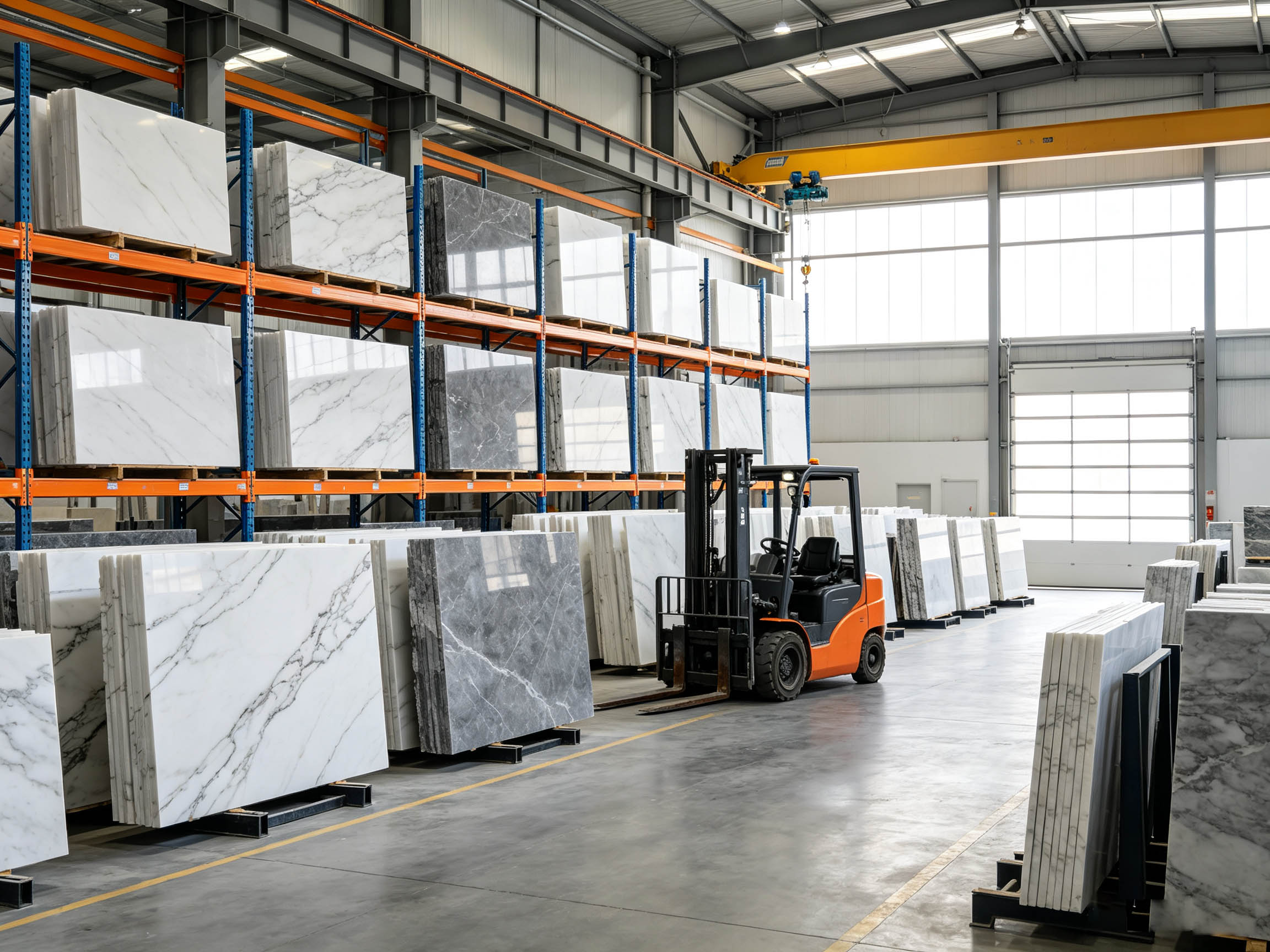
Proper packaging is essential for safe international shipping. Apex uses protective film applied to each slab surface to prevent scratching during transport. Corner protectors shield the most vulnerable areas of each slab. Slabs are packed vertically in steel frames with padded separators between each slab, preventing surface-to-surface contact that can cause friction damage.
Container loading follows documented procedures to maximize space utilization while protecting the cargo. Slabs are distributed evenly within the container to maintain balance during shipping. Each container is photographed during loading for documentation purposes, providing visual evidence of packaging quality.
Apex ships from Xiamen port, one of China’s busiest and most efficient export hubs, providing reliable container shipping connections to markets worldwide. The factory’s proximity to the port reduces inland transportation costs and minimizes the risk of damage during the overland portion of the journey. For importers planning their first order, detailed export documentation and logistics coordination are provided as part of Apex’s standard service. Start your inquiry on the contact page to request a factory tour or product catalog.
Why Factory Tours Matter for Importers
A factory tour provides information that cannot be obtained from brochures or websites. Seeing the production facility in person or via live video reveals how organized the operation is, how well equipment is maintained, and how workers handle materials. These observations tell an experienced buyer more about product quality than any certification document.
During a tour, buyers should pay attention to several indicators. Check whether raw materials are stored properly under cover. Observe whether workers use safety equipment, which indicates management standards. Inspect the polishing line to see how many polishing heads are in use. Visit the quality control lab and ask to see recent test records. Look at finished goods storage to see how slabs are treated before shipment. These observations build confidence in the supplier or raise red flags that deserve further investigation.
Apex welcomes serious buyers to tour the facility in person or via live video walkthrough. For importers who cannot travel to China, virtual factory tours provide a practical alternative that still allows real-time observation of production conditions. Arrange a factory visit through the About Us page to schedule directly with our export team.
Conclusion
Apex Quartz Stone’s 40,000-square-meter factory combines nearly three decades of industry experience with modern engineered stone manufacturing technology. From company-owned quartz quarries to computer-controlled production lines and comprehensive quality control systems, the facility is designed for consistent, high-volume production that serves international buyers across 20+ countries. For importers seeking a reliable quartz slab manufacturer with transparent production practices, Apex provides factory tour access, detailed quality documentation, and a product range that covers standard and custom colors. Explore the product range or contact the export team to begin the partnership process.
Post time: Jul-13-2026