
A 3D printed quartz slab offers better value whenever the specification calls for premium veining: it delivers marble-grade pattern realism and slab-to-slab repeatability at a quartz price, typically 10–20% above the same body in a traditional speckle and far below the natural marble it imitates. Traditional slabs offer better value everywhere else — entry and mid-range looks, honed finishes, and layouts where cutting waste matters more than drama — because they skip the digital decoration stage entirely. The one thing this comparison is not about is durability: both routes use the same roughly 90–93% quartz aggregate body, and the printed vein, deposited as ink into the unset mat before curing, is integral to the slab rather than a coating on it.
That framing matters because most buyers arrive at this question having read a technology story, and technology stories make poor purchasing decisions. Value in engineered stone is decided by five measurable things: what the pattern looks like, whether slab 400 matches slab 4, how much stone the fabricator throws away, what the re-order looks like in year three, and what the surface is worth to the next owner of the property. Because both routes share one slab body, the entire value difference concentrates in those five dimensions — and once you score them for your own project, the decision usually makes itself. This article is that scoring, done once, in public.
TL;DR
- Choose 3D printed quartz when the look is veined: it delivers Calacatta- and Carrara-grade realism at 10–20% over the same body in a speckle, and its digital design file repeats identically across every slab in the order.
- Choose traditional blends for speckled, honed, or budget-driven specs: same durability, lower price, and homogeneous grain means every offcut is interchangeable and waste runs 5–10% lower.
- Durability is a tie by construction — density near 2.4 g/cm³, water absorption under 0.05% per ASTM C97 methods, same flexural behaviour — because the decoration route changes the look, not the body.
- Re-orders are where print wins structurally: a digital file can be reprinted years later for phase two, while a traditional blend batch is a one-time statistical mix that can only be approximated.
- Both routes fall under identical fabrication and silica-safety rules, so shop cost and safe handling should never differ between the two.
Two Manufacturing Routes, One Slab Body
Traditional engineered quartz is decoration by mixing. Screened quartz grains in a controlled palette of tones and sizes are blended with pigment and resin, vibro-compacted under vacuum, and cured — the colour and pattern live in the body itself, distributed statistically by the mixer. Because the pattern is statistical rather than designed, two slabs from the same traditional batch are sisters, not twins — close, but with individual grain distributions that no one controls. This is a strength for hiding wear and a limit for matching.
The 3D printed route keeps that body and changes the decoration stage. On our lines, the quartz mat is first laid down with a controlled base tone, then a digital inkjet system deposits vein and mineral patterns with ceramic-stabilised inks while the mat is still unset; pressing and curing follow, locking the ink roughly 0.5–1.0 mm into the body. Digital decoration of surfaces is now a mature industrial discipline — EU-funded research tracked how digital glazing and printing transformed ceramic tile production, and engineered stone adopted the same logic for veining. Because the pattern comes from a design file instead of a mixer, the printed route converts pattern from a manufacturing accident into an archived, repeatable asset.
Everything after decoration is identical: the same pressing, the same curing ovens, the same gauging and polishing lines, the same 3200 × 1600 mm format and 12–30 mm thickness options. That shared body is why the durability conversation between the two routes is short and boring — by design.
The Five Dimensions That Decide Value
| Dimension | 3D Printed Slab | Traditional Slab | Value verdict |
|---|---|---|---|
| Pattern realism | Marble-grade veining with 4–8 ink channels; grain-scale texture under the veins | Speckle and mineral scatter; veining only in rare premium blends | Print, decisively, for veined looks |
| Slab-to-slab consistency | Design file repeats identically across the order | Sister slabs from one batch; close but not identical | Print for multi-unit veined specs |
| Cutting waste | Directional veins need layout planning; ~5–10% more waste | Homogeneous; offcuts fully interchangeable | Traditional on tight budgets |
| Price per slab | Typically 10–20% above same body in speckle | Entry and mid-range price bands | Traditional at entry level |
| Re-order fidelity (year 3) | File archived; reprint matches | New batch approximates the original | Print for phased projects |
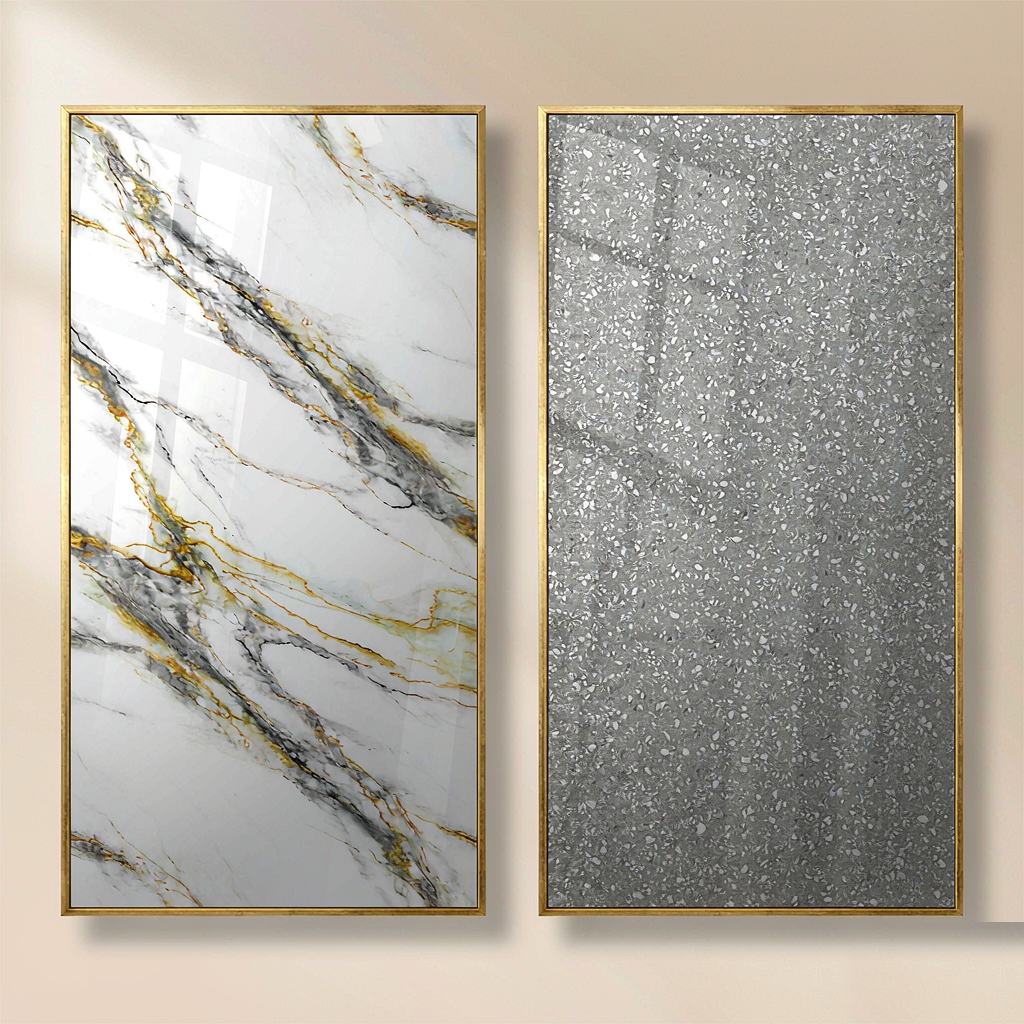
Read the table as a scorecard, not a ranking: print wins three dimensions, traditional wins two, and which wins your decision depends entirely on which dimensions your project actually uses. A 40-unit apartment tower speckling every kitchen grey-and-white should not pay a print premium it will never see; a boutique hotel specifying bookmatched Calacatta-style islands cannot get there with a mixer.
Where 3D Printed Slabs Win
The printed route’s core advantage is realism at scale: a four-to-eight-channel ink system lays down veining with tone-on-tone depth, gradient edges, and grain-scale texture beneath it, at a slab price that sits a fraction of the natural marble it replaces. Ten years ago the choice was real Calacatta at marble pricing or a speckle that read as “engineered” from across the room; today a 3D printed quartz slab closes most of that gap for buyers who were never going to pay for quarry stone.
The second advantage is repeatability, and it matters more commercially than the pattern itself. Because the design file drives every slab, unit 1 and unit 40 in a residential tower receive the same vein logic — and when the client calls about phase two in year three, the file reprints. I have watched traditional batches be approximated for re-orders; I have never watched one be matched. Because the alternative to a reprint is blending new batches until one lands close enough, phased projects save more in re-order risk than the print premium ever cost them.
The third advantage hides in the edge details. Printed veining continues over eased and mitred edges with the vein mapped in 3D, so a 40 mm mitred island edge shows the vein wrapping rather than a speckle cut in half. On waterfall edges — where the pattern has to turn a corner — printed slabs are the only engineered option that reads as continuous stone.
Where Traditional Blends Still Win
Traditional slabs win first on price where the look doesn’t need printing. A grey-and-white or beige-and-cream speckle skips the ink, the print heads, and the slower line speed, landing typically 10–20% below the same body in a printed design on our own price list. Because most residential specs and nearly all commercial fit-outs use neutral speckles, the majority of the market is still buying the cheaper route and losing nothing by it.
They win second on fabricator economics. A homogeneous speckle has no grain direction, so every offcut fits any position, nesting software works at full efficiency, and a mis-cut is a rectangle, not a tragedy. On complex kitchens with sink cut-outs, cooktop drops, and waterfall returns, that 5–10% waste difference is real money — often more than the price gap between the routes. Because cutting waste is paid at the fabricated-top price rather than the slab price, the fabricator’s nest efficiency can outweigh the factory’s price list on tightly budgeted jobs.
And they win third on finish flexibility. Honed and matte finishes mute printed veining — clients who specify honed surfaces for their softness often prefer the traditional mineral scatter, which was designed to be seen unpolished. A soft Carrara quartz slab in a honed traditional blend is, for many kitchens, a better surface than a printed vein dulled by the same finish.
The Ten-Year Value Math
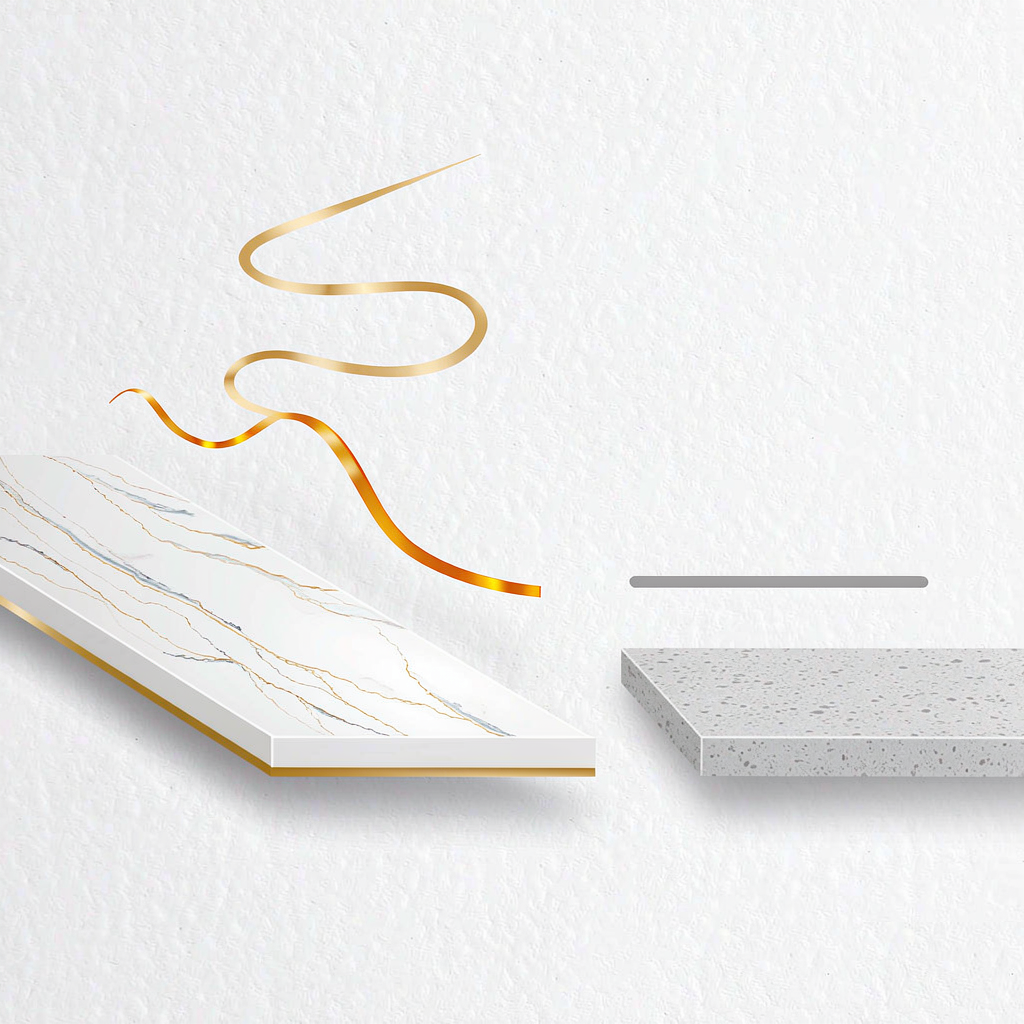
Value over a decade is not the price at day one; it is price plus risk plus what the surface is worth to the next owner. Model it honestly and the two routes separate by use case rather than by quality.
Maintenance is identical — the same non-porous body, the same soap-and-water routine, the same resistance to wine, oil, and coffee at the slab level. Durability is identical, because density and absorption behaviour per ASTM C97 methods and flexural behaviour per ASTM C880 describe the shared body, not the decoration. Replacement risk is not identical: because a printed vein runs only 0.5–1.0 mm deep, a chip through a vein is harder to repair invisibly than a chip in a speckle — on a veined island, a repair that reads as a scar can push owners toward replacement, which is the single largest cost either route can incur. Traditional speckle hides repairs; print forgives less but needs forgiving less often on busy patterns.
Resale desirability favours print in premium segments. A kitchen that reads as bookmatched marble photographs like a renovation budget twice its actual cost, and appraisers and buyers respond to that reading. Because perceived material quality drives renovation ROI more than invoice accuracy, the printed premium is usually recouped at resale in stone-adjacent price brackets — the same reason quartzite-look slabs command their own premium over plain speckles in every showroom. In rental and mid-market segments, none of this premium is recoverable, which is exactly why traditional blends dominate them.
Fabrication, Safety, and Waste: The Rules That Never Change
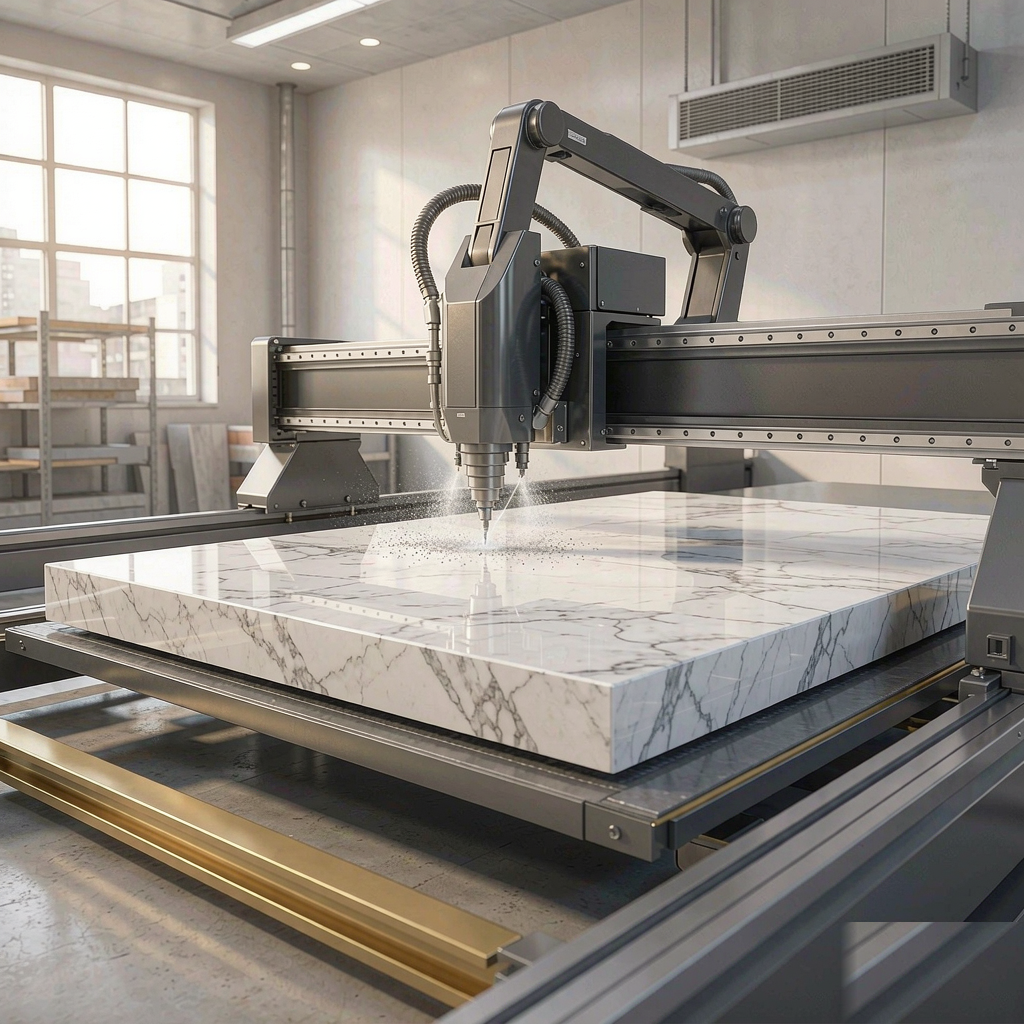
Whichever route you buy, the fabricator’s experience should be identical, and any shop quoting differently is quoting a process, not a product. Cutting, routing, and polishing are the same wet operations on the same tools; layout planning is the only difference, and it is the buyer’s job to confirm the fabricator has planned vein direction on any printed order before the saw starts.
Safety obligations are also identical, and this is the one place where “traditional” must not be read as “old rules.” Both routes are engineered stone containing crystalline silica in the quartz body, and OSHA’s crystalline silica standards apply to fabrication of both — wet cutting, ventilation, and respiratory protection, with dry cutting simply prohibited as a workable practice. Because the silica exposure lives in the slab body rather than the decoration, choosing print over speckle changes nothing about shop safety — the routes are identical at the saw, and shops that treat either casually are shops to leave. For buyers under particular pressure on this point, the industry’s response is body chemistry rather than decoration: non-silica quartz surfaces remove the crystalline silica from the slab itself, a separate decision from the printed-versus-traditional one.
A 60-Second Decision Framework
Choose the printed route if any two of these are true:
- The specified look is veined — Calacatta, Statuario, or dark dramatic marble styles.
- The project has multiple units that must match, or a phase two that must match phase one.
- Bookmatched islands, waterfall edges, or mitred edge build-ups are on the drawing.
- The property sits in a price bracket where buyers pay for perceived stone quality.
Choose the traditional route if any two of these are true:
- The specified look is a neutral speckle or mineral blend, in polished or honed.
- The budget is fixed at entry or mid-range price bands, and the look doesn’t need veining.
- The layout is cut-heavy — multiple sinks, cooktops, and waterfall returns — making waste the dominant cost.
- The property is rental or commercial, where matching and resale premium don’t price.
If your project splits evenly between the two lists, specify printed veining on the one surface that photographs — the island — and traditional speckle everywhere else. Because most kitchens are 60–80% perimeter and only one island, this hybrid captures nearly all of the print route’s visual value at a fraction of its cost, and it is the single most common specification I sign off.
Frequently Asked Questions
Are 3D printed quartz slabs more expensive than traditional slabs?
Is the printed vein pattern only on the surface of the slab?
Do 3D printed and traditional quartz slabs have the same durability?
Can fabricators cut and polish 3D printed slabs the same way?
Which is better for large multi-unit projects?
Do printed vein patterns fade over time?
Buy the Pattern, Not the Story
The value verdict compresses to one sentence: pay the printed premium when the pattern is the product — veined, matched, repeated across units, or pointed at a resale bracket that pays for stone looks — and keep the traditional speckle when the surface just has to be neutral, durable, and cheap to fabricate. Neither route is a technology you buy into; both are stone bodies you buy by the slab, and the decoration is a line item you either need or don’t.
Apex Quartz Stone has manufactured engineered stone since 1997 from a 40,000 m² facility in Shuitou, Nan’an — nearly three decades of slab production, now more than 100,000 slabs a year across traditional blends and digitally printed designs for buyers in over 20 countries. If you are pricing both routes for a project, send us the layout drawings and the look you are targeting: we will quote the same body in both decorations side by side, confirm batch or file availability for your timeline, and tell you honestly which route your project’s numbers favor. Start with the 3D printed quartz slab range, then compare against the full engineered quartz stone collection — the prices will do the rest.
Alex Wang
Alex Wang has worked in engineered stone exports since 2014 and advises importers, fabricators, and developers on slab specification across more than 20 markets. Apex Quartz Stone (Quanzhou APEX Co., Ltd.) has manufactured engineered stone since 1997. Connect on LinkedIn.
Post time: Sep-30-2026