
You might already know that quartz dominates the modern countertop market…
But have you noticed the massive shift toward eco-conscious materials?
We aren’t just talking about a fleeting design trend. We are witnessing The Rise of Recycled/Sustainable Quartz as the new global standard for luxury and safety.
As an industry manufacturer, I know that finding the perfect kitchen quartz slab now involves navigating complex questions about silica content, bio-resins, and true durability.
Is it just marketing hype? Or is it actually better for your home?
In this guide, you’re going to learn exactly how sustainable technology is reshaping the kitchen slab quartz industry and how to choose a surface that delivers on both performance and ethics.
Let’s dive right in.
What Drives the Rise of Recycled/Sustainable Quartz?
Why are architects and homeowners suddenly prioritizing eco-friendly surfaces? The answer goes beyond simple environmentalism. The Rise of Recycled/Sustainable Quartz is a direct response to urgent manufacturing challenges and safety concerns that the stone industry can no longer ignore. At Quanzhou APEX, we aren’t just following this trend; we are engineering the solution to meet the demands of the modern market.
The Shift Toward the Circular Economy
We are moving away from the traditional “take-make-waste” linear model. In the past, manufacturing a kitchen quartz slab meant extracting raw minerals, processing them, and discarding the excess. Today, we prioritize a circular economy in manufacturing.
By repurposing post-industrial waste—such as glass, porcelain, and mirror fragments—we keep valuable materials out of landfills. This approach allows us to produce high-quality surfaces without the heavy environmental toll associated with virgin mining. It is about maximizing resource efficiency while delivering the durability you expect.
Addressing the Silica Factor and Safety
One of the most critical drivers for innovation in our sector is the health and safety of fabricators. Traditional engineered stone can contain high levels of crystalline silica, which poses respiratory risks during cutting and polishing.
We are actively transitioning toward low-silica engineered stone. By substituting raw quartz with recycled minerals and advanced binders, we achieve two goals:
- Reduced Health Risks: Significantly lowering silica content makes the material safer for the workers who cut and install your kitchen slab quartz.
- Regulatory Compliance: Meeting stricter occupational safety standards in the US and Europe.
Meeting Global ESG Regulatory Standards
Sustainability is no longer optional; it is a metric of business success. Developers and commercial builders are under increasing pressure to meet Environmental, Social, and Governance (ESG) criteria. High-performance green building materials are essential for reducing the carbon footprint reduction of new construction projects.
Our sustainable quartz lines are designed to help projects align with these rigorous standards, offering tangible benefits:
- Compliance: Meets requirements for green building certifications.
- Transparency: Clear sourcing of recycled components.
- Future-Proofing: Aligns with tightening environmental laws regarding manufacturing emissions.
Deconstructing the Tech Behind Sustainable Quartz
We aren’t just grinding up rocks anymore; we are fundamentally engineering a smarter surface. The rise of recycled/sustainable quartz is driven by a complete overhaul of the production recipe, moving away from purely mined resources to a model that prioritizes the circular economy in manufacturing. This technical evolution ensures that every kitchen quartz slab we produce meets rigorous performance standards while significantly lowering its environmental impact.
Integrating Post-Consumer Recycled Glass and Porcelain
The most visible change in modern engineering is the aggregate itself. Instead of relying solely on quarried quartz, we are incorporating post-consumer recycled glass and discarded porcelain into the mix. This isn’t just filler; it is high-performance material.
- Recycled Mineral Composition: By using crushed glass and porcelain, we reduce the demand for raw mining.
- Low-Silica Engineered Stone: Substituting quartz minerals with recycled content naturally lowers the crystalline silica percentage, addressing key safety concerns.
- Aesthetic Depth: Recycled fragments create unique visual textures that mimic natural stone without the unpredictability.
The Shift to Bio-Resin Technology
Traditional engineered stone relies on petroleum-based binders to hold the minerals together. To reduce our reliance on fossil fuels, the industry is making a massive shift toward bio-resin technology. These binders are derived from renewable plant sources, such as corn or soy, rather than synthetic chemicals. This switch contributes directly to carbon footprint reduction without compromising the structural integrity of the kitchen slab quartz. The result is a non-porous surface that is just as hard as traditional quartz but far kinder to the planet.
Zero-Waste Water Systems in Manufacturing
Producing eco-friendly kitchen countertops requires water—specifically for cooling the machinery and polishing the slabs. However, wasting that water is no longer acceptable. Advanced manufacturing facilities now utilize closed-loop water filtration systems. We capture 100% of the water used during the vibro-compression and polishing stages, filter out the stone sludge, and recirculate clean water back into the production line. This ensures that our manufacturing process puts zero strain on local water reserves.
Sustainability vs. Durability in Kitchen Quartz Slabs
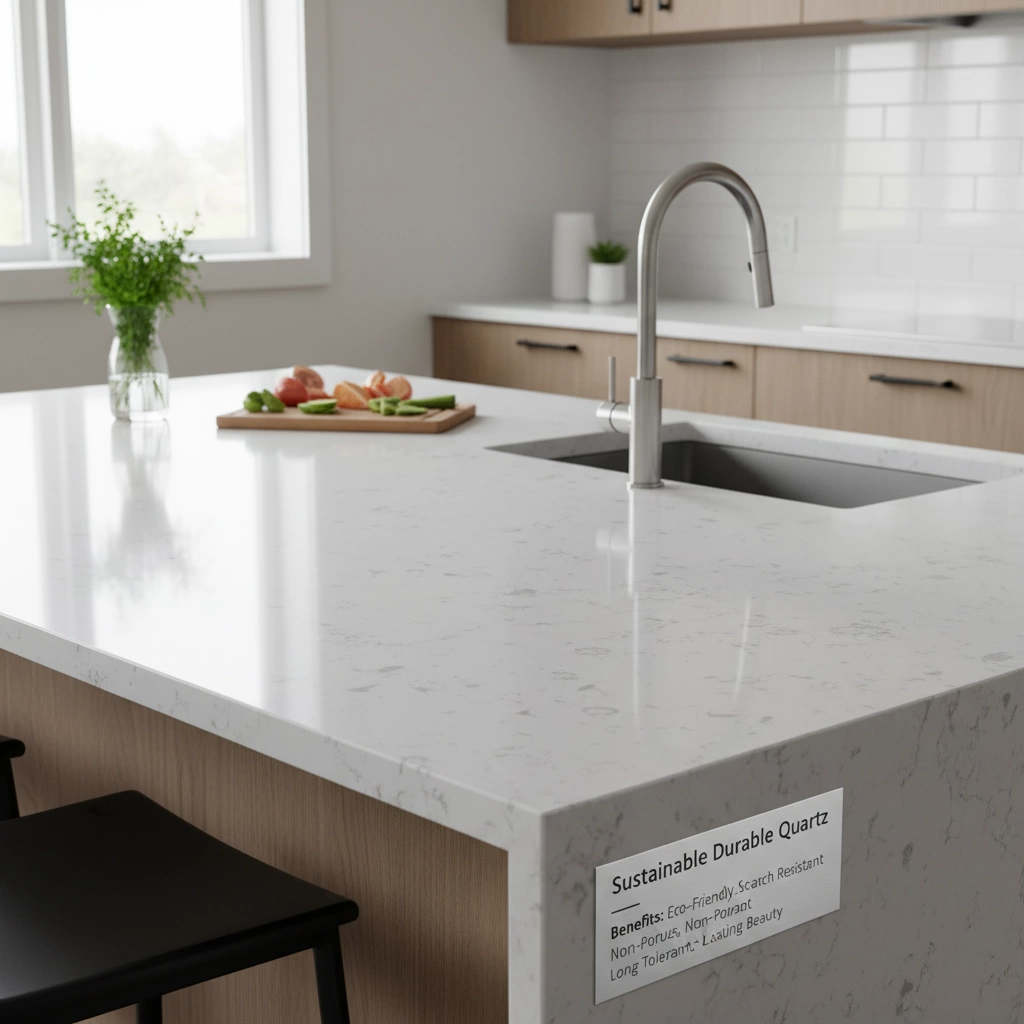
There is a common misconception that choosing eco-friendly materials means compromising on strength. I hear it all the time: “If it’s recycled, is it weak?” The reality is that kitchen quartz slab durability has evolved significantly. We aren’t just gluing scraps together; we are engineering high-performance green building materials that rival, and often exceed, the toughness of traditional stone.
The Vibro-Compression Vacuum Process Explained
The durability of a kitchen slab quartz comes down to the manufacturing technology, not just the raw ingredients. We utilize a specialized vibro-compression vacuum process to create these surfaces.
- Compaction: The mixture of recycled minerals and bio-resin is subjected to intense vibration to pack particles tightly.
- Vacuum Extraction: Simultaneously, a powerful vacuum removes practically all air from the mix.
- Solidification: This creates an incredibly dense slab with zero internal voids or weak spots.
This process ensures that whether the aggregate is virgin quartz or post-consumer recycled glass, the structural integrity remains rock solid.
Scratch and Stain Resistance Metrics
When you are prepping dinner, you need a surface that can take a beating. Sustainable quartz is engineered to rank high on the Mohs hardness scale. The inclusion of recycled porcelain or glass often reinforces the matrix, making the surface highly resistant to scratches from knives or heavy cookware.
Stain resistance is equally robust. Because the resin binds the recycled particles so tightly, typical kitchen culprits like red wine, lemon juice, and coffee cannot penetrate the surface. It offers the same low-maintenance benefits as standard quartz.
Why Non-Porous Surfaces Matter for Hygiene
Beyond physical strength, health is a major priority for US homeowners. Non-porous sustainable surfaces are essential for a sanitary kitchen environment. Since the vacuum process eliminates microscopic pores, there is nowhere for bacteria, mold, or mildew to hide.
- No Sealing Required: Unlike natural granite or marble, you never have to seal these slabs.
- Easy Cleaning: You don’t need harsh chemical cleaners; warm soapy water is usually enough.
- Food Safety: Raw meat juices or spillages won’t absorb into the countertop, preventing cross-contamination.
By choosing these materials, you get a kitchen quartz slab that supports a circular economy without sacrificing the hygiene or resilience required for a busy home.
The Aesthetic Evolution of Eco-Friendly Countertops
Gone are the days when choosing green meant settling for a chunky, speckled surface. As part of The Rise of Recycled/Sustainable Quartz, we have completely overhauled how these materials look to meet the high standards of American homeowners. Early iterations often relied heavily on large chips of post-consumer recycled glass, resulting in a distinct “terrazzo” appearance that didn’t fit every home style. Today, we use advanced crushing and blending technologies to create a recycled mineral composition that is smooth, uniform, and sophisticated.
Moving Beyond the “Terrazzo” Look
The market demanded versatility, and we delivered. We moved away from the mandatory “recycled look” by pulverizing raw materials into a fine powder before binding. This allows us to produce eco-friendly kitchen countertops that possess the solid, consistent color depth required for modern design, rather than looking like a mosaic project.
Achieving Marble-Like Veining
The biggest leap forward is our ability to replicate the elegance of natural stone. We can now engineer a kitchen quartz slab that features intricate, deep veining indistinguishable from premium marble. By manipulating the bio-resin and mineral mix, we achieve organic flow and depth. You no longer have to choose between sustainability and the luxury aesthetic of a Calacatta or Carrara finish.
Styling for Minimalist and Industrial Kitchens
Modern sustainable interior design trends in the US favor clean lines and raw textures. Our sustainable slabs cater directly to this demand, proving that a kitchen slab quartz can be both beautiful and responsible:
- Minimalist: We produce pure whites and subtle grays that offer a sleek, monolithic look without the visual noise of traditional granite.
- Industrial: We achieve concrete-style finishes using recycled porcelain, perfect for urban lofts and matte applications.
- Transitional: We offer warm, neutral tones that bridge the gap between classic warmth and modern crispness.
Quanzhou APEX’s Approach to Green Manufacturing
At Quanzhou APEX, we view sustainability as a manufacturing standard rather than just a marketing trend. As The Rise of Recycled/Sustainable Quartz reshapes the global market, our philosophy is grounded in practical innovation. We focus heavily on producing low-silica engineered stone, significantly reducing the crystalline silica content compared to traditional methods. By substituting raw quartz with recycled mineral composition and glass, we create a safer production environment for workers and a more responsible product for end-users.
Ensuring Quality Control with Eco-Materials
There is a common misconception that “green” materials are softer or less reliable. We prove that wrong through rigorous testing. Working with eco-materials like post-consumer glass requires precise calibration to ensure the kitchen quartz slab maintains structural integrity. We don’t just mix recycled content; we engineer it.
Our quality assurance process includes:
- Density Verification: We ensure our vibro-compression technology eliminates all air pockets, maintaining a non-porous surface.
- Batch Consistency: We strictly manage the variations found in recycled inputs to guarantee uniform color and pattern across every slab.
- Performance Stress Tests: Every kitchen slab quartz we produce undergoes impact and stain resistance testing to match or exceed standard industry ratings.
Collections Featuring High-Performance Green Building Materials
Our product lines are designed to meet the specific aesthetic and functional needs of the US market. We have developed collections featuring high-performance green building materials that cater to both commercial LEED-certified projects and residential kitchen upgrades. These collections offer the sophisticated veining and durability homeowners expect, backed by a commitment to carbon footprint reduction. Whether you are looking for an industrial concrete look or a classic marble style, our sustainable slabs deliver premium performance without the environmental heavy lifting.
How to Verify Your Quartz is Truly Sustainable
Greenwashing is a real issue in the building materials industry. You will see “eco-friendly” stamped on plenty of samples, but without hard data, it is just marketing fluff. As a manufacturer, I know that producing genuine high-performance green building materials requires rigorous testing and transparency. To ensure you are getting a truly sustainable kitchen quartz slab, you need to look beyond the label and check the certifications.
Checking for GREENGUARD Gold and LEED Points
The most reliable way to verify sustainability is through third-party testing. In the United States, the gold standard for indoor air quality is being GREENGUARD Gold certified. This certification proves that the kitchen slab quartz has low chemical emissions (VOCs), making it safe for use in schools and healthcare facilities, not just homes.
For those looking to maximize the environmental value of their renovation, check if the material contributes to LEED certification points. We also recommend asking for an Environmental Product Declaration (EPD). An EPD is like a nutrition label for building products; it transparently details the carbon footprint reduction and environmental impact of the slab from the raw material extraction to the finished product.
Questions to Ask Your Supplier About Recycled Content
Don’t be afraid to grill your supplier or fabricator about the recycled mineral composition of the stone. A legitimate provider should have these answers ready. Here is a checklist of questions to verify the authenticity of eco-friendly kitchen countertops:
- What is the specific percentage of recycled content? Distinguish between pre-consumer (industrial waste) and post-consumer recycled glass or porcelain.
- What type of binder is used? Ask if they have shifted toward bio-resin technology or if they are still relying 100% on petroleum-based resins.
- How is the water managed during production? Look for manufacturers utilizing closed-loop water filtration systems.
- Does the factory use renewable energy manufacturing?
Understanding the Lifecycle Cost of Green Materials
There is a misconception that sustainable products always cost significantly more. While the upfront price of a premium green kitchen quartz slab might be slightly higher than standard commodity quartz, the lifecycle cost tells a different story.
True sustainability isn’t just about how the slab is made; it is about how long it lasts. High-quality recycled quartz is engineered for extreme durability. Because it is a non-porous surface, it resists staining and bacterial growth without needing chemical sealants. When you factor in the longevity and the lack of maintenance costs, the investment in verified sustainable materials often yields a better return than cheaper, less durable alternatives that may need replacing in a decade.
FAQs About the Rise of Recycled/Sustainable Quartz
As we push for greener standards in manufacturing, I hear a lot of questions from homeowners and contractors about how these materials actually perform in a real American home. Here are the honest answers regarding the rise of recycled/sustainable quartz.
Is recycled quartz as strong as traditional quartz?
Absolutely. There is a misconception that “recycled” implies “weaker,” but that isn’t the case here. Kitchen quartz slab durability relies on the binding process, not just the raw aggregate. We use high-pressure vibro-compression technology to bond recycled glass and minerals with bio-resins. The result is a high-performance green building material that offers the same Mohs hardness and resistance to chipping as standard engineered stone.
Do sustainable slabs cost more?
In the past, processing waste materials into usable aggregate was more expensive than mining new stone. However, as technology improves and supply chains for post-consumer recycled glass mature, the price gap is closing. While some premium eco-friendly kitchen countertops may carry a slight markup due to certification costs (like LEED or GREENGUARD), the price is becoming increasingly competitive with standard kitchen slab quartz.
Is low-silica quartz safer for my home?
For the homeowner, cured quartz has always been safe. The primary safety benefit of low-silica engineered stone is for the people manufacturing and cutting your countertops. Reducing silica content drastically lowers the risk of silicosis for workers. By choosing low-silica options, you are supporting a safer, more ethical supply chain without compromising the safety or quality of the surface in your kitchen.
How do I maintain eco-friendly quartz countertops?
Maintenance is identical to traditional quartz because the surface properties are the same. These are non-porous sustainable surfaces, meaning they don’t absorb liquids or bacteria.
- Daily Cleaning: Use a soft cloth with warm water and mild soap.
- Avoid: Harsh chemicals like bleach or abrasive scouring pads.
- Sealing: No sealing is required, unlike natural granite or marble.
Your kitchen quartz slab will retain its polish and hygiene with minimal effort, making it a practical choice for busy households.
Post time: Jan-19-2026