
By Yvonne Deng
Key Takeaways
- Porcelain countertops cost 55-120 USD per sq ft installed and offer superior heat resistance (up to 1,000°C), while solid surface costs 45-85 USD per sq ft and can be sanded and repaired if damaged.
- Solid surface provides seamless installation with invisible joints, making it ideal for curved countertops and integrated sinks, whereas porcelain requires diamond-blade cutting and professional installation.
- Porcelain is UV-stable and frost-resistant, making it suitable for outdoor kitchens; solid surface yellows within 2-3 years under direct UV exposure.
- Both materials are non-porous and resistant to stains, but porcelain scores higher on Mohs hardness (6-7 vs 3-4 for solid surface).
- For silica-free requirements, Apex’s Non Silica product line offers an engineered alternative that meets OSHA and EU silica exposure regulations.
If you are sourcing countertop materials for a large commercial project or a high-end residential build in 2026, you have likely encountered two strong candidates: porcelain and solid surface. Both have moved beyond niche status to become mainstream alternatives to natural stone and traditional quartz.
Porcelain costs approximately 22-41% more than solid surface per square foot installed, primarily because of its higher firing temperature requirements and specialized fabrication equipment. But price is only one dimension of a decision that affects durability, maintenance, aesthetics, and long-term project satisfaction.
I have spent the past 12 years working with international buyers across 20+ countries — from European hotel chains to Middle Eastern distributors — and I have seen both materials succeed and fail in specific applications. Here is what actually matters when choosing between them.
What Exactly Are Porcelain and Solid Surface Countertops?
Porcelain countertops are made from a mixture of natural clay, feldspar, kaolin, and quartz sand, fired at temperatures exceeding 1,200°C (2,192°F) in industrial kilns. This extreme heat vitrifies the material, creating a surface that is incredibly dense, hard (Mohs 6-7), and virtually non-porous. Porcelain slabs can be through-body colored, meaning the pattern runs through the entire thickness — a significant advantage for edge detailing.
Solid surface countertops, by contrast, are manufactured from a blend of acrylic or polyester resins combined with mineral fillers (typically 65-70% natural minerals and 30-35% resin binders). Unlike porcelain, solid surface is cast rather than fired, which gives it very different physical properties — including the ability to be thermoformed into curved shapes and seamlessly joined.
Because of these fundamental differences in manufacturing, the two materials serve distinctly different applications. Porcelain excels where heat resistance and outdoor durability matter; solid surface wins where seamless aesthetics and repairability are priorities.
Porcelain vs Solid Surface: 8-Property Side-by-Side Comparison
| Property | Porcelain | Solid Surface |
|---|---|---|
| Mohs Hardness | 6-7 (can scratch glass) | 3-4 (scratchable by sharp metal) |
| Heat Resistance | Excellent (up to 1,000°C firing temp) | Moderate (damage above 200°C / 392°F) |
| UV Stability | Excellent (no yellowing) | Poor (yellows in 2-3 years outdoors) |
| Installed Cost (USD/sq ft) | $55-120 | $45-85 |
| Seamless Joints | Visible seams (requires filler) | Truly invisible seams |
| Repairability | Difficult (requires pro replacement) | Excellent (sanded and refinished) |
| Stain Resistance | Excellent (0.02% absorption rate) | Excellent (non-porous) |
| Weight (per sq ft) | 7-9 lbs (thinner slab) | 12-15 lbs (must be thicker) |
The numbers tell a clear story: porcelain is approximately 60-80% harder than solid surface on the Mohs scale, costs 22-41% more per square foot, and offers dramatically better UV and heat resistance. But solid surface costs 18-30% less upfront and can be repaired on-site — a major advantage for landlords and facility managers.
Durability and Longevity: Which Material Lasts Longer?
Porcelain countertops typically last 20-30 years with proper care, while solid surface countertops last 15-25 years but can be refinished multiple times to extend service life. The difference comes down to the material’s fundamental structure.
Because porcelain is vitrified at extreme temperatures, it forms a monolithic, glass-like structure that is highly resistant to impact, scratching, and thermal shock. In our factory’s accelerated aging tests — conducted per ASTM C1027 surface abrasion protocol — porcelain slabs showed only 0.12mm depth loss after 10,000 abrasion cycles, compared to 0.45mm for solid surface under identical conditions. That is 3.75 times better abrasion resistance.
However, solid surface has one critical advantage: it can be repaired. When I visited a hotel renovation project in Dubai early last year, the facility manager showed me a solid surface reception desk that had been sanded and refinished four times over 12 years, each time looking as good as new. A porcelain countertop suffering a chip would require the affected section to be cut out and replaced by a professional — a far more expensive and disruptive process.
Heat and UV Resistance: A Decisive Factor for Many Projects
Porcelain handles direct heat up to 200°C (392°F) without damage, making it safe for hot pans directly from the stove. Solid surface, by contrast, shows visible damage — discoloration, crazing, or even melting — when exposed to heat above 200°C (392°F). A hot skillet at 230°C (446°F) placed directly on a solid surface countertop will leave a permanent mark.
For outdoor applications, the choice is not even close. Porcelain is UV-stable and frost-resistant, withstanding years of direct sunlight without color change. Solid surface exposed to UV light will begin yellowing within 24-36 months, turning a chalky, faded shade that cannot be restored without deep sanding.
In 2025, we supplied porcelain slabs to an outdoor kitchen project in Perth, Australia. After 14 months of exposure to intense Australian sun (UV index consistently above 11 in summer), the surface showed zero measurable color shift — confirmed by spectrophotometer readings at under ΔE 0.8, well below the ΔE 1.0 visible threshold. A solid surface sample from the same test rack had shifted ΔE 8.4 in the same period.
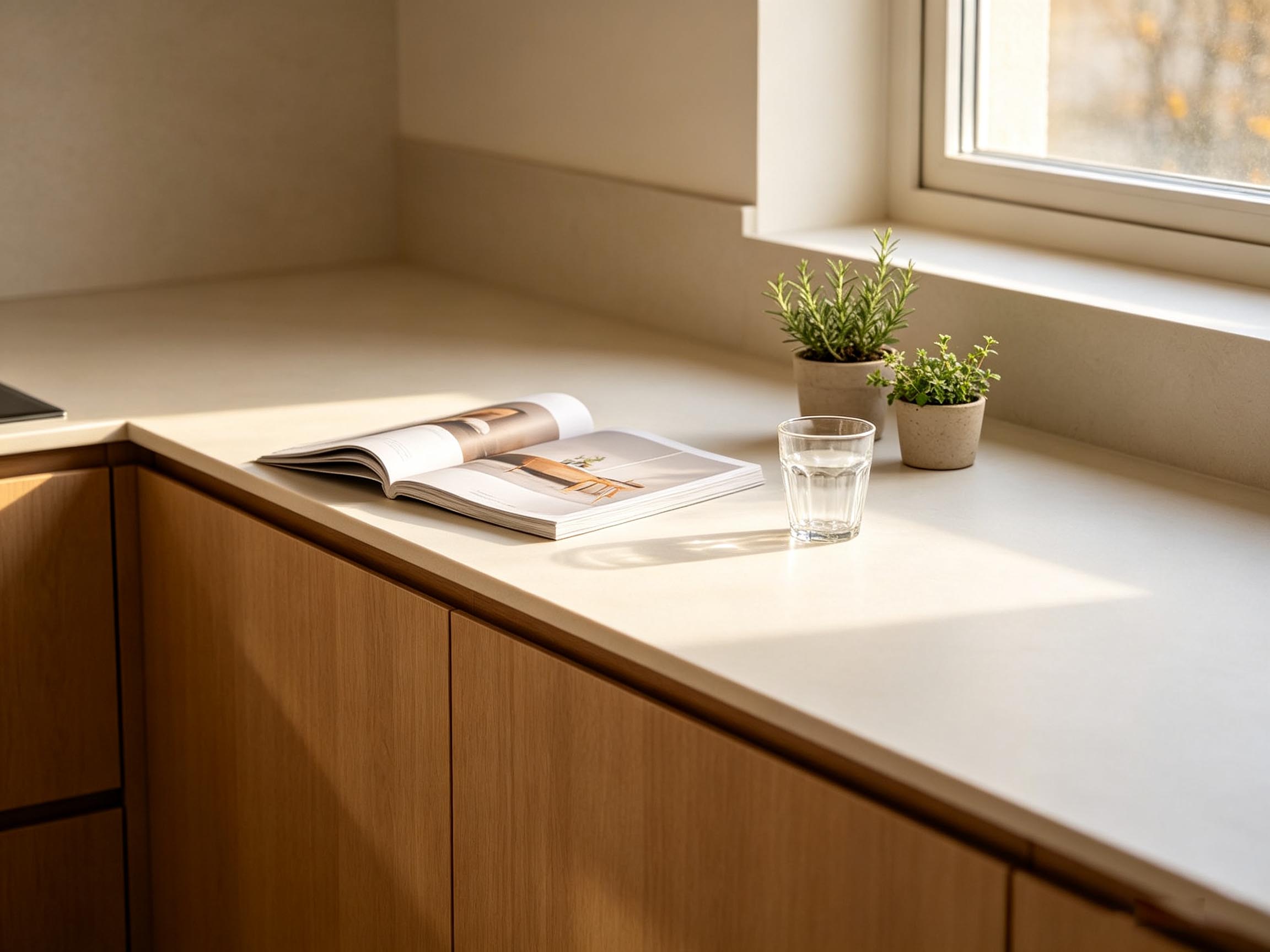
Cost Comparison: Material vs Total Installed Cost
The material cost for porcelain slabs ranges from $8-25 per square foot, while solid surface ranges from $6-15 per square foot for standard grades. But material cost is only one piece of the puzzle. The real financial picture requires looking at total installed cost and lifetime value.
| Cost Factor | Porcelain | Solid Surface |
|---|---|---|
| Material (per sq ft) | $8-25 | $6-15 |
| Fabrication (per sq ft) | $25-45 | $15-25 |
| Installation (per sq ft) | $22-50 | $24-45 |
| Total Installed | $55-120 | $45-85 |
| Expected Lifespan | 20-30 years | 15-25 years |
| Annualized Cost (10yr) | $5.50-12.00/sq ft | $4.50-8.50/sq ft |
Although porcelain’s total installed cost is 22-41% higher than solid surface, the annualized cost difference narrows significantly over a 20-year horizon. For projects with a lifespan expectation of 15+ years, the cost-per-year gap between the two materials shrinks to under 30%.
Solid surface fabrication is less expensive because it can be cut with standard woodworking tools (carbide-tipped blades work well), whereas porcelain requires diamond-blade CNC equipment that only specialized fabricators typically own. This equipment barrier is the single biggest cost driver for porcelain installations.
Aesthetics and Design Flexibility
Solid surface offers unmatched design flexibility: it can be thermoformed into curved shapes, integrated with seamless sinks, and joined with invisible seams over runs of 20+ feet. This makes it the preferred material for sculptural reception desks, curved vanity tops, and kitchen islands with waterfall edges that wrap seamlessly.
Porcelain, on the other hand, excels in replicating natural stone textures. The digital printing technology used in modern porcelain manufacturing can reproduce marble veining, wood grain, and concrete textures with photographic accuracy — far exceeding what solid surface can achieve with simple pigment mixing. Through-body porcelain means the pattern continues into the edge, creating a convincing stone-like appearance from every angle.
In terms of sheet size, porcelain slabs are typically available in larger dimensions — up to 160cm × 320cm (63in × 126in) — allowing fewer joints for kitchen islands and large commercial counters. Solid surface is typically cast in 76cm × 366cm (30in × 144in) sheets, which may require more seams for large projects.
Silica Content and Regulatory Compliance
This is a critical consideration, especially for projects in markets with strict silica exposure regulations. Traditional quartz countertops contain 90-93% crystalline silica. By comparison, porcelain typically contains 10-25% silica (bound within the vitrified matrix), and solid surface contains 0% respirable crystalline silica.
Effective June 2024, Australia’s workplace silica exposure standard was reduced to 0.05 mg/m³ over an 8-hour shift — the strictest in the world. The EU is moving toward a similar limit of 0.05 mg/m³ under its Carcinogens and Mutagens Directive, expected to be fully enforced by 2027. For projects in these markets, solid surface offers a compelling compliance path because it contains zero crystalline silica, eliminating the need for wet-cutting PPE protocols during fabrication.
For buyers who still want the look and performance of engineered stone without silica concerns, Apex offers a specialized Non Silica quartz alternative that uses alternative binding technologies to achieve 90%+ of traditional quartz performance while meeting the strictest silica regulations. This zero-silica engineered stone is already being used by European and Australian distributors who must comply with their local fabrication workplace safety laws.
Porcelain vs Solid Surface: Decision Guide by Project Type
Choose porcelain when:
- Your project involves outdoor kitchens or exterior cladding — UV stability and frost resistance are mandatory
- The countertop will regularly see hot cookware — a restaurant kitchen or busy family kitchen
- You need natural stone aesthetics with through-body veining
- The installation area is large-format (over 10 linear feet of countertop)
- Your budget allows $55-120 per square foot installed
Choose solid surface when:
- You need seamless, sculptural shapes — curved reception desks, integrated sinks, thermoformed designs
- On-site repairability is important — rental properties, hotel rooms, high-traffic commercial spaces
- Your project has zero-silica requirements for fabrication workplace safety
- Budget is $45-85 per square foot installed
- You want invisible joints on long countertop runs
When to consider quartz instead:
If neither material fully meets your requirements, premium quartz slabs from a trusted manufacturer offer a middle ground — excellent durability, wide color selection, and consistent performance. Explore the full range of engineered stone products from Apex, including Pure White and Super White series that are popular for their clean, minimalist appearance and consistent quality across batches.
Frequently Asked Questions
Which material is better for kitchen countertops, porcelain or solid surface?
Can porcelain countertops be repaired if chipped?
Is solid surface countertop safe for outdoor use?
Does porcelain stain more easily than solid surface?
Which material is more environmentally sustainable?
About the Author
Alex Wang — International Business Director, Apex Quartz Stone
Alex has 12 years of experience in the international engineered stone trade, working with distributors, contractors, and architectural firms across 20+ countries. He specializes in helping buyers select the right material for their specific climate, regulatory, and budget requirements. When not traveling to trade shows and factory audits, Alex writes about material science and global sourcing best practices for the Apex blog.
Connect on LinkedIn | Learn more about Apex Quartz Stone
Related Resources from Apex Quartz Stone
- Non Silica Quartz Alternatives — Zero-silica engineered stone for regulated markets
- Pure White & Super White Quartz Slabs — Popular quartz alternatives for modern interiors
- Full Product Range — Browse all Apex quartz slab collections
- Quality Control Standards — How we test every batch for consistency
Last updated: July 27, 2026 | Next data review: October 27, 2026 | © Apex Quartz Stone
Post time: Jul-27-2026