
Defining the Contenders: What Are Calacatta and Carrara Quartz?
When we discuss marble look quartz, we aren’t talking about stone quarried from the mountains of Tuscany. We are talking about high-definition engineered stone countertops designed to replicate that luxury aesthetic without the maintenance headaches. As manufacturers, we engineer these surfaces to offer the beauty of natural stone with the superior durability of quartz.
Understanding the Names: Pattern Styles vs. Origins
In the natural stone world, the name dictates the geographic origin. However, in our industry, “Calacatta” and “Carrara” refer strictly to veining patterns and background hues. We engineer these surfaces to capture the essence of the stone, giving you control over consistency that nature simply can’t match. These are design classifications, not geological locations.
Carrara Quartz Profile: Soft Veining and Cool Backgrounds
Carrara is the definition of understated elegance. It typically features a cooler, grey-white background with soft, feathery veining. The lines are rarely harsh; instead, they appear like delicate, gossamer clouds drifting across the surface. It is the ideal choice for those seeking a uniform, subtle backdrop that doesn’t overpower the room.
Calacatta Quartz Profile: Bold Drama and Bright Whites
If Carrara is a whisper, Calacatta is a shout. Artificial calacatta quartz stone is characterized by a stark, bright white background intersected by thick, dramatic veining. The veins often range from deep grey to warm gold, creating a high-contrast look that demands attention. When we manufacture artificial calacatta countertops, we aim for that “wow” factor—the statement piece that anchors a luxury kitchen.
Key Visual Differences Between Artificial Calacatta and Carrara
To help you visualize the distinction instantly, here is how the two styles stack up side-by-side:
| Feature | Carrara Quartz Style | Calacatta Quartz Style |
|---|---|---|
| Background Color | Cool Grey or Soft Off-White | Bright, Crisp, Pure White |
| Veining Type | Fine, Feathery, Linear | Thick, Bold, Dramatic |
| Contrast Level | Low (Subtle & Blended) | High (Striking & Sharp) |
| Visual Impact | Classic, Uniform, Soft | Luxurious, Modern, Statement |
Pro Tip: If you want a clean, bright white kitchen, artificial calacatta quartz stone is usually the better option because its background is significantly whiter than the greyish tones found in Carrara.
Side-by-Side Comparison: The Meat of the Debate
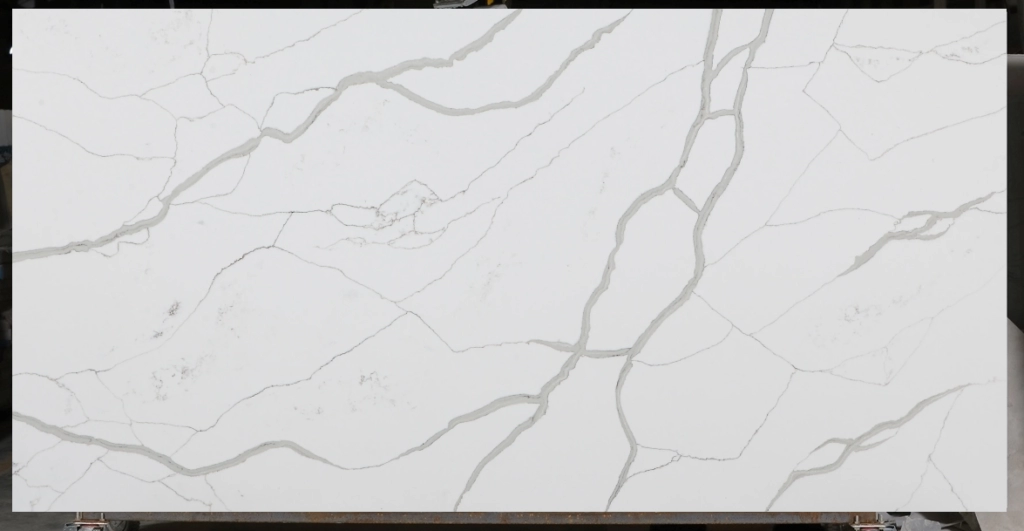
When deciding between these two giants of the engineered stone countertops world, the choice often comes down to how much visual weight you want the surface to carry. While both mimic natural Italian marble, the execution differs significantly in our manufacturing process.
Veining and Pattern Depth: Linear vs. Cloud-Like
The most obvious difference lies in the veining patterns. Artificial calacatta quartz stone is designed to be the protagonist of the room. We engineer these slabs with thick, dramatic veins that often stretch across the entire surface. The patterns are bold, linear, and distinct.
In contrast, Carrara quartz offers a “cloud-like” appearance. The veining is fine, feathery, and often blends softly into the background. It provides texture without demanding immediate attention, making it a safer bet for busy spaces.
- Calacatta: Thick, dramatic, high-contrast veins.
- Carrara: Wispy, soft, diffuse gray veins.
Background Hue and Undertones: Warm vs. Cool
Lighting in American homes varies greatly, so understanding the base color is critical. Artificial calacatta countertops typically feature a bright, crisp white background. This stark whiteness creates a high-contrast look that pairs exceptionally well with modern, clean aesthetics.
Carrara quartz leans towards a cooler, grey-white or blue-grey background. It feels softer and less sterile. If your kitchen has warmer lighting or you want a cozy vibe, the starkness of Calacatta might be too intense, whereas Carrara provides a gentle, neutral canvas.
| Feature | Calacatta Quartz | Carrara Quartz |
|---|---|---|
| Primary Look | Bold, dramatic luxury | Subtle, classic elegance |
| Vein Style | Thick, wide, defined | Thin, feathery, soft |
| Background | Bright, pure white | Soft white or light grey |
| Visual Impact | High contrast (Statement piece) | Low contrast (Blends in) |
Price Point Analysis: Manufacturing Complexity and Costs
Let’s talk numbers. Generally, artificial calacatta quartz stone commands a higher price point than Carrara. This isn’t just about branding; it is about quartz slab cost and manufacturing difficulty.
Creating the specific, wide-veined look of Calacatta requires more complex technology and precision. We have to control the flow of minerals to mimic those massive natural veins without looking pixelated or fake. Carrara patterns are more uniform and easier to reproduce consistently, which keeps production costs—and the final wholesale price—lower.
Why Through-Body Technology Matters for Realism
For a truly high-end finish, through-body veining is non-negotiable. In cheaper marble look quartz, the pattern is sometimes just printed on the surface. If you chip the edge or opt for a fancy profile, the illusion is ruined because the inside is a solid, pattern-less color.
We utilize full-body technology where the veins run through the entire thickness of the slab. This is essential for:
- Waterfall islands: The vein flows naturally over the edge.
- Undermount sinks: The cut-out reveals a consistent pattern.
- Durability: Surface scratches don’t reveal a different color underneath.
Investing in through-body technology ensures your artificial calacatta countertops look authentic from every angle, not just from the top down.
Design Pairing: Which One Fits Your Project?
Choosing between these two giants of engineered stone countertops often comes down to the specific layout and lighting of your room. We see thousands of renovations, and the “best” choice is always the one that balances the room’s scale with the cabinetry. Here is how we break it down based on real-world applications.
Scenario A: The Waterfall Island Statement Piece
If you are investing in a waterfall edge—where the stone extends down the side of the cabinetry to the floor—you want drama. Artificial calacatta quartz stone is the undisputed winner here. The large, sweeping veins need space to show off their movement. When we manufacture these slabs, we ensure the veining is bold enough to carry the eye from the horizontal surface down the vertical drop. Using a subtle Carrara here often results in the pattern getting lost, making the island look like a plain block of white from a distance. For a true centerpiece in kitchen island design, go bold.
Scenario B: Designing for Small Kitchen Footprints
In tighter spaces, like galley kitchens or condos, less is often more. A massive, aggressive vein pattern can make a small room feel cluttered or chaotic. This is where Carrara quartz shines. Its soft, cloud-like background and fine grain reflect light and make the space feel airier. It provides the elegance of a marble look quartz without visually shrinking the room.
Scenario C: Matching Quartz with Cabinet Colors
Your countertop does not exist in a vacuum; it has to talk to your cabinets. Here is our cheat sheet for nailing the interior design color palette:
- White Cabinets: If you go white-on-white, you need contrast to avoid a “hospital” look. Artificial calacatta countertops are perfect here because the thick grey or gold veins break up the monotony and add depth.
- Grey and Navy Cabinets: These popular cabinet colors usually have cool undertones. Carrara quartz pairs beautifully here because its background often leans towards a cool, blue-grey white, creating tonal harmony rather than a stark clash.
- Natural Wood Cabinets: Whether it is white oak or walnut, wood adds warmth. To bridge the gap between stone and wood, we recommend Calacatta Gold varieties. The subtle gold or beige accents in the veining pick up the warmth of the timber, tying the whole look together naturally.
Durability and Maintenance: The Technical Equalizer
When deciding between these two styles, many of my clients worry that the intricate veining of Artificial calacatta quartz stone might make it more fragile than the tighter grain of Carrara. Here is the truth: the difference is purely skin deep. Underneath the pattern, both are built from the exact same high-performance engineered stone countertops formula. Whether you choose the bold, dramatic veins or the soft, cloudy background, you are getting the same industrial-grade durability.
Mohs Hardness and Scratch Resistance Specs
We engineer these slabs to be tough. Quartz typically ranks a 7 on the Mohs Hardness Scale. To put that in perspective, stainless steel is usually around a 5.5, and natural marble is a soft 3. This means your quartz surface is significantly harder than the knife blade you might accidentally drag across it.
While I always recommend using a cutting board to protect your knives, the stone itself is incredibly resistant to scratching, chipping, and cracking. This hardness makes both Calacatta and Carrara styles ideal for high-traffic American kitchens where the island is used for everything from homework to meal prep.
Stain Resistance and Non-Porous Benefits
The biggest selling point for Artificial calacatta countertops over real marble is the non-porous surface. Natural stone is like a sponge; it has microscopic pores that suck up liquids. Engineered quartz is sealed by the resin during manufacturing.
- No Sealing Required: Unlike natural granite or marble, you never have to apply a chemical sealer to quartz.
- Hygiene: Bacteria and viruses have nowhere to hide because liquids cannot penetrate the surface.
- Stain Barrier: Common kitchen enemies like red wine, coffee, lemon juice, and olive oil sit on top of the surface rather than soaking in, making them easy to wipe away.
Simple Cleaning Routines for Engineered Stone
Countertop maintenance shouldn’t be a second job. Because these surfaces are chemically resistant, you don’t need expensive specialty cleaners. In fact, harsh chemicals are the only thing you really need to avoid.
The Daily Routine:
- Do: Use a soft cloth or sponge with warm water and mild dish soap.
- Do: Wipe up spills as they happen to keep the shine perfect.
- Don’t: Use abrasive scrubbing pads (like steel wool) which can dull the polish.
- Don’t: Use high-pH cleaners like bleach, oven cleaner, or paint remover. These can damage the resin bond over time.
Comparing Longevity: Is One Stronger Than the Other?
There is absolutely no difference in structural integrity between Calacatta and Carrara quartz. The vein pattern does not create weak points in the slab. Both styles utilize the same vibro-compression vacuum process, ensuring the material is dense and void-free.
Here is a quick breakdown of why marble look quartz outlasts the real thing:
| Feature | Engineered Quartz (Calacatta & Carrara) | Natural Marble |
|---|---|---|
| Porosity | Non-Porous (Waterproof) | Porous (Absorbs liquids) |
| Maintenance | Low (Soap & Water) | High (Regular Sealing) |
| Hardness | High (Resists Scratches) | Low (Prone to Etching) |
| Consistency | Uniform Strength | Natural Fissures/Cracks |
Whether you go for the bold look of Artificial calacatta quartz stone or the subtle elegance of Carrara, you are investing in a surface designed to last a lifetime.
Why Sourcing Matters: The Manufacturing Difference
When you invest in artificial calacatta quartz stone, the manufacturer you choose is just as critical as the color you pick. Not all engineered stone is created equal. The difference between a surface that looks like authentic luxury marble and one that looks like a cheap plastic imitation comes down to the technology and sourcing standards used during production. As an artificial stone manufacturer, we know that quality lies in the details.
Precision Technology for Realistic Non-Repetitive Patterns
The biggest giveaway of low-quality quartz is a repetitive, stamped pattern. Real marble doesn’t repeat itself every few feet, and neither should your countertops. We utilize advanced high-definition quartz printing and molding technologies to create artificial calacatta countertops with depth and variation.
- Randomized Veining: Our process ensures veins flow naturally across the slab rather than looking like a photocopied image.
- Depth Simulation: We layer materials to mimic the translucency of natural stone, avoiding that flat, one-dimensional look common in budget options.
- Through-Body Design: High-quality manufacturing ensures the pattern isn’t just printed on top but runs through the material, essential for realistic edges.
Customization Options for Wholesale Projects
For contractors and developers, off-the-rack solutions don’t always fit the bill. Sourcing directly from a manufacturer allows for customization that retail outlets simply cannot offer. When ordering wholesale quartz slabs, we can tweak specifications to fit the unique demands of a project.
- Slab Size & Thickness: Custom dimensions reduce waste and installation seams.
- Vein Matching: We can produce book-matched slabs for seamless waterfall islands or expansive backsplashes.
- Specific Hues: Adjusting the background whiteness or vein intensity to match specific cabinet paint codes.
Batch Consistency: The Advantage Over Natural Stone
One of the biggest headaches with natural marble is that the sample you see in the showroom is rarely what arrives at the job site. Engineered stone countertops solve this logistics nightmare through controlled manufacturing. When we produce a batch of artificial calacatta quartz stone, we guarantee uniformity in tone and pattern structure.
Consistency Comparison: Natural vs. Engineered
| Feature | Natural Marble | Premium Engineered Quartz |
|---|---|---|
| Color Variance | High; varies wildly between bundles. | Consistent; strictly controlled formulas. |
| Pattern Predictability | Unpredictable; depends on the quarry. | Designed; you get exactly what you ordered. |
| Scalability | Difficult to match large quantities later. | Repeatable; easy to source matching slabs for future phases. |
This consistency is vital for large-scale renovations or multi-unit developments where every kitchen needs to look identical. By controlling the source, we eliminate the guesswork and deliver a product that performs exactly as promised.
Frequently Asked Questions About Marble Look Quartz
We field a lot of questions from homeowners and contractors trying to decide between these two heavyweights. Since engineered stone countertops are a significant investment, it is crucial to clear up the confusion before placing an order. Here are the answers to the most common inquiries we receive.
Is Calacatta quartz always more expensive than Carrara?
Generally speaking, yes. Artificial calacatta quartz stone usually commands a higher price point than Carrara styles. This isn’t just about branding; it comes down to the manufacturing complexity.
- Production Time: Creating the wide, dramatic, and specific veining of Calacatta requires more precise technology and time than the uniform, speckled patterns of Carrara.
- Ink and Materials: Achieving that crisp, bright white background with bold contrasting veins often uses more expensive raw materials.
If you are working with a tight budget, Carrara is often the more wallet-friendly option for a marble look quartz surface.
Which style looks more like authentic luxury marble?
Both styles use high-definition quartz printing and through-body technology to look incredibly realistic, but they mimic different types of natural stone.
- Calacatta: Mimics rare, high-end Italian marble. If you want your kitchen to look like a luxury hotel lobby, artificial calacatta countertops are the closest match to that exclusive aesthetic.
- Carrara: Mimics the classic, standard marble found in older European architecture. It looks authentic in a traditional or understated way.
Does the vein pattern affect the durability of the slab?
No, and this is a major advantage of engineered stone countertops over natural rock. In natural marble, a heavy vein can sometimes indicate a fissure or a weak point where the stone might crack.
With quartz, the “vein” is purely aesthetic pigment suspended in the same durable resin-quartz mix as the rest of the slab. Whether you choose a slab with massive, thick veins or one with light dusting, the Mohs hardness and structural integrity remain exactly the same. You don’t have to worry about the pattern compromising the strength.
How do I choose between bold drama and subtle elegance?
This choice usually comes down to your kitchen island design and the size of your space.
- Choose Bold (Calacatta): If you have a large kitchen or a massive island that you want to use as a centerpiece. The wide veins need room to “breathe” to look their best.
- Choose Subtle (Carrara): If you have a smaller galley kitchen or busy cabinetry. If your cabinets are a bold color (like navy or forest green), a subtle Carrara backsplash won’t fight for attention.
Ultimately, check your interior design color palette. If you need warmth and drama, go Calacatta. If you need cool tones and consistency, stick with Carrara.
Post time: Jan-22-2026