
By Yvonne Deng
What Is the Difference Between Calacatta Quartz and Natural Marble
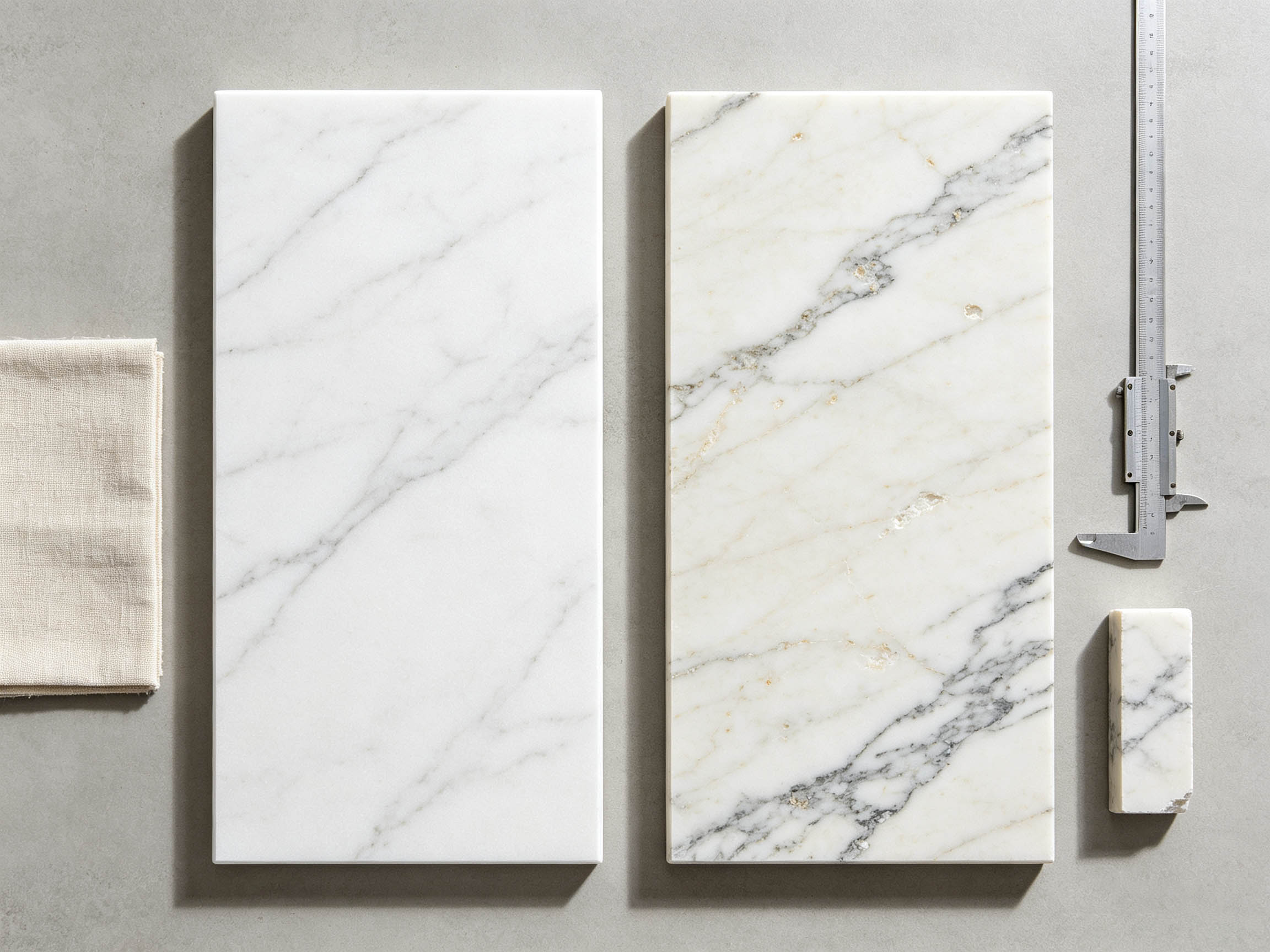
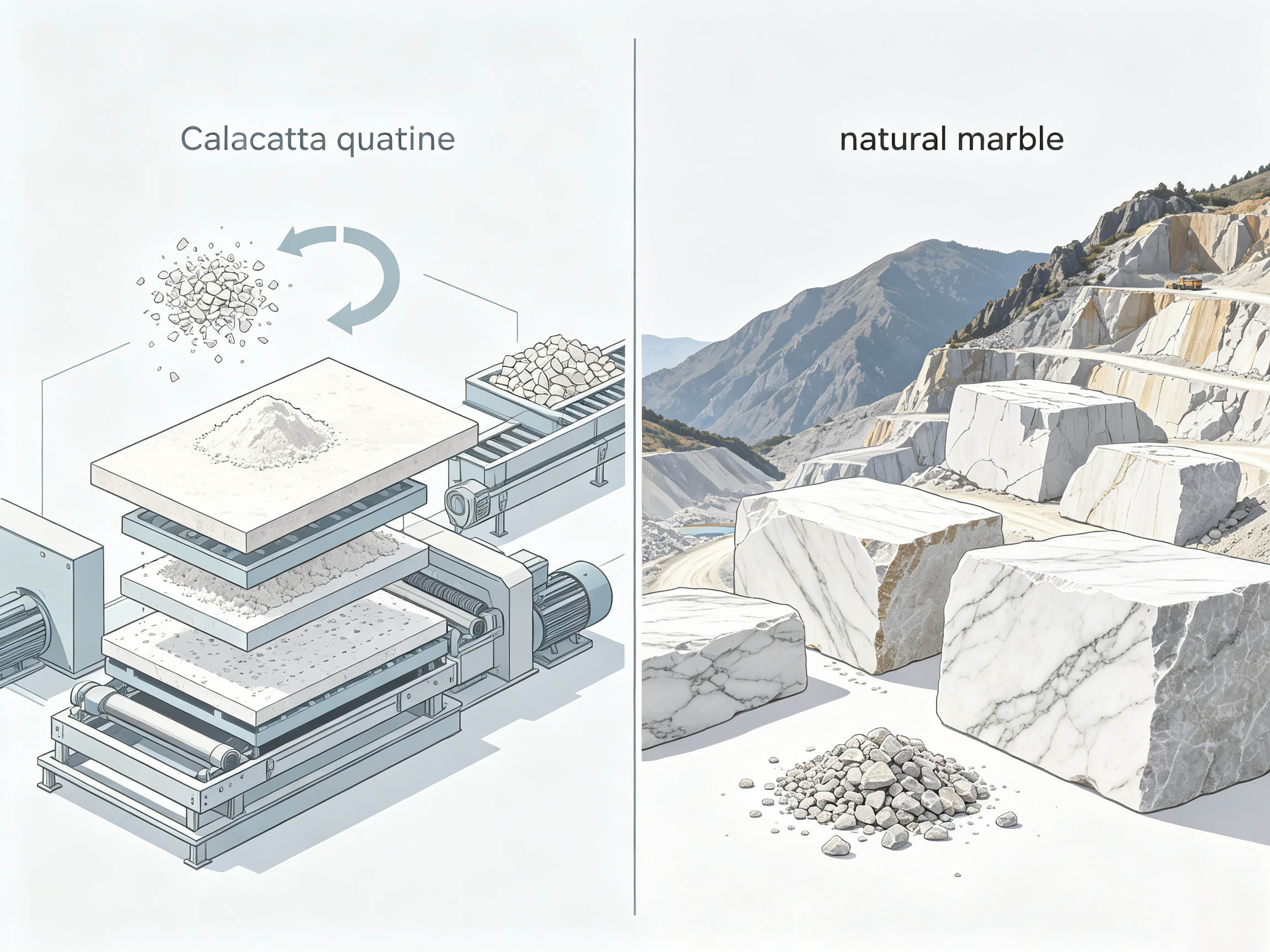
Calacatta quartz is an engineered stone composed of approximately 90-93% natural quartz aggregates bound with polymer resins and pigments that replicate the distinctive veining patterns of Calacatta marble. The result is a surface with the visual character of premium Italian marble and the enhanced physical properties of engineered quartz. Natural Calacatta marble, by contrast, is a metamorphic rock formed from limestone under extreme heat and pressure over millions of years, quarried from the Apuan Alps region of Italy. Its appeal lies in its authentic depth, translucency, and the unique veining patterns that no two slabs share. However, these natural qualities come with inherent vulnerabilities that engineered quartz addresses.
Comparison Dimension 1: Durability and Hardness
Quartz rates 7 on the Mohs hardness scale because of its 90-93% natural quartz crystal content. Natural Calacatta marble rates 3-4 on the same scale. Because of this 3-4 point hardness gap, quartz is significantly more resistant to scratching, chipping, and everyday wear. In practical terms, a kitchen countertop made of Calacatta quartz can withstand cutting board use, kitchen tools, and daily cleaning without visible surface change. A marble countertop of the same visual style will develop scratches, etches, and surface wear within months of regular use.
The difference in structural integrity is measurable. Engineered quartz has flexural strength of 40-60 MPa per ASTM C880 testing standards, while natural marble typically tests at 10-30 MPa depending on the specific quarry and block. Quartz is approximately 2-3 times stronger than marble in terms of resistance to bending stress.
| Property | Calacatta Quartz | Natural Calacatta Marble |
|---|---|---|
| Mohs Hardness | 7 | 3-4 |
| Flexural Strength | 40-60 MPa | 10-30 MPa |
| Water Absorption | Less than 0.1% | 0.2-0.5% |
| Scratch Resistance | High | Low |
| Impact Resistance | Moderate-High | Low-Moderate |
Comparison Dimension 2: Stain Resistance and Porosity
Quartz is non-porous because of the polymer resin that fills all spaces between quartz particles. Water absorption is less than 0.1%. Natural marble is porous. Water absorption typically ranges from 0.2-0.5%, and the stone contains micro-fractures and natural fissures that absorb liquids. Because of this fundamental difference, quartz does not require sealing and resists staining from coffee, wine, oil, and acidic foods. Marble requires periodic sealing and immediate cleanup of spills. Even with sealing, acidic substances like lemon juice or vinegar can etch the polished surface of marble within minutes of contact.
In a kitchen environment, the practical implication is significant. A Calacatta quartz countertop can handle daily cooking without special care. A marble countertop in the same setting requires constant vigilance, immediate spill cleanup, and regular professional maintenance to maintain its appearance. The total cost of ownership for marble includes ongoing maintenance expenses that quartz does not require.
Comparison Dimension 3: Heat Resistance
Natural marble performs better under direct heat. Because marble is 100% natural stone formed under extreme geological heat and pressure, it can withstand direct contact with hot cookware without damage. An empty hot pan straight from the stove can sit on marble without causing harm. Engineered quartz, because of its resin content (7-10%), is heat-resistant but not heat-proof. The polymer resin binders soften at temperatures above 150 degrees Celsius. Placing a very hot pan directly on a quartz surface can cause localized damage or discoloration.
This is one area where honest comparison requires acknowledging marble’s advantage. For homeowners who frequently place hot cookware directly on countertops, marble offers superior heat tolerance. The practical solution for quartz users is to use trivets or hot pads, which is standard practice for most countertop materials regardless. When compared with other engineered surfaces, quartz still outperforms solid surface materials (which can be damaged by heat above 80 degrees Celsius) and competes well with sintered stone alternatives.
Comparison Dimension 4: Maintenance Requirements
Calacatta quartz requires minimal maintenance. Daily cleaning with mild soap and water is sufficient. No sealing is needed. No special cleaners are required. For homeowners, this means the countertop maintains its appearance with basic cleaning routines. Marble requires significantly more maintenance. Annual or semi-annual sealing with a penetrating sealer is required. Acidic cleaners cannot be used. Spills must be wiped immediately. Professional re-polishing may be needed every 3-5 years to restore surface finish. The annual maintenance cost for marble, including sealant and professional services, typically ranges from $200-500 depending on countertop size and local service rates. Quartz has no comparable ongoing maintenance cost.
| Maintenance Factor | Calacatta Quartz | Natural Marble |
|---|---|---|
| Sealing Required | Never | Every 6-12 months |
| Daily Cleaner | Mild soap + water | pH-neutral stone cleaner only |
| Acidic Substance Risk | Low | High – etches immediately |
| Professional Maintenance | None needed | Every 3-5 years |
| Annual Maintenance Cost | $0 | $200-500 estimated |
Comparison Dimension 5: Appearance and Visual Consistency
Natural Calacatta marble offers unmatched depth, translucency, and organic veining that is unique to each slab. Light penetrates the surface of natural marble and reflects from within, creating a luminous quality that engineered materials cannot fully replicate. The veining in natural marble is formed by mineral deposits over geological time, resulting in complex, unpredictable patterns that are uniquely beautiful. Each slab of natural Calacatta marble is genuinely one of a kind.
Calacatta quartz offers consistent veining patterns across production batches. For large projects requiring multiple slabs, this consistency is a significant advantage. A commercial kitchen or hotel lobby using quartz can achieve matching appearance across all surfaces. The same project in natural marble would require marble selection from the same block, which is logistically challenging and expensive. Modern quartz manufacturing has advanced significantly in replicating marble’s visual character. Premium Calacatta quartz designs use multiple particle sizes, layered color application, and sophisticated veining techniques to approach the visual complexity of natural marble. Browse the Calacatta quartz slab collection to see current design capabilities.
Comparison Dimension 6: Cost Analysis
Calacatta quartz costs significantly less than natural Calacatta marble. Quartz pricing for Calacatta designs typically ranges from $60-100 per square foot installed for premium products. Natural Calacatta marble costs $100-250 per square foot installed depending on slab selection, thickness, and fabrication complexity. The price difference is roughly 40-60% in quartz’s favor at the installation stage. When total cost of ownership is considered over a 20-year period, the gap widens further because of marble’s ongoing maintenance costs. For a typical kitchen with 50 square feet of countertop, the 20-year total cost for quartz is approximately $3,000-5,000 installed with zero maintenance cost. The same kitchen in natural marble costs $5,000-12,500 installed plus $200-500 per year in maintenance, totaling $9,000-22,500 over 20 years.
Marble also requires fabrication by specialists experienced with natural stone, and fabrication costs are higher because of the material’s delicacy. Seam matching is more complex for marble because of its varied veining. Breakage risk during fabrication is higher for marble, and fabricators typically factor this risk into their pricing. Contact the Apex team for current pricing on Calacatta quartz slabs and export terms.
Comparison Dimension 7: Sustainability and Lifecycle
Both materials have environmental considerations. Quartz manufacturing consumes energy for mixing, compression, and curing, and the resin content (7-10%) is petroleum-derived. However, quartz production generates minimal waste because rejected slabs and trimmings can be reprocessed into new products. Marble quarrying involves extracting large blocks from mountains, with significant quarry waste. Approximately 30-40% of quarried marble becomes unusable scrap, and quarry operations have visible environmental impact on mountain landscapes. Marble has the advantage of being a completely natural material with no synthetic content, and it can be repurposed or crushed for aggregate at end of life.
In terms of longevity, both materials can last 20+ years with proper care. Marble may require more intensive maintenance to maintain appearance over time. Quartz may need professional re-polishing after 15-20 years of heavy use to restore original gloss levels. Neither material is clearly superior from a sustainability perspective. The choice depends on which environmental factors matter most to the buyer.
Which One Should You Choose
Choose Calacatta Quartz when:
- Low maintenance is a priority — you want beautiful countertops without ongoing care requirements
- The application is a kitchen — daily cooking demands scratch and stain resistance
- Budget is a consideration — quartz offers significant upfront and lifecycle cost advantages
- Color consistency across multiple slabs matters — quartz provides batch-to-batch uniformity
- You need a warranty with reliable performance guarantees
Choose Natural Calacatta Marble when:
- Authenticity is non-negotiable — the depth and uniqueness of natural stone are essential to your design
- The application is low-traffic — bathroom vanities, fireplace surrounds, and decorative surfaces where wear is minimal
- Heat exposure is frequent — for avid cooks who frequently place hot cookware on countertops
- Budget is not a constraint — the higher cost of material, installation, and ongoing maintenance is acceptable
- You appreciate natural variation — the unique character of each slab is part of the appeal
When neither ideal applies: For projects requiring extreme heat resistance or industrial durability, sintered stone or porcelain slabs may offer better performance than either quartz or marble. Consult with a material specialist for specialized application requirements.
Conclusion
The choice between Calacatta quartz and natural marble depends on your specific priorities. Calacatta quartz excels in durability, stain resistance, low maintenance, consistency, and cost. Natural marble excels in authenticity, heat resistance, and unique visual character. For most kitchen applications and high-traffic commercial settings, engineered Calacatta quartz provides superior practical performance with the same elegant aesthetic. For installations where authenticity and natural beauty are the primary concern and maintenance requirements are acceptable, natural marble delivers an unmatched experience. View the Calacatta quartz collection to see how modern engineered stone captures the beauty of Italian marble with enhanced performance characteristics.
Post time: Jul-17-2026