
What Exactly is Calacatta Quartz?
If you have been scrolling through Pinterest or Instagram looking for kitchen inspiration, you have definitely seen calacatta quartz countertops. But there is often confusion about what this material actually is. Is it natural? Is it fake? The answer lies somewhere in between. As someone deeply involved in the stone industry, I can tell you that this is where nature gets a massive upgrade from technology.
Composition: Nature Meets Engineering
We call this engineered stone surfaces for a reason. It is not sliced directly from a mountain like granite; it is crafted to perfection. Calacatta quartz is typically composed of about 90% to 93% ground natural quartz—one of the hardest minerals on Earth.
To create that durable slab you see in showrooms, we mix the crushed quartz with a small percentage of high-quality polymers, resins, and pigments. This resin and natural quartz blend binds the rock together, resulting in a surface that is significantly harder and more flexible than natural stone. You get the raw strength of rock without the brittleness or hidden fissures found in quarried slabs.
The Aesthetic: Defining the Calacatta Look
Why is everyone obsessed with Calacatta specifically? It is all about the drama. Unlike Carrara quartz, which usually features soft, wispy veining, the Calacatta look is bold and distinct.
- Stark White Background: The canvas is usually a bright, crisp white, much cleaner than the greyish hues of other stone types.
- Dramatic Veining Patterns: We engineer these slabs to feature thick, striking veins that range from deep grey to warm gold.
- Luxury Appeal: It is the ultimate marble lookalike, designed to mimic the high-end Italian Calacatta marble found in Tuscany, but with consistent coloring that nature can’t guarantee.
Manufacturing Excellence: The Vibro-Compression Process
The secret to the durability of our calacatta quartz countertops isn’t just the ingredients; it is the process. We use a manufacturing technique often referred to as vibro-compression under vacuum.
Here is the breakdown of how we ensure structural integrity:
- Vacuum Sealing: We remove all air pockets from the mix to ensure there are no weak spots.
- Vibration & Pressure: The slab is vibrated at high frequencies while being compressed under immense weight (often up to 100 tons).
- Curing: The slabs are heated to cure the resin, locking everything in place.
This process transforms the mix into a completely non-porous material. Unlike natural marble, which acts like a sponge for red wine and oil, our engineered quartz is dense and impenetrable right out of the factory.
Why Homeowners Are Switching to Engineered Stone
We see it every day—people love the look of marble but hate the upkeep. That is exactly why engineered stone surfaces have taken over the US market. We aren’t just selling a surface; we are providing a solution that solves the headaches associated with natural stone without sacrificing that high-end aesthetic.
Unmatched Durability on the Mohs Hardness Scale
When we talk about toughness, we look at the Mohs hardness scale. Natural marble is soft and prone to scratching, usually ranking around a 3 or 4. Our quartz sits at a solid 7. This means your calacatta quartz countertops are harder than steel and significantly more resistant to chips and scratches than granite or marble. It is built to handle the daily grind of a busy American kitchen.
Non-Porous and Stain-Resistant Benefits
The real game-changer here is that quartz is a non-porous material. Natural stone is full of microscopic holes that suck up liquids. Our manufacturing process eliminates those pores.
- Stain Resistance: Spills like red wine, coffee, and olive oil stay on the surface rather than soaking in, making these stain resistant countertops.
- Easy Cleanup: Because liquids don’t penetrate, you don’t need special cleaners to get stains out.
Zero Maintenance vs. Natural Marble
If you choose natural marble, you are signing up for a lifetime of maintenance. It requires regular sealing to prevent permanent damage. With our quartz, there is no sealing required—ever. This delivers a true low maintenance kitchen design where you can enjoy the beauty of the stone without the chore list.
Hygienic Properties for Food Prep
Since there are no pores for bacteria, mold, or mildew to hide in, quartz is one of the safest surfaces for food preparation. You can prep meals directly on the surface knowing it meets high hygiene standards, making it the smart choice for families.
Popular Variations of Calacatta Quartz Countertops
When we talk about calacatta quartz countertops, we aren’t limited to a single design. The beauty of engineered stone is the ability to curate specific aesthetics that fit different home styles, from traditional farmhouses to sleek city apartments. We see a few distinct styles leading the market right now.
Calacatta Gold: Warm Undertones
This is the top choice when you want to avoid the “coldness” sometimes associated with white stone. Calacatta Gold features a crisp white background interrupted by thick veins of grey and distinctive ribbons of gold or beige.
- Best for: Kitchens with brass or gold hardware.
- Vibe: Luxurious and inviting.
- Pairing: Looks incredible against warm wood cabinetry.
Calacatta Laza & Classique: Dramatic Grey Veins
If you are looking for dramatic veining patterns, this is where the action is. These variations mimic the boldest natural stones with sweeping movement across the slab. The veins are often dark and prominent, creating a high-contrast look that serves as art for your kitchen. This style is frequently used for a kitchen island waterfall edge because the pattern flows beautifully down the sides.
Calacatta Nuvo: The Minimalist Look
Not everyone wants the countertop to shout. For modern kitchen remodeling, variations like Nuvo offer a subtler approach. The veining is typically wider but much softer and more diffused than the sharp lines of Classique. It provides that classic marble elegance without overpowering the rest of the room’s design.
Quick Comparison: Calacatta Gold vs Laza
- Gold: Adds warmth, pairs with mixed metals.
- Laza: Adds drama, focuses on high-contrast grey movement.
Calacatta Quartz vs. Natural Marble: The Showdown
When we talk to homeowners about calacatta quartz countertops, the biggest competitor is always the real deal: natural marble. We appreciate the classic history of natural stone, but when it comes to living with it every day, the differences become obvious. Here is why engineered stone surfaces are winning the battle against traditional quarry stone in American homes.
Cost Comparison
Let’s be real about the budget. Genuine Calacatta marble from Italy is one of the most expensive stones on the market due to its rarity. You are paying for the name, the import logistics, and the scarcity.
- Natural Marble: High initial price tag, plus significant lifetime costs for professional sealing and specialized cleaners.
- Calacatta Quartz: Offers that high-end marble lookalike aesthetic at a much more accessible price point. You get the luxury vibe without breaking the bank on installation or future upkeep.
Consistency in Pattern
Nature is unpredictable. With marble, you might fall in love with a sample, but the actual slab could have heavy inclusions, fissures, or uneven coloring you didn’t expect. Because we manufacture quartz, we have total control over the design.
- Predictable Beauty: We ensure the dramatic veining is consistent across every slab, so there are no surprises on install day.
- Perfect Alignment: It is much easier to create seamless bookmatched quartz slabs for a massive island or feature wall because the pattern is engineered to line up perfectly, unlike the random variations of nature.
Application Suitability
This is where the “form vs. function” debate usually ends. Marble is porous and soft (calcite-based); it etches the second lemon juice, tomato sauce, or vinegar touches it. Calacatta quartz countertops are non-porous and incredibly tough.
| Feature | Natural Marble | Calacatta Quartz |
|---|---|---|
| Porosity | High (Absorbs liquids) | Non-porous (Repels liquids) |
| Acid Resistance | Poor (Etches easily) | Excellent (Resists acids) |
| Maintenance | High (Requires sealing) | Zero Maintenance (No sealing) |
For busy kitchens, quartz handles the mess without staining. It resists moisture and bacteria better than natural stone, making it the superior choice for everything from bathroom vanities to high-traffic kitchen islands. If you want a surface that stays looking pristine with zero stress, quartz is the practical winner.
Design Inspiration: Where to Use Calacatta Quartz
When planning a modern kitchen remodeling project, the versatility of engineered stone is a game-changer. We aren’t limited to just standard counter surfaces anymore; these slabs are being used to create architectural statements. Here is how I see calacatta quartz countertops making the biggest impact in American homes.
The Waterfall Island
Nothing anchors a room quite like a kitchen island waterfall edge. By extending the quartz material down the sides of the cabinetry to the floor, you create a stunning focal point that defines the space.
- Seamless Flow: We often use bookmatched quartz slabs to ensure the dramatic veining flows uninterrupted from the horizontal surface over the edge.
- Cabinet Protection: Beyond aesthetics, the stone protects the side of your cabinets from scuffs, spills, and shoe marks in high-traffic zones.
Full-Height Backsplash
I always suggest extending the countertop material up the wall to replace traditional tile. A full-height backsplash eliminates the visual clutter of grout lines, offering a sleek, unified appearance. It makes the kitchen feel larger and showcases those bold grey or gold veins at eye level. Plus, wiping down a smooth quartz surface is infinitely easier than scrubbing grease out of tile grout behind a stove.
Bathroom Vanities
Calacatta quartz countertops are perfect for turning a master bath into a personal spa. Because the material is non-porous, it handles humidity, makeup spills, and toothpaste splatters without etching or staining. Whether it is a floating vanity or a double-sink setup, the bright white background keeps the space feeling clean and airy while standing up to daily wear.
How to Recognize High-Quality Calacatta Quartz Countertops
Not all engineered stone surfaces are created equal. I have seen plenty of slabs that look fantastic from a distance but fail the inspection when you get up close. If you are investing in calacatta quartz countertops for your home, you need to know exactly what separates premium manufacturing from budget imitations. Here is what I look for to ensure a slab meets the highest standards.
The Importance of Through-Body Veining
This is the number one indicator of quality. On cheaper slabs, the “marble” pattern is essentially printed on the surface. If you chip it or cut an edge, the design disappears.
- Check the Edge: High-quality quartz features through-body veining. This means the dramatic veining patterns run through the entire thickness of the slab.
- Why it Matters: This is non-negotiable if you are planning a kitchen island waterfall edge or an undermount sink. You want the veins to flow naturally over the edge, mimicking the behavior of real stone.
Whiteness of the Background
The defining characteristic of the Calacatta look is the stark contrast between the background and the veining.
- Crisp vs. Muddy: A premium slab should have a bright, crisp white background. Lower-quality resin and natural quartz blends often suffer from a muddy, greyish, or yellowish tint due to impure raw materials.
- Clarity: We prioritize high-purity quartz sand to ensure the background remains snowy white, providing the perfect canvas for those bold grey or gold veins.
Avoiding Resin Pooling
“Resin pooling” is a manufacturing defect you need to avoid. It happens when the resin and quartz aggregate are not mixed or vibrated correctly during the vibro-compression process.
- The Look: It looks like a blob of colored plastic or a dark pool where the pattern distorts or disappears. It breaks the illusion of natural stone.
- Consistency: A top-tier slab will have a consistent distribution of quartz and resin across the entire surface, ensuring the pattern flows smoothly without awkward, artificial-looking splotches.
Care and Maintenance Tips
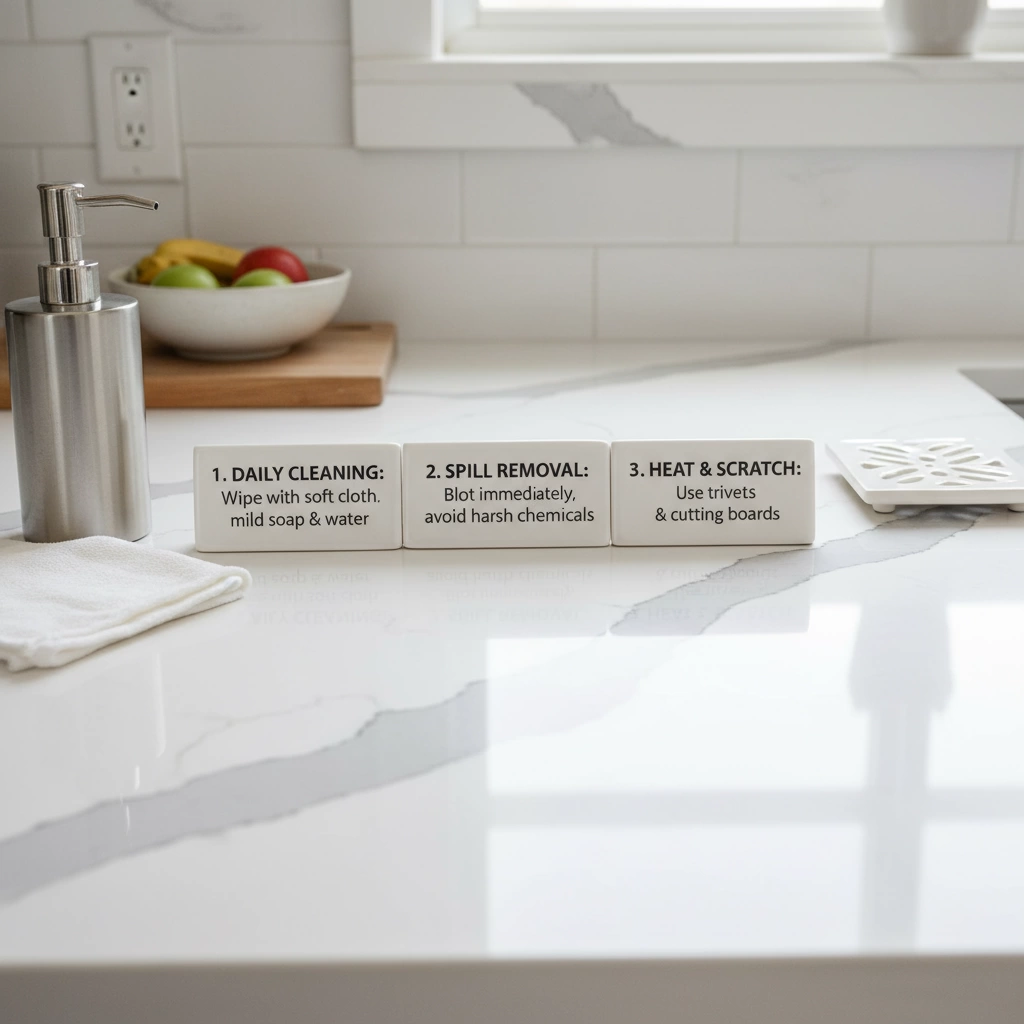
One of the main reasons homeowners love calacatta quartz countertops is the low maintenance kitchen design they offer. We engineered these slabs to handle the chaos of a busy American home without needing the constant sealing required by marble. However, low maintenance doesn’t mean zero maintenance. Keeping that pristine white background and dramatic veining looking sharp is simple if you follow the right routine.
Daily Cleaning Routine
You don’t need expensive specialty cleaners to keep your surfaces shining. Since we are dealing with stain-resistant countertops, the cleaning process is straightforward:
- Mild Soap and Water: A soft cloth or sponge with warm water and a drop of mild dish soap is usually all it takes to remove grease and crumbs.
- Wipe Spills Promptly: While the surface is non-porous, letting wine, coffee, or tomato sauce sit for days can eventually leave a surface film or make cleaning harder than it needs to be.
- Avoid Abrasives: Steer clear of steel wool or scouring pads. They can dull the polished finish over time.
What to Avoid: Chemicals and Heat
Despite being durable, engineered stone surfaces have specific vulnerabilities due to the resin used in manufacturing. Understanding the heat resistance limits is crucial for longevity.
- Use Trivets and Hot Pads: Sudden, extreme heat from a pot right off the stove can cause thermal shock or discolor the resin (leaving a yellow ring). Always put a barrier between hot cookware and the quartz.
- Skip Harsh Chemicals: Avoid bleach, oven cleaners, drain openers, or anything with a high pH. These can strip the polish and damage the surface permanently.
- No Sharp Objects: While quartz is scratch-resistant, cutting directly on the countertop can dull your knives and potentially scratch the resin binder. Always use a cutting board.
Frequently Asked Questions About Calacatta Quartz
Is Calacatta Quartz Expensive?
generally, Calacatta quartz countertops sit at the higher end of the engineered stone surfaces price spectrum. Because the manufacturing process required to create those dramatic veining patterns is more complex than standard fine-grain quartz, you are paying for the aesthetic precision. However, when compared to the authentic Italian marble it mimics, it is often more affordable and offers significantly better long-term value due to its lack of maintenance costs.
Does Calacatta Quartz Stain?
One of the biggest selling points here is that this is a non-porous material. Unlike natural stone, it does not have microscopic holes that hold onto liquids. Stain-resistant countertops like these handle red wine, coffee, and lemon juice exceptionally well without needing to be sealed. While it is incredibly resistant, I always recommend wiping up spills reasonably quickly to keep the surface pristine.
Can You Put Hot Pans on Quartz?
This is the most common mistake homeowners make. While quartz is tough, the resin and natural quartz blend has specific heat resistance limits. Placing a scorching hot skillet directly on the surface can cause “thermal shock” or scorch the resin binder, leaving a permanent mark. To stay safe, always use a trivet or hot pad.
How Does Quanzhou APEX Ensure Quality?
At Quanzhou APEX, we focus heavily on consistency and structural integrity. Our quality control process ensures that every slab maintains precise slab thickness and that the through-body veining looks natural rather than printed on. We rigorously inspect for color consistency to ensure the background is a crisp, clean white and that there are no defects or resin pools, ensuring you get a premium product ready for installation.
Post time: Feb-25-2026