
You’ve seen them all over design feeds: sleek, continuous countertops that flow perfectly into the basin without a single gap.
But is a seamless quartz sink actually practical for a real home, or just a fragile design trend waiting to crack?
It is the biggest question in 2026 kitchen renovations.
On one hand, you get superior hygiene and a stunning monolithic quartz sink aesthetic. On the other, you face higher costs and the fear of permanent damage.
Well, you’re in the right place.
In this guide, we are cutting through the marketing noise to break down the real pros, cons, and costs of integrated kitchen sinks.
Here is the honest truth about whether they are worth the hype.
Let’s dive in.
What Is a Seamless Quartz Integrated Sink?
You’ve likely seen them in high-end design magazines—kitchen islands where the countertop seems to dive effortlessly into the basin without a break in the visual flow. That is a seamless quartz sink. Unlike traditional setups where a metal or ceramic bowl is glued underneath or dropped on top of the counter, an integrated kitchen sink is fabricated from the exact same slab material as your quartz countertops.
This isn’t just a design trick; it’s a feat of custom quartz fabrication. We create these units by taking the slab material and using precision CNC routing to cut the basin components. The pieces are then joined using mitered edges and high-strength, color-matched epoxy. The result is a monolithic quartz sink that looks like it was carved from a single block of stone.
How It Differs From Standard Sinks
To understand the hype, you have to look at the construction. Standard quartz composite sinks or stainless steel basins are separate units. An integrated sink is physically bonded to become part of the countertop structure.
Here is a quick breakdown of how they compare:
| Feature | Integrated Quartz Sink | Undermount Sink | Drop-In Sink |
|---|---|---|---|
| Connection | Fused with epoxy (Seamless) | Silicone caulk & clips | Rim rests on counter |
| Visual Flow | Continuous, monolithic look | Visible rim/overhang | Distinct separation |
| Hygiene | No crevices for grime | Silicone can mold over time | Rim traps debris |
| Material | Matches countertop perfectly | Metal, porcelain, or composite | Metal or porcelain |
The Material Science: Engineered Quartz
These sinks are crafted from engineered quartz, typically a blend of 90%+ natural ground quartz aggregates mixed with polymer resins and pigments. This composition is crucial because it makes the sink non-porous. Unlike natural marble or granite which might require sealing, the resin binder in a seamless quartz sink creates a hard surface that resists water absorption and bacteria penetration naturally.
The Visual Payoff
The primary driver for choosing this style is the aesthetic. By eliminating the silicone joint found in undermount vs integrated sink debates, you achieve a clean, contemporary look. There is no visual interruption—just a smooth transition from the prep surface down to the drain. For a luxury kitchen remodel, this seamless transition offers a level of sophistication that standard drop-ins simply cannot match.
The Pros of Seamless Quartz Integrated Sinks
When we talk about a seamless quartz sink, we aren’t just talking about a pretty face. The real value lies in how it solves the headaches typical with standard sinks. Here is why I often recommend this setup for a luxury kitchen remodel.
Superior Hygiene and Cleanliness
The number one reason homeowners switch to an integrated kitchen sink is hygiene. Traditional undermount sinks rely on a bead of silicone to seal the gap between the counter and the basin. Over time, that silicone degrades and becomes a breeding ground for black mold and bacteria.
- No Crevices: Because the sink and counter are bonded as a monolithic quartz sink, there is nowhere for grime to hide.
- Effortless Cleaning: You can wipe crumbs, water, and veggie peels directly from the countertop into the basin without hitting a “speed bump” or lip.
Aesthetic Excellence and Noise Reduction
Visually, nothing beats the continuous flow of a quartz countertop sink. It creates a sleek, modern look that makes the kitchen feel larger and less cluttered. Beyond looks, the density of the material offers a practical benefit: silence. Unlike the tinny clang of stainless steel, the thick quartz dampens the sound of dishes and running water significantly.
Customization and Sustainability
Since we fabricate these from the same slab material, we aren’t limited to stock sizes found at big-box stores.
- Tailored Fit: We can customize the depth and shape to fit your specific cooking habits, or add integrated drainboards.
- Eco-Friendly: Often, the basin is constructed using offcuts from the main slab fabrication, reducing waste and maximizing the material yield.
The Cons and Potential Drawbacks of Seamless Quartz Sinks
While the aesthetic appeal of a monolithic quartz sink is undeniable, I always believe in giving the full picture before you commit to a luxury kitchen remodel. The reality is that achieving that sleek, continuous look comes with specific trade-offs that don’t apply to a standard drop-in or undermount setup.
High Upfront Investment
The biggest hurdle for most homeowners is the price tag. You are looking at a 30-50% premium over standard undermount vs integrated sink installations. This isn’t just about the material cost; the bulk of this expense goes into custom quartz fabrication. Creating a seamless flow requires precise CNC routing, mitered edges, and skilled labor to bond the sink to the quartz countertops. It is labor-intensive work that simply costs more than cutting a hole for a stainless steel basin.
The “Fatal Flaw” of Repair Risks
This is the most critical point I stress to clients: integration means permanence. Because the sink is fused to the countertop to create that seamless quartz sink look, they act as a single unit.
- Major Damage: If you crack the basin, you generally cannot just pop it out and replace it. In many cases, a damaged sink means ripping out the entire countertop run.
- Chip Repair: Small chips can be filled with color-matched epoxy, but structural cracks are often catastrophic for the assembly.
Vulnerability and Durability Concerns
When comparing stainless steel vs quartz sink durability, steel is flexible; quartz is rigid. If you drop a heavy cast-iron skillet into a stainless sink, it might dent. If you drop that same skillet into a composite quartz sink, the stone can chip or crack. It is less forgiving of clumsy moments, which is a significant factor for busy family kitchens.
Thermal and Stain Considerations
Despite being non-porous, quartz sink durability has limits regarding heat and chemicals.
- Heat Shock: Pouring boiling water directly into the basin or placing a hot pot on the surface can cause thermal shock, leading to cracks or discoloration (white hazing).
- Chemical Sensitivity: Harsh cleaners (like bleach or drain uncloggers) can dull the resin finish over time. Proper quartz countertop care extends to the sink—you have to be more gentle with it than you would with granite or steel.
Installation and Resale Factors
This is absolutely not a DIY project. The installation requires specialized adhesives and clamping systems that only professional fabricators possess. Furthermore, the design is highly specific. While you might love a custom-colored integrated kitchen sink, future buyers might prefer the versatility of a standard sink. The personalized nature of these sinks can sometimes limit resale flexibility compared to universally accepted materials like stainless steel or white fireclay.
Seamless Quartz vs. Popular Alternatives
When I’m planning a luxury kitchen remodel, the sink decision usually comes down to a battle between aesthetics and utility. While a seamless quartz sink offers that stunning monolithic look, it is vital to see how it stacks up against the standard options found in most American homes.
Here is a breakdown of how integrated kitchen sinks compare to stainless steel, composite undermounts, granite, and solid surface options in terms of durability, cost, and daily livability.
Material Showdown: Integrated Quartz vs. The Rest
| Feature | Integrated Quartz Sink | Stainless Steel | Quartz Composite (Undermount) | Granite | Solid Surface (Acrylic) |
|---|---|---|---|---|---|
| Durability | High (Scratch resistant, but can chip) | Very High (Heat/Impact resistant) | High (Heat resistant, tough) | High (Hard, but porous) | Medium (Scratches easily) |
| Cost | $$$$ (Premium fabrication) | $ – $$ (Affordable) | $$ – $$$ (Mid-range) | $$$$ (Expensive) | $$ – $$$ (Mid-range) |
| Maintenance | Easy (Seamless wipe-down) | Easy (Scrubbable) | Moderate (Can stain/haze) | High (Requires sealing) | Easy (Sandable) |
| Noise Level | Low (Dampens sound) | High (Clatters without pads) | Low (Dampens sound) | Low (Solid mass) | Low (Soft material) |
| Aesthetics | Seamless, Modern, High-end | Industrial, Classic, Utilitarian | Matte, Contemporary | Natural, Unique Veining | Seamless, Plastic-feel |
| Repair Ease | Difficult (Professional fix only) | Easy (Replace unit) | Difficult (Replace unit) | Difficult (Epoxy fill) | Very Easy (Buff out) |
Key Matchups: Where Quartz Wins and Loses
Stainless Steel vs. Quartz Sink
The biggest debate usually happens here. Stainless steel is the undisputed champion of heat tolerance and affordability. You can drop a hot cast iron skillet in it without a second thought. However, seamless quartz sinks win hands down on hygiene and style. Without the silicone rim found in undermount vs. integrated sink installations, there is nowhere for gunk to hide. If you hate scrubbing that rim of black mold, quartz is the winner.
Quartz Composite vs. Integrated Fabrication
Standard composite quartz sinks (drop-in or undermount) are molded in a factory, making them denser and more heat resistant than a fabricated slab sink. However, they lack the color continuity of quartz countertops. If you want the sink to perfectly match the counter veins, custom fabrication is the only path, even if it demands slightly more care regarding thermal shock.
Solid Surface vs. Quartz
Solid surface (like Corian) allows for seamless integration just like quartz but is much softer. It scratches if you look at it wrong. Quartzite stone countertops and engineered quartz offer a much harder surface that resists daily wear and tear far better than acrylics, making them the superior choice for a high-traffic modern kitchen.
Real-World Maintenance and Longevity
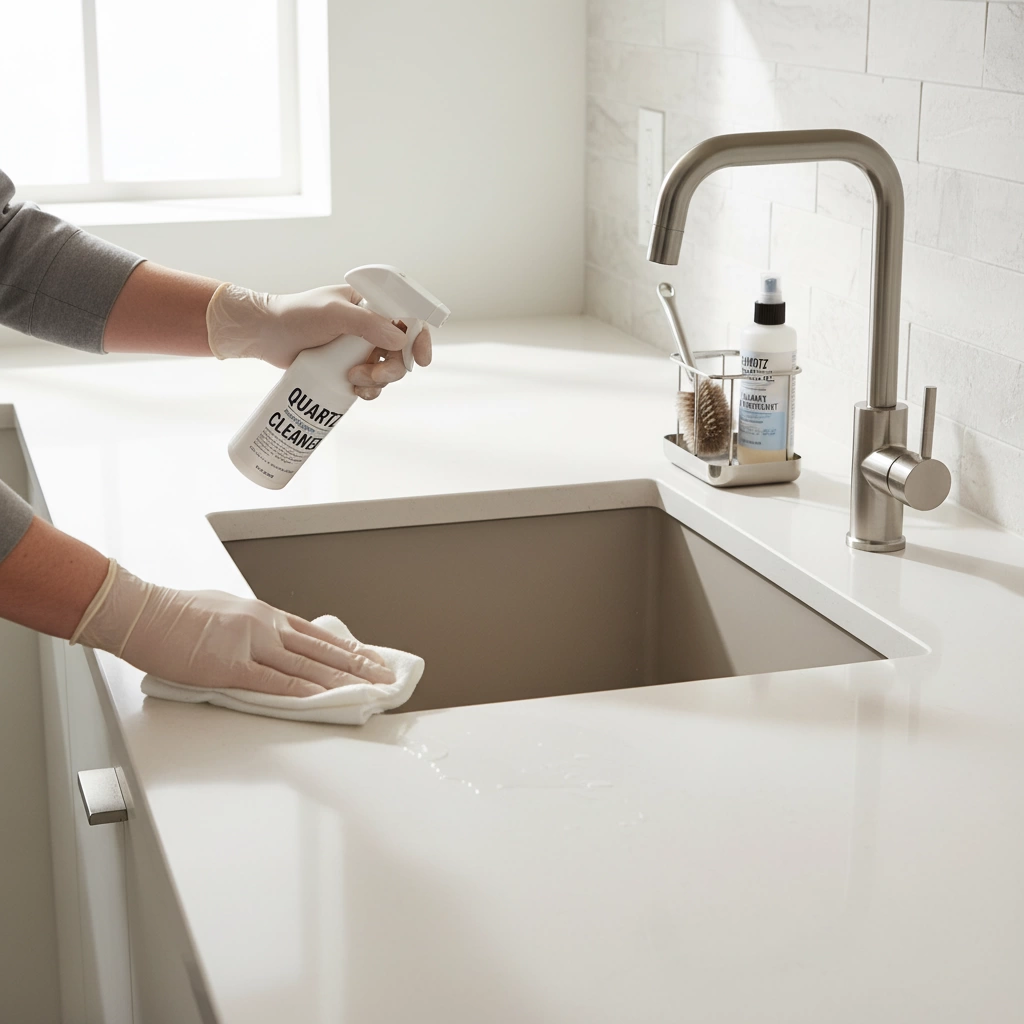
Living with a seamless quartz sink requires a slightly different mindset than using stainless steel, but the payoff in hygiene and aesthetics is substantial. I always tell clients that while quartz sink maintenance is low effort, it is not “no effort.” The key is consistency rather than heavy-duty scrubbing.
Daily Care and Cleaning Tips
For day-to-day cleaning, simplicity wins. You generally do not need expensive specialty products for effective quartz countertop care.
- Routine Cleaning: Use warm water and mild dish soap with a soft cloth or microfiber towel. This removes grease and food residue without damaging the surface.
- Avoid Abrasives: Steer clear of steel wool, green scouring pads, or harsh scrub brushes. These can dull the polished finish over time.
- Chemical Safety: Keep high-pH cleaners (like drain openers, oven cleaners, or paint strippers) away from the surface. These chemicals can break down the resin bonds in the composite quartz sink material.
Handling Stains and Scratches
Even though quartz sink durability is high, the material is not invincible.
- Stain Prevention: Highly pigmented liquids like coffee, red wine, and beet juice should be wiped up immediately. If a stain does set, a non-abrasive liquid cleanser (like Soft Scrub gel with bleach) usually lifts it right out without harming the stone.
- Scratch Protection: While quartz is hard, dragging heavy cast iron pots across the bottom can leave metal transfer marks or scratches. I highly recommend using a stainless steel bottom grid or a silicone mat to protect the basin.
Lifespan and Future Trends
If you treat it right, a monolithic quartz sink will easily last 15 to 25+ years, often outlasting the style of the kitchen itself. The industry is also evolving rapidly. Insights into 2026-2026 trends show manufacturers rolling out advanced resin technologies that significantly boost scratch resistance and UV stability. These new formulations are designed to make integrated kitchen sinks even tougher against daily wear, ensuring your investment stays looking pristine for decades.
Cost Breakdown: Is an Integrated Quartz Sink Worth the Investment?
Let’s be real—achieving that sleek, monolithic quartz sink look is not the budget-friendly option. When you choose a seamless design, you are paying for a premium architectural feature, not just a place to wash dishes. Generally, you can expect to pay a 30% to 50% premium over a standard undermount setup.
Here is where your money actually goes:
- Fabrication Labor: This is the biggest cost factor. Unlike a mass-produced stainless steel basin, a seamless quartz sink requires skilled craftsmanship. Fabricators must precisely cut, miter, and epoxy-bond the quartz countertops material to create a leak-proof box.
- Material Costs: You are essentially building the sink out of the countertop slab. This often requires purchasing extra square footage of quartzite stone countertops or engineered quartz compared to installing a separate sink unit.
- Installation: These units are heavy and integrated directly into the slab. Professional installation is non-negotiable to ensure the seams hold up during transport and placement.
Value Assessment: Luxury vs. Utility
Determining if the cost is justified depends entirely on your project goals.
- The “Worth It” Scenario: If you are planning a luxury kitchen remodel for your “forever home,” the investment makes sense. The value comes from the visual continuity and the superior hygiene of having no silicone joints where grime collects. It elevates the entire kitchen aesthetic.
- The “Skip It” Scenario: For rental properties, fix-and-flips, or budget renovations, the ROI just isn’t there. The high upfront cost of custom quartz fabrication won’t necessarily translate into a proportionally higher resale value in these markets.
Long-Term ROI and Maintenance
From a long-term perspective, the return on investment is mixed. On one hand, you save time and effort on daily cleaning. There is no rim to scrub and no caulk to replace every few years. However, you must factor in the financial risk of repair.
If a heavy cast-iron pot cracks a standard sink, you spend a few hundred dollars to swap it out. If you crack an integrated kitchen sink, you are often looking at repairing or replacing the entire countertop section. While quartz countertop care is generally easy, the permanence of this design means you need to be committed to treating your sink with the same care as your fine china.
Who Should Choose a Seamless Quartz Integrated Sink?
Deciding on a seamless quartz sink isn’t just about picking a color; it is a commitment to a specific lifestyle and maintenance routine. In my experience working with homeowners on luxury kitchen remodels, I’ve found that this style is polarizing. You either love the sleek functionality, or you find the limitations frustrating.
Ideal Buyer Profiles
If you fall into one of the following categories, an integrated kitchen sink is likely a perfect fit for your home:
- The Modern Minimalist: You want that monolithic quartz sink look where the countertop flows effortlessly into the basin. You hate visual clutter and visible silicone joints.
- The Hygiene-Conscious Family: You prioritize a hygienic kitchen sink. The lack of rims and seams means there is nowhere for grime or mold to hide, making it ideal for households that want the cleanest surfaces possible.
- The Low-Maintenance Seeker: You want to wipe crumbs and water directly into the sink without them getting stuck on a lip. You value ease of cleaning over heavy-duty industrial durability.
When to Avoid This Style
Conversely, I usually steer clients toward stainless steel vs quartz sink alternatives if they fit these descriptions:
- The Heavy-Duty Chef: If you regularly toss heavy cast-iron skillets into the basin or handle boiling pots directly off the stove without caution, quartz sink durability might be an issue. While tough, quartz can chip under heavy impact.
- The Budget Renovator: Custom fabrication for a quartz countertop sink commands a premium. If you are flipping a house or working with a tight budget, a standard drop-in or undermount is a smarter financial move.
- The Modular Homeowner: If you like the idea of easily swapping out your sink in five years without touching the countertops, avoid this. Since the sink and counter are bonded (or made from the same material), replacing the sink often means replacing the entire slab.
Quick Decision Checklist
Still on the fence? Use this checklist to see if a seamless quartz sink aligns with your kitchen habits.
| Lifestyle Factor | Yes (Go for Integrated Quartz) | No (Consider Alternatives) |
|---|---|---|
| Budget | I am willing to pay extra for a custom, high-end look. | I need to keep costs low. |
| Cooking Style | I am generally careful with dishes and cookware. | I tend to drop heavy pots or use industrial tools. |
| Cleaning | I want a seamless wipe-down experience. | I don’t mind scrubbing around a sink rim. |
| Aesthetics | I want a continuous, modern design flow. | I prefer the contrast of a metal or farmhouse sink. |
| Long-Term | I plan to keep this kitchen design for 15+ years. | I might want to upgrade just the sink later. |
If you checked “Yes” for most of these, the investment in a custom quartz fabrication is likely worth it for the visual and functional upgrade it brings to your space.
Modern Kitchen Sink Trends: What’s New in 2026
The landscape of luxury kitchen remodels is shifting rapidly. In 2026, we aren’t just installing basins; we are engineering complete work surfaces. The biggest move I’m seeing is the evolution of the workstation integrated sink. US homeowners want serious utility without sacrificing that sleek, monolithic quartz sink aesthetic. It is no longer just about having a place to wash dishes; it is about maximizing every square inch of the quartz countertops.
Here is what is dominating the market right now:
- Built-in Functionality: We are routing dual-tier ledges directly into the stone walls of the sink. This allows custom accessories—like walnut cutting boards, stainless steel colanders, and drying racks—to slide flush with the countertop surface. It transforms a standard seamless quartz sink into a high-efficiency prep zone.
- Advanced Formulations: The technology behind quartz sink durability has improved significantly. New high-performance resin blends are hitting the market, offering superior resistance to chipping and impact compared to older composite models.
- Texture Over Shine: High-gloss is taking a backseat. We are seeing a massive demand for matte, honed, and “leathered” finishes. These textures not only look sophisticated but also hide water spots and fingerprints better than polished surfaces.
- Eco-Conscious Design: Sustainability is a requirement, not an option. Many integrated kitchen sink designs now incorporate higher percentages of recycled glass and minerals. This is paired with trending earth-toned color palettes—think warm taupes, charcoal greys, and deep greens—that create a grounded, organic feel in the kitchen.
FAQ: Common Questions About Seamless Quartz Sinks
Are seamless quartz sinks prone to staining?
While quartz countertops are engineered to be non-porous, the resin binder used in the manufacturing process can still react to strong pigments. Generally, a seamless quartz sink resists staining much better than porous natural stone, but it isn’t invincible. If you leave red wine, coffee, or turmeric sitting in the basin overnight, you might see discoloration. The good news is that most surface stains can be lifted with a gentle cleaner or a paste made of baking soda and water. It’s all about consistent quartz sink maintenance—wipe it down regularly, and it stays pristine.
Can you repair damage in an integrated quartz sink?
This is the most critical consideration for buyers. Minor chips in a monolithic quartz sink can often be filled and buffed out by a professional using color-matched epoxy, similar to how we fix quartzite stone countertops. However, if the basin develops a structural crack due to thermal shock or heavy impact, repair is rarely invisible or permanent. Because the sink is fabricated from the same slab as the counter, a major failure often means replacing the entire integrated kitchen sink and countertop run.
How do seamless quartz sinks compare to stainless steel in daily use?
The stainless steel vs quartz sink debate comes down to utility versus aesthetics. Stainless steel is a workhorse—it handles hot pans and heavy impacts without cracking, though it is prone to scratching and denting. A composite quartz sink offers a significantly quieter experience (dampening the noise of clanging dishes) and a stunning, high-end look. However, quartz requires more mindfulness; you cannot throw a hot cast-iron skillet directly into the basin without risking thermal damage or discoloration.
Is professional installation required?
Absolutely. Creating a seamless quartz sink is not a DIY project. It requires custom quartz fabrication using CNC machines to cut the mitered edges perfectly, followed by specialized epoxy bonding to create that invisible join. The structural integrity of the sink depends entirely on the quality of this fabrication. If the bonding isn’t done correctly by a skilled fabricator, the heavy weight of a water-filled sink could cause the seams to fail over time.
What are the best colors for hiding wear in quartz integrated sinks?
If your goal is to hide water spots, crumbs, and minor wear, avoid solid black or stark white.
- Mid-tone grays and beiges: These are the most forgiving options for busy kitchens.
- Patterned or veined designs: Styles that mimic natural stone camouflage daily mess effectively.
- Matte finishes: These are popular in modern kitchen sink trends, but be aware they can sometimes show oil smudges more than polished surfaces.
Post time: Jan-09-2026