
TL;DR
- On every mechanical test we run in-house, certified 0-silica stone lands within roughly 10% of traditional quartz — flexural 42.8 MPa vs 46.2 MPa per ASTM C880, water absorption 0.05–0.08% vs 0.04–0.06% per ASTM C97 — so durability is not the deciding column.
- The one column where the difference is absolute is dust: traditional quartz contains up to 95% crystalline silica by weight, 0-silica stone under 1%, which is why Australia bans one and not the other.
- Because the aggregates differ — crystalline quartz versus amorphous glass and feldspar — 0-silica gives up a little scratch hardness (Mohs 6–6.5 vs 7) and carries an 8–18% price premium on current factory sheets.
- Installed slabs of either category are not a silica hazard; the risk lives entirely in fabrication, where dry-cutting crystalline silica can exceed OSHA’s 50 µg/m³ 8-hour limit.
- Buy on documents, not claims: per-batch ASTM C880/C97 reports, a third-party crystalline-silica content certificate, and warranty text that names both materials.
Strip the marketing off both product categories and you get one honest sentence: 0-silica stone matches traditional quartz on every mechanical property a buyer’s warranty file cares about, usually within 10%, and the difference that actually matters is invisible in the finished kitchen — crystalline silica content, up to 95% by weight in traditional quartz versus under 1% in the 0-silica category. Because quartz is silicon dioxide — Britannica calls it the second most abundant mineral in Earth’s crust — the dust released when fabricators cut and polish a traditional slab is respirable crystalline silica, the specific hazard regulators now write rules about, so the aggregate swap in 0-silica stone changes the safety column while leaving the performance columns almost intact. In our 2026 in-house comparison of 12 batches of each material, flexural strength came in at 46.2 MPa for traditional quartz against 42.8 MPa for 0-silica on the same ASTM C880 rig, and both absorbed under 0.1% water — the non-porous threshold. This dossier walks through the nine numbers side by side, the chemistry that explains the small deltas, the fabrication-safety column where there is no second place, and the three documents that settle any spec dispute. If you are new to the category itself, our non-silica quartz collection page is the product-side companion to this comparison.
What Exactly Are You Comparing?
Two resin-bound stone families, same production logic, different mineral load. Traditional quartz is 90–95% crushed crystalline quartz by weight, bonded with 5–10% polyester resin and pigments; 0-silica stone keeps the same resin system but replaces the crystalline quartz with aggregates that carry under 1% crystalline silica — typically recycled amorphous glass, feldspar and other non-crystalline minerals. The distinction is mineralogical, not cosmetic: amorphous glass contains its silica in a disordered atomic structure that does not fracture into the sharp respirable crystals that damage lung tissue, which is the entire regulatory pivot.
The 1% threshold is not our shorthand — it is written into law. Under the Australian ban administered by Safe Work Australia, engineered stone is defined as an artificial product containing at least 1% crystalline silica by weight; products below that line are outside the ban. That is why the material category on our engineered quartz stone range matters on the loading dock, not just in the brochure.
Head to Head: The Nine Numbers That Decide
Here is the full comparison in one table — the three tests you can ask any factory to run, plus the properties that show up in daily use. Ours come from 12 production batches of each material tested during 2026; your supplier’s should come from their own release testing.
| Property | Traditional quartz | 0-silica stone | What it means for buyers |
|---|---|---|---|
| Crystalline silica content | Up to 95% w/w | <1% w/w | Drives fabrication safety and Australia’s ban; invisible once installed |
| Flexural strength (ASTM C880) | 46.2 MPa avg (12 batches, ±2.1 MPa) | 42.8 MPa avg (12 batches, ±3.0 MPa) | Both comfortably above the span-acceptance range for countertops; 0-silica has slightly wider lot-to-lot scatter |
| Water absorption (ASTM C97) | 0.04–0.06% | 0.05–0.08% | Both under the 0.1% non-porous threshold; stain resistance is comparable |
| Scratch hardness | Mohs 7 (quartz aggregate) | Mohs 6–6.5 (glass/feldspar aggregate) | Traditional wins on knife-edge wear; neither belongs under a sand trail |
| Bulk density | 2.35–2.45 g/cm³ | 2.15–2.30 g/cm³ | Roughly 8% lighter slabs — slightly cheaper freight per m², marginally easier handling |
| Thermal resistance | Resin-bound; trivets beyond ~150 °C | Resin-bound; trivets beyond ~150 °C | A tie, honestly: both are polymer matrices and neither takes a 250 °C pan |
| UV aging (ΔE after 300 h, in-house) | 0.6 | 0.9 | Both below the ΔE 1.0 visibility threshold used in color control |
| Fabrication dust hazard | Respirable crystalline silica | None from crystalline silica; dust control still mandatory | The absolute column — regulatory and ethical, not mechanical |
| Factory price (white bases, 2026) | Baseline | +8–18% depending on color | Premium reflects aggregate cost and smaller production runs |
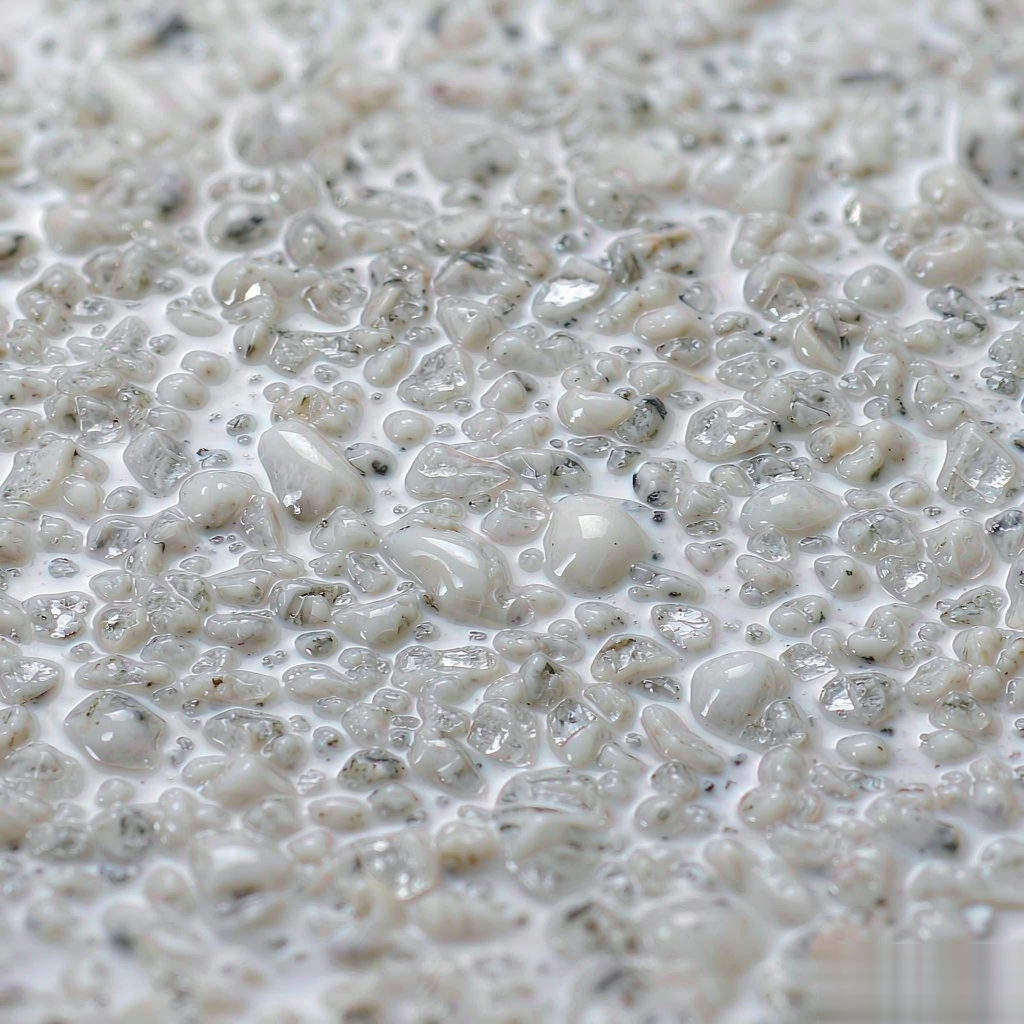
Aggregate chemistry drives every small delta in the table — the same resin, two different mineral loads.
Read the table as a warranty engineer would: the two materials are engineering peers on flexural, absorption and aging, and the honest losses for 0-silica are scratch hardness, lot-to-lot consistency and price — three columns a buyer can price, not three reasons to disqualify the material. The absorption row deserves a pause, because both categories sit an order of magnitude below the 0.1% line, which is why we can describe both as a non-porous quartz slab — spills sit on the surface rather than soaking into it, on either material.
Why Do the Mechanical Numbers Differ?
Three causal chains explain every delta in the table, and none of them involves marketing — the materials differ because the mineral load differs, and the mineral load is the one variable a buyer can point to on a certificate.
Because crystalline quartz is a harder, more angular aggregate than amorphous glass or feldspar, the load paths through a traditional slab bridge more efficiently between particles, so the flexural average sits about 7.4% higher and the scratch surface holds a full Mohs point longer. That is particle mechanics, not brand loyalty — the same reason concrete engineers specify crushed granite over rounded pea gravel when they want strength.
The second chain is density. Amorphous glass and feldspar run lighter per cubic centimetre than dense quartzite aggregate, so 0-silica slabs come out roughly 8% lighter — a small freight saving per container and easier handling on site, paid for with a marginal loss in thermal mass.
The third chain is the resin system, and it explains the tie in the heat row. Both categories are polymer-matrix composites at heart, so their thermal ceiling is set by the resin, not the rock — the polyester binder softens well below the melting point of any mineral, which is why both materials demand the same trivet discipline beyond roughly 150 °C. We covered the failure mechanics in our heat-damage guide: a 250 °C cast-iron pan does not care what the aggregate is.
Fabrication Safety: The One Column With No Second Place
Everything above is a matter of degree. This column is binary. OSHA’s standard 29 CFR 1910.1053 caps worker exposure to respirable crystalline silica at 50 µg/m³ as an 8-hour time-weighted average, with an action level of 25 µg/m³ — and dry-cutting high-silica engineered stone can generate concentrations an order of magnitude above that in seconds. Because the hazard is generated at the saw, not in the kitchen, an installed countertop of either category is inert — the buyer’s real safety decision is about which material they ask a fabrication shop to breathe while producing their order.
This is precisely the logic Australia legislated. The ban on manufacture, supply, processing and installation of engineered stone at or above 1% crystalline silica took effect on 1 July 2024, imports followed on 1 January 2025, and the boundary between banned and legal is exactly the aggregate swap this article is about. For any project that sells into, resells into, or might later ship to Australia, the performance table is academic: only the under-1% category is legal. For the United States and most other markets, both categories remain lawful, and the choice is a values-and-budget decision made with wet-fabrication controls in place.
Where 0-Silica Honestly Loses Today
A comparison article that only lists its own favorite’s strengths is a brochure. Here is the other side of the ledger:
- The price premium is real, at 8–18% on 2026 white-base factory sheets. The aggregates cost more than crushed quartz — itself nearly free as a mineral — and production runs are smaller, so the economies of scale have not arrived yet.
- The pattern library is thinner. Traditional quartz offers three decades of accumulated colors and vein systems because quartzite aggregate takes pigment and mirrored glass the way the market has learned to expect; 0-silica palettes are still catching up, especially in dramatic veined looks.
- Lot-to-lot consistency has a wider tolerance. Our ±3.0 MPa scatter on 0-silica flexural versus ±2.1 MPa for traditional quartz is not a defect — it is what a younger formulation looks like — but it means buyers should demand per-batch test reports rather than a one-page “typical values” sheet.
- The track record is shorter. Traditional engineered stone has been in kitchens since the 1990s; we have made it since 1997 and I can show you projects two decades old. The 0-silica category simply has not had the calendar time to build that archive, and no accelerated-aging chamber fully substitutes for a real 20-year kitchen.
Three Documents That Beat a Sales Pitch
Whether you order either material from us or from anyone else, the same three papers protect the purchase, and asking for them is the fastest quality audit available to a buyer.
Per-batch mechanical reports: insist on flexural and absorption results per ASTM C880 and ASTM C97 for the actual production lot, not the catalog’s “typical values” — the scatter row above is exactly why. Second, a crystalline-silica content certificate from a third-party laboratory, batch-linked. We XRF-scan our 0-silica lots on the loading dock and the certificate travels with the container; a supplier who cannot produce one is selling a prefix, not a material. Third, warranty text that names your category explicitly — a document that says “engineered stone” without percentages leaves your position ambiguous in exactly the markets where definitions have legal force.
Which One Should You Specify?
The decision framework, compressed:
Specify 0-silica stone when:
- Your project ships to Australia, or your client may resell into markets moving toward the 1% threshold.
- Fabricator safety is a stated procurement value, or an ESG scorecard rewards documented safer-material sourcing.
- The design uses light, simple colors where the younger pattern library is not a constraint.
Specify traditional quartz when:
- Budget leads the brief, and your fabrication market allows compliant wet processing of high-silica stone.
- The design demands the deepest pattern catalog or maximum scratch hardness (Mohs 7) for hard-use surfaces.
- A multi-decade installation track record is part of the specification’s risk assessment.
Frequently Asked Questions
Is 0-silica stone as durable as traditional quartz?
Why does Australia ban one and not the other?
Does 0-silica stone cost more than traditional quartz?
Can a fabricator work with 0-silica stone the same way as quartz?
Is an installed traditional quartz countertop a silica hazard?
Which material should a buyer specify for a project in the United States?
Decide on the Column That Applies to You
Buyers keep asking which material “wins,” and the honest answer is that the performance table is nearly a tie while the safety, price and pattern columns trade off cleanly. If your market or your conscience points at the dust column, specify 0-silica stone and pay the 8–18% premium knowingly; if your brief needs Mohs 7 hardness, the deepest vein catalog and the longest track record, traditional quartz — fabricated wet, by a compliant shop — is still one of the best surfaces the industry has ever produced. Either way, order against per-batch test reports and a batch-linked silica certificate rather than a brochure. Send us your project’s market, color family and fabrication arrangements, and we will quote both categories on the same brief — request a side-by-side quotation and 0-silica certificates here.
Alex Wang
International Business Director, Quanzhou APEX Co., Ltd. (Apex Quartz Stone)
Alex Wang has spent nearly three decades in the stone trade in Shuitou, Nan’an — the heart of China’s stone industry — and leads international business for Apex Quartz Stone, founded in 1997. He writes from the production floor: 40,000 m² of manufacturing, 100,000+ slabs a year, and a flexural rig that both product categories have to face.
Post time: Nov-10-2026